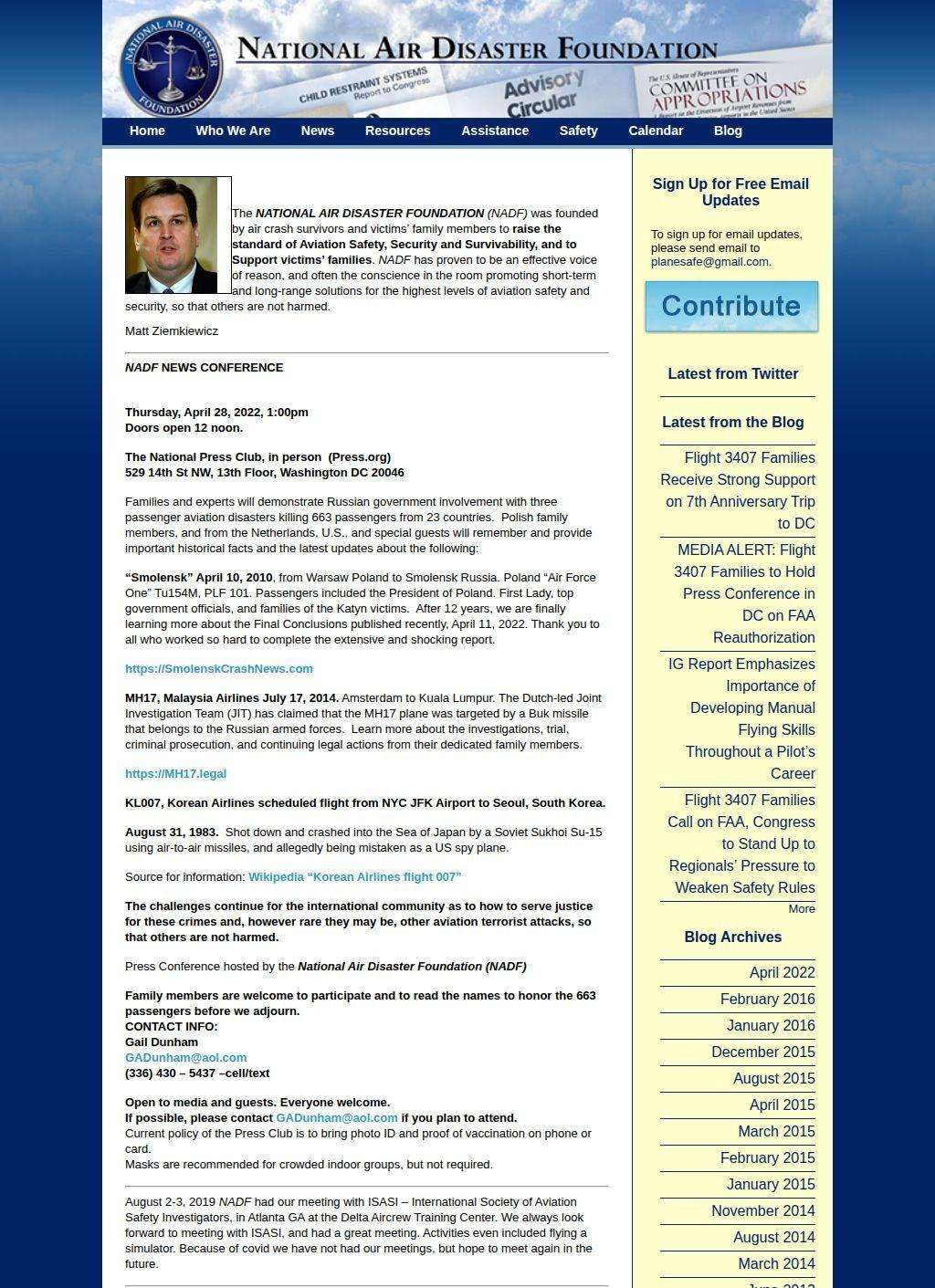
A memorial calendar that logs the date of every major air disaster, year after year, sits near the center of what planesafe.org puts in front of a visitor. That single feature tells you a lot about who built the site. The National Air Disaster Alliance/Foundation (NADA/F) was started by people who survived crashes and by relatives of those who did not, and the work reads like it grew from grief rather than a marketing plan. The stated purpose is to push the standard of aviation safety, security, and survivability higher, and to stand beside families after the worst day of their lives.
Support for families after crashes
The family-facing side is the part that feels most lived-in. There is direct support and counseling for relatives of crash victims, plus annual gatherings that bring affected families together. A memorial section and a photo gallery give those losses a permanent place online, kept alive by the people who return to them year after year. None of this is dressed up. It is presented plainly, and that plainness suits the subject.
Memorial resources and gatherings
Alongside the human support runs a steady policy operation. The National Air Disaster Alliance/Foundation (NADA/F) tracks how the FAA and NTSB handle investigations, advocates for safety legislation, and takes part in international safety efforts. The site references a safety lawsuit tied to aircraft icing, so the National Air Disaster Alliance/Foundation (NADA/F) is willing to go past commentary and into the courts when it believes a hazard is being ignored. For a small nonprofit, that is a real commitment of effort.
Policy advocacy with regulators
It is a fair question, because the National Air Disaster Alliance/Foundation (NADA/F) is not a law firm and does not present itself as one. What it does is sit one step upstream and one step alongside the legal process. Families who land here after a crash are often looking for somewhere to turn before they have any idea whether they need an attorney, and the National Air Disaster Alliance/Foundation (NADA/F) fills that gap with people who have been through it themselves.
Legal referral and guidance
The connection to the legal world is concrete, though. The site is cited as a resource by aviation disaster firms, including Podhurst Orseck, which pointed Ethiopian Flight 302 families toward it. So a reader who arrives expecting lawyers will instead find the kind of organization that lawyers themselves recommend to grieving families. That is useful to know going in, and it reframes the listing as a starting point instead of a destination.
The group also keeps the conversation current. A daily aviation news feed and a blog with safety commentary keep the National Air Disaster Alliance/Foundation (NADA/F) active in the present, well beyond an archive of past tragedies. There is an educational books library for people who want to understand survivability and accident prevention in more depth, which fits an audience that ranges from a frightened relative to a researcher or a reporter chasing context.
On standing, the evidence is unusually solid for an organization of this size. The National Air Disaster Alliance/Foundation (NADA/F) has given public testimony before the U.S. House Committee on Transportation and Infrastructure. It turns up in FAA advisory circulars and in the U.S. State Department's Foreign Affairs Manual, specifically the section dealing with aviation disasters. It has appeared on C-SPAN. These are not endorsements anyone can buy, and together they place the group inside the working machinery of American aviation safety policy. No consumer rating sites carry reviews of it, which is unsurprising for a nonprofit advocacy body, so judgement here leans on those documented appearances instead.
The contact details are handled the way a serious organization should handle them. There is a toll-free phone line, a fax number, two email addresses, and a Washington, DC mailing address on Pennsylvania Avenue. Anyone who needs to reach the group, whether a family in crisis or a journalist on deadline, can do so without hunting. Executive Director Gail Dunham is named openly, which adds a face and a point of accountability to the operation. For a cause-driven nonprofit, that kind of transparency does more to build trust than any polished slogan would.
Membership and funding model
Membership runs on a suggested minimum donation of twenty dollars, which keeps the door low for ordinary supporters and points to a grassroots funding model. That fits the founding story. The people who started the National Air Disaster Alliance/Foundation (NADA/F) were not insiders. They were passengers and relatives who decided the system needed an outside voice, and the twenty-dollar membership is the mechanism that lets others join that voice cheaply.
If there is a caveat, it is one of scope. The National Air Disaster Alliance/Foundation (NADA/F) cannot represent anyone in court, settle a claim, or replace specialized counsel. A family with a live legal matter still needs a firm. What the National Air Disaster Alliance/Foundation (NADA/F) offers is the layer most lawyers cannot: peer support from people who have walked the same road, plus a watchdog presence on the regulators that the legal system alone does not provide. Reading the site, the boundary between those roles is clear, and the group does not overreach into territory it has no business claiming.
Set this against something like the National Transportation Safety Board's own family assistance resources, which a grieving relative might also reach for. The NTSB material is authoritative and procedural, written from inside the federal apparatus. The National Air Disaster Alliance/Foundation (NADA/F) gives you the same subject from the other side of the table, shaped by people who lost someone and decided to fight. For a family who wants both official guidance and a human ally with a track record in front of Congress and the FAA, this organization belongs on the short list, and its decades of documented advocacy make that an easy call.
Business address
National Air Disaster Alliance/Foundation
2020 Pennsylvania Avenue NW #315,
Washington,
DC
20006
United States
Contact details
Phone: (888) 444-6232