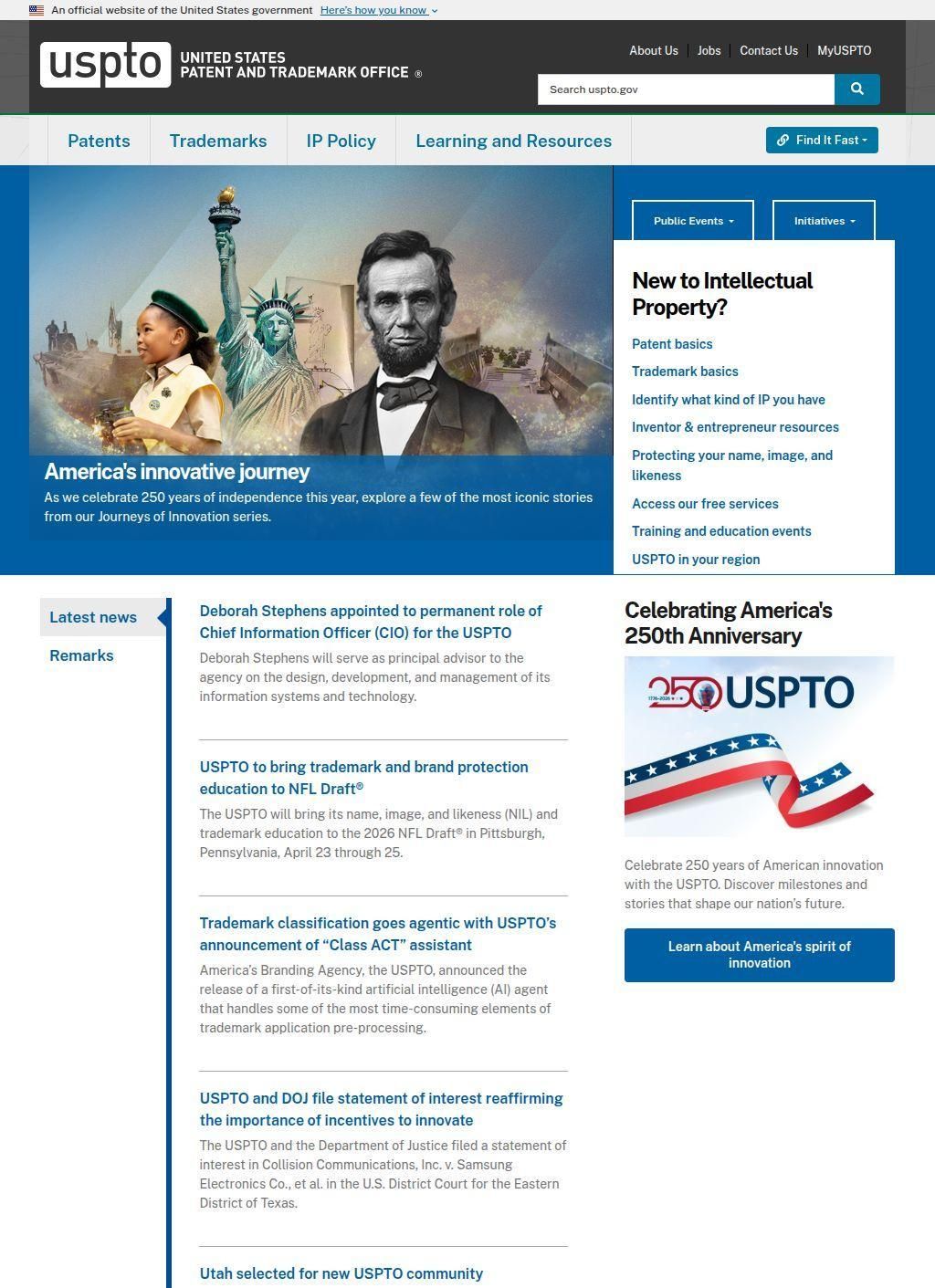
What the United States Patent and Trademark Office offers at its most basic is the federal machinery for granting patents and registering trademarks across the country, and its website is the working front door to both processes. This is not a marketing site or an explainer that points you elsewhere. It is where the filing, searching, tracking, and fee-paying happen, which makes it the single resource most inventors, founders, and intellectual property attorneys end up returning to whether they want to or not.
Filing and managing patents through Patent Center
On the patent side, the core machinery sits in Patent Center, where applications are filed and managed. The United States Patent and Trademark Office site lets you search the patent databases, check application status, respond to office actions, keep up with maintenance fees, request reexamination, and carry a dispute to the Patent Trial and Appeal Board. That is the full arc of a patent's life, from the first filing to the appeals that decide whether a claim survives. For anyone who has tried to assemble this picture from third-party summaries, having the authoritative version in one place is genuinely useful, because the procedural details change and only the source keeps pace.
Reference manuals for examiners
Underneath the filing systems, the United States Patent and Trademark Office publishes the two reference works that practitioners live by. The Manual of Patent Examining Procedure and the Trademark Manual of Examining Procedure are the official guides to how examiners apply the rules, and they are hosted here in full. These are dense documents written for specialists, and they are not light reading, but they are the authoritative answer to most procedural questions. A patent attorney citing the MPEP is citing the source, and the United States Patent and Trademark Office is where that source is kept current.
Trademark databases and registration tools
Trademarks get a parallel set of tools that mirror the patent workflow fairly closely. There is the TMSEARCH database for clearance searches, Trademark Center for filing, and TSDR for monitoring status. Renewals and ownership transfers are handled through the site, and contested matters go before the Trademark Trial and Appeal Board. The symmetry between the two sides is helpful, since someone protecting both an invention and a brand can move between the patent and trademark sections of the United States Patent and Trademark Office without relearning the logic each time. The naming is dry, but the structure is coherent.
From IP Identifier to Global Dossier
The toolset goes beyond the obvious filing and search functions. IP Identifier helps someone figure out which kind of protection applies to what they have made, which is a real service for first-time filers who do not know whether they need a patent, a trademark, or a copyright. Global Dossier pulls together patent family data across participating offices in other countries, so an applicant pursuing protection in several jurisdictions can see the related filings in one view. Assignment Center handles the searching of ownership transfer records, which is an unglamorous but necessary function that becomes important the moment a patent or mark changes hands. None of these are flashy, and that is appropriate to what they do.
Researchers and data-minded users have their own path through the Open Data portal, which offers bulk patent and trademark datasets for download. This is a different audience from the lone inventor, and the United States Patent and Trademark Office clearly accommodates both, since the same site serves the person filing one application and the analyst pulling millions of records. There is also a broader IP Policy section covering copyright, trade secrets, and international affairs, including an attache program that places intellectual property specialists abroad and a Global IP Academy that runs training. The reach here is wider than a filing office strictly needs to be, and it reflects the agency's role in shaping policy as well as processing paperwork.
For day-to-day mechanics there are fee schedules, the Official Gazette where new registrations and grants are published, system status pages so filers know when a service is down, and a video learning center for people who would rather watch than read a manual. MyUSPTO accounts tie a lot of this together, letting a registered user track applications and manage correspondence in one place. The guidance is split by audience, with separate routes for attorneys, entrepreneurs, and educators, so a self-represented filer is not dropped into material written for seasoned practitioners. That segmentation is one of the more thoughtful choices in how the United States Patent and Trademark Office organizes its content.
The honest weakness of the site is the same one that comes with almost any large government system, which is that the sheer volume of tools and the bureaucratic naming make it hard to navigate on a first visit. Patent Center, Trademark Center, TSDR, TMSEARCH, Global Dossier, Assignment Center: the names tell you very little about what each one does until you have used them. A newcomer trying to file a single trademark may spend real time just working out which door to walk through. The video center and the audience-specific guidance soften this, but they do not erase it. This is a system built for repeat users who learn its vocabulary, and it shows.
It is also worth being clear about what this resource is and is not. The United States Patent and Trademark Office processes filings and adjudicates disputes through its appeal boards, but it does not give legal advice, and a complicated patent or contested trademark still tends to need a qualified practitioner. Listing the United States Patent and Trademark Office under intellectual property lawyers is accurate in the sense that this is the institution those lawyers work in front of constantly, though the site itself is the government counterpart to the lawyer, not a substitute for one. Someone expecting hand-holding through a difficult claim will find procedure and reference material here, not counsel.
Weighed as a whole, this is an indispensable resource that is also, at times, a frustrating one. The depth is unmatched because it is the source: the databases are the official record, the manuals are the governing text, and the filing systems are the only legitimate route to a U.S. patent or registered trademark. The supporting tools and data access push the United States Patent and Trademark Office well past the bare minimum of what a filing office could offer. The cost of admission is patience with a dense, jargon-heavy interface, and that trade is usually worth making. Heavy users will clear the learning curve and find that the United States Patent and Trademark Office covers nearly every practical need without requiring a trip elsewhere.
Business address
United States Patent and Trademark Office
600 Dulany Street,
Alexandria,
VA
22314
United States
Contact details
Phone: 1-800-786-9199