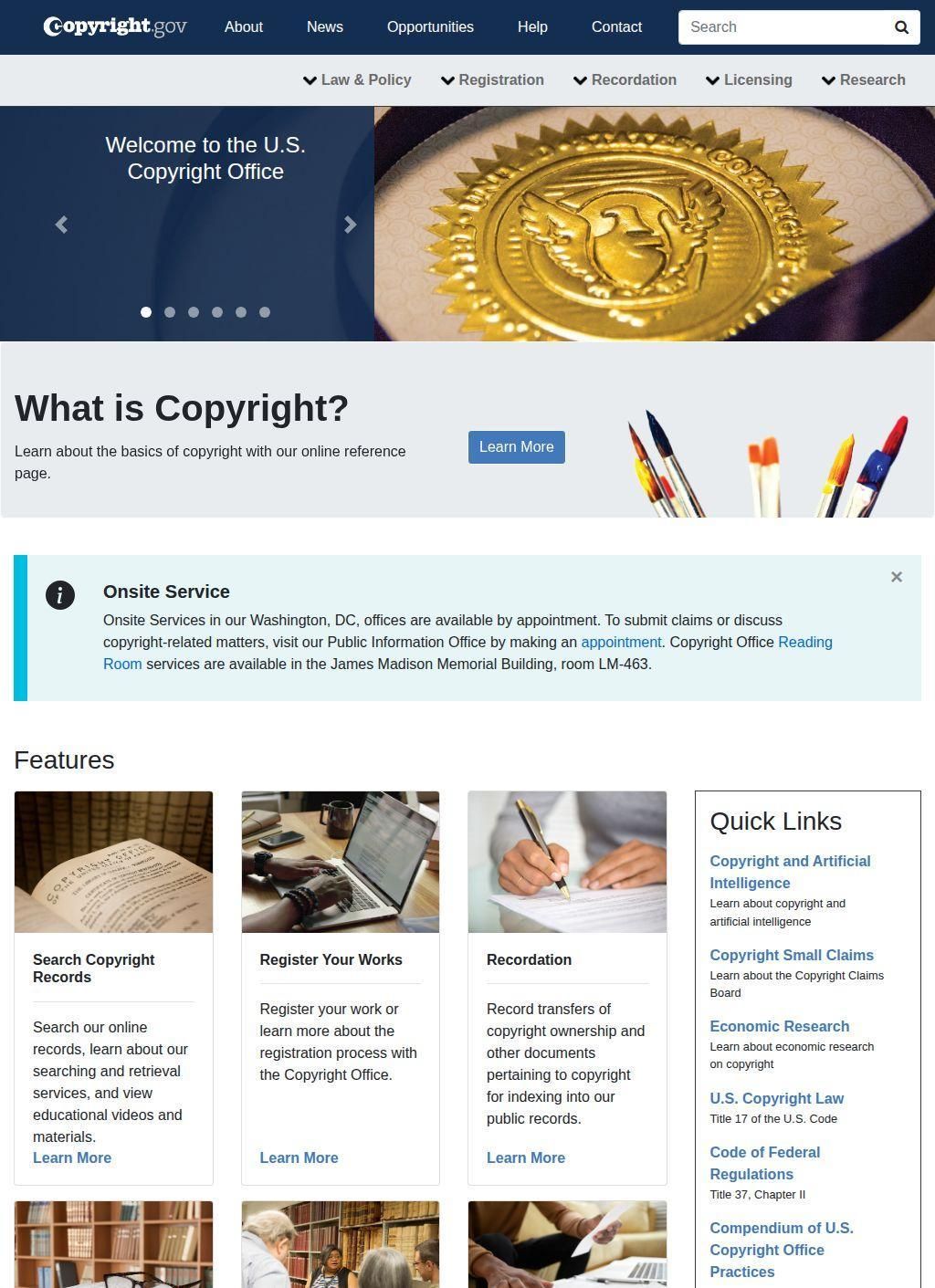
Most people encounter the United States Copyright Office at one specific moment: when they want something they made placed on the federal record. That impulse usually lands them in the Electronic Copyright Office, known as eCO, the filing portal that sits at the practical center of the whole site. What tends to surprise first-time visitors is how many distinct registration paths exist. You can register up to ten unpublished works on one application. There are separate tracks for two-dimensional artwork, for the songs collected on an album, for short online literary works, and for the running updates an editor pushes to a news website. Each carries its own acronym and eligibility rules, and the United States Copyright Office treats them as distinct products with distinct requirements, not one vague catch-all container.
Filing and registration through eCO
Behind the registration machinery is a public records operation that researchers and attorneys probably value more than the filing tools themselves. The Copyright Public Records System lets anyone search registration and recordation data with fairly granular filters, and a Virtual Card Catalog covers the older material that predates the modern database. Copyright ownership questions so often turn on what was recorded and when, and having that searchable history available without a fee or a login is more useful than it first appears. The same recordation function handles transfers of ownership and other documents, indexing them into the public record so a chain of title can be reconstructed later. None of this is flashy, but it is the connective tissue that makes the rest of copyright law workable.
Searching records and ownership history
The United States Copyright Office is, formally, a department of the Library of Congress, and it administers the law under Title 17 of the U.S. Code. That lineage matters because it explains the breadth of what the agency actually does beyond stamping applications. It runs the statutory and compulsory licensing schemes for cable, satellite, and digital audio recording, publishing the fee schedules and licensing documents that go with them. It conducts rulemaking under the Digital Millennium Copyright Act, including the triennial Section 1201 proceedings that decide which acts of circumvention get a temporary exemption. And it advises Congress on copyright policy directly, a role most registrants never see but one that shapes the field they are filing into.
Licensing, rulemaking, policy functions
One feature deserves attention for a specific audience. The Copyright Claims Board, a small-claims style tribunal, hears disputes with damages capped at thirty thousand dollars and exists as an alternative to federal court. For an independent photographer or a small label that has been infringed but cannot justify the cost of full litigation, that is a meaningful door, and the United States Copyright Office presents it with full procedural coverage as a working process. I find a low-cost forum like this more genuinely useful to ordinary creators than the registration mechanics, because it addresses the part of copyright that usually goes unenforced: the claim that is real but too small to fund a lawsuit.
Small claims tribunal for infringement disputes
There is also a service that quietly matters to the wider internet. The DMCA Designated Agent Directory is where online service providers register the agent who receives takedown notices, and the United States Copyright Office maintains that searchable list. Anyone trying to send a properly addressed notice, or confirming that a platform has met its safe-harbor housekeeping requirements, ends up here. It is a narrow tool with a broad reach, and its location at the federal level, open to anyone, is itself worth knowing.
DMCA agent directory for takedown notices
For people who arrive without a law degree, the educational layer is decent without being padded. There are Intellectual Property Toolkits and a Learning Engine video series aimed at explaining the basics, and they read as genuine instruction rather than marketing. The toolkits in particular help bridge the gap between someone who knows they made something and someone who understands what registration does and does not protect. Copyright is a dense subject, and no amount of friendly framing makes the eligibility rules for, say, the news-website group option simple. The material lowers the barrier; it does not remove it.
Educational resources for creators
If there is a fair criticism, it is that the site reflects the density of the law it administers. The structure is comprehensive, which also means it is large, and a first-time registrant can feel the distance between the welcoming educational pages and the precise, form-driven reality of eCO. The group registration categories, useful as they are, demand that you correctly identify which bucket your work falls into before you start, and getting that wrong has consequences. This is government infrastructure, and it reads like it: thorough, authoritative, and not especially forgiving of guesswork.
How the site reflects copyright law complexity
The United States Copyright Office is the definitive source for anything touching U.S. copyright, and no real substitute exists for it. Registration legally happens here or it does not happen at all. The public records tools are strong, the small-claims board is a practical addition, and the licensing and policy functions give context that private sites can only summarize secondhand.
Why use the Copyright Office?
The verdict comes with one honest qualifier. The United States Copyright Office is a reference and filing destination built for a task you already need to accomplish, not a place that makes copyright feel easy, and a creator with a complicated claim will still benefit from an attorney to navigate it. For the registration itself, the public record, and the authoritative read on the law, this is where the work gets done.
Inside the institution's unglamorous work
What tips the assessment toward a clear recommendation, with eyes open about the learning curve, is that the United States Copyright Office does not pretend to be lighter than it is. The breadth of the group options, the searchable history reaching back through the Virtual Card Catalog, and the steady stream of rulemaking all point to an institution doing the unglamorous administrative work that the entire creative economy quietly depends on. A songwriter, a documentary filmmaker, an attorney building a chain of title, or a platform operator confirming an agent registration will each find the specific thing they came for. The United States Copyright Office is thorough where thoroughness is what the law requires, and that is what makes it worth treating as the first stop rather than a last resort.
Business address
United States Copyright Office
101 Independence Avenue SE,
Washington,
DC
20559-6000
United States
Contact details
Phone: (202) 707-3000