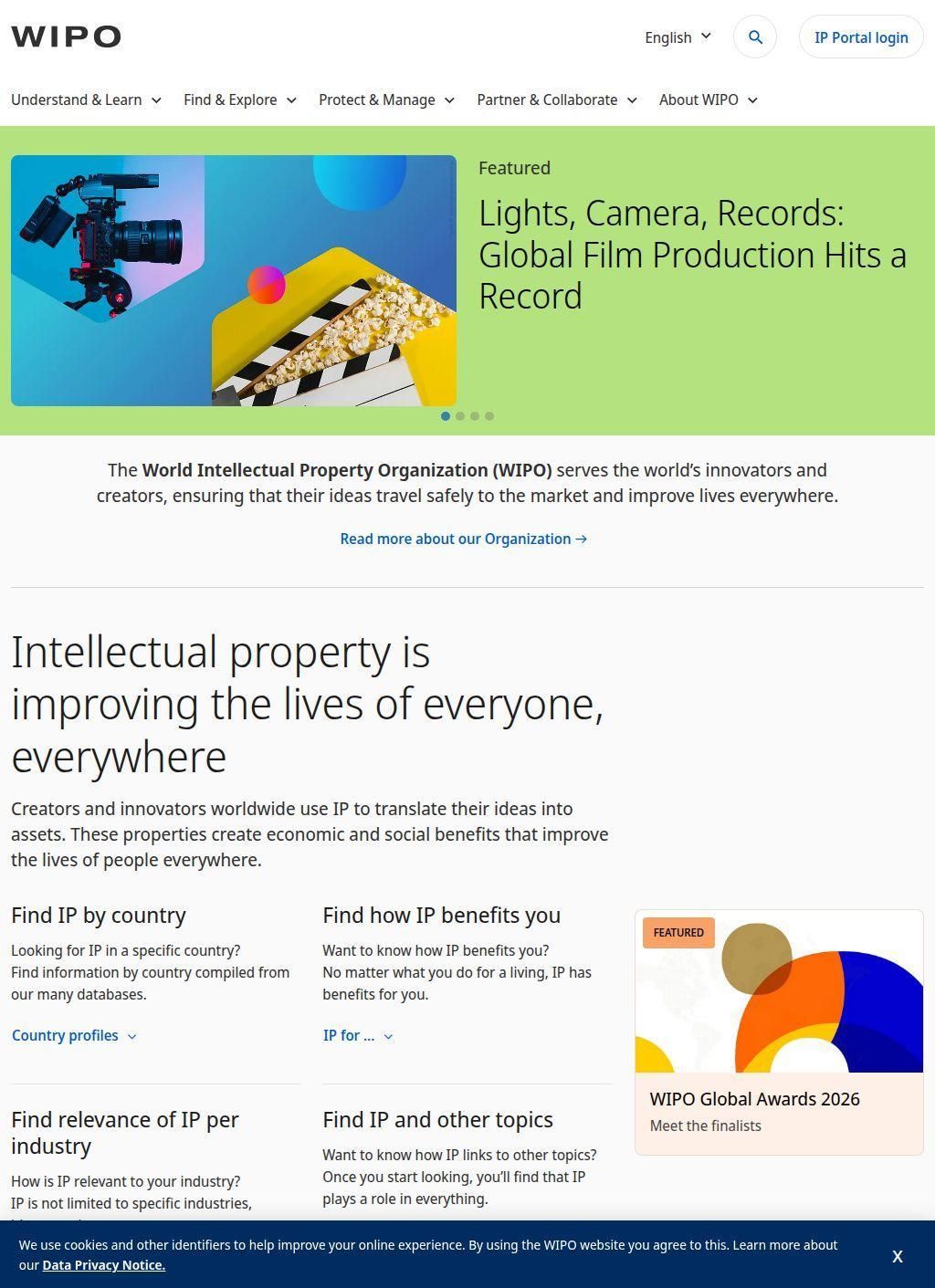
Intellectual property does not stop at national borders, and the body that ties the national systems together is the World Intellectual Property Organization, known as WIPO. It is a specialized agency of the United Nations, headquartered in Geneva, Switzerland, with a membership of most of the world's countries. Its mandate is to promote the protection of intellectual property across borders and to administer the international agreements that make cross-border filing possible.
Origins in nineteenth-century treaties
The agency grew out of treaty arrangements that date to the nineteenth century, including the Paris Convention for industrial property and the Berne Convention for literary and artistic works. Over time those arrangements were brought under a single organization, and WIPO took on the job of administering a growing set of treaties. Today it oversees a large number of them, covering patents, trademarks, industrial designs, geographical indications, and copyright.
Filing patents through the PCT
What makes WIPO directly useful to applicants is its set of global filing services. The Patent Cooperation Treaty, usually called the PCT, lets an inventor file a single international patent application that can later lead to protection in many member countries through a streamlined procedure. Rather than filing separately in each country from the start, an applicant files once, and the system handles the early international phase before the application moves into individual national offices for examination and grant.
Registering trademarks and designs internationally
For trademarks, the agency administers the Madrid System, which works on a similar principle. A brand owner can seek protection in many member territories through one international application filed in one language with one set of fees. The Hague System does the same for industrial designs, and the Lisbon System covers appellations of origin and geographical indications. These services reduce the cost and complexity of seeking protection in multiple markets, which is the practical reason businesses and law firms interact with WIPO.
The organization also maintains searchable databases that are open to the public. PATENTSCOPE provides access to published international patent applications and to collections from many national and regional offices. The Global Brand Database and the Global Design Database do the same for trademarks and designs. For anyone assembling a business directory of intellectual property tools that reach beyond a single country, these databases are among the most valuable public resources available, because they aggregate filings from around the world in one place.
Searching global IP databases
Dispute resolution is another service. The WIPO Arbitration and Mediation Center handles commercial disputes involving intellectual property and technology, and it administers domain name disputes under the Uniform Domain-Name Dispute-Resolution Policy. When a business believes a web address infringes its trademark, the case is often resolved through this center rather than through national courts, which makes the agency a recognized forum for that specific type of conflict.
Resolving domain name disputes
Because WIPO is an intergovernmental body rather than a commercial firm, its role in any business directory is that of a standard-setter and administrator, not a vendor competing for clients. It does not grant patents or register trademarks that take legal effect on their own in member states; the national and regional offices still issue the enforceable rights. What WIPO provides is the connective machinery, the treaties, the filing systems, and the common procedures that let those national rights be pursued efficiently across many jurisdictions at once.
The way the agency is funded sets it apart from many UN bodies. Most of its income comes from fees paid by users of its global services, especially the PCT and the Madrid System, rather than from member contributions. That fee-based model ties the organization's resources directly to the demand from inventors and businesses who use its filing systems, and it is one reason the agency invests steadily in keeping those systems running and updated.
Funding through user fees
The agency invests heavily in capacity building, especially for developing countries. It runs training through the WIPO Academy, helps governments draft and modernize intellectual property laws, and supports technology transfer initiatives. It also publishes economic studies and statistics, including annual reports that track filing trends worldwide, which researchers, policymakers, and businesses rely on to understand where innovation activity is concentrated.
Standards and classification are part of the quiet but important work. WIPO administers the international classification systems used to organize patents, trademarks, and designs, such as the International Patent Classification and the Nice and Locarno classifications. These shared systems let offices and searchers in different countries describe and find the same categories of subject matter using a common framework.
The headquarters sits at 34 chemin des Colombettes in Geneva, with the postal designation CH-1211 Geneva 20, and the main switchboard can be reached at +41 22 338 9111. From there the organization coordinates a global staff and hosts the assemblies where member states set policy and adjust the treaty systems.
Placed within an international business directory of intellectual property institutions, WIPO is the body that gives the whole field a shared structure. Its filing systems lower the cost of global protection, its databases open up worldwide records to the public, and its treaties create the common rules that national offices apply. For a company planning to protect an invention or a brand in several countries, the agency and its systems are the recognized international gateway.
Business address
World Intellectual Property Organization
34 chemin des Colombettes,
Geneva,
Geneva
CH-1211
Switzerland
Contact details
Phone: +41 22 338 9111