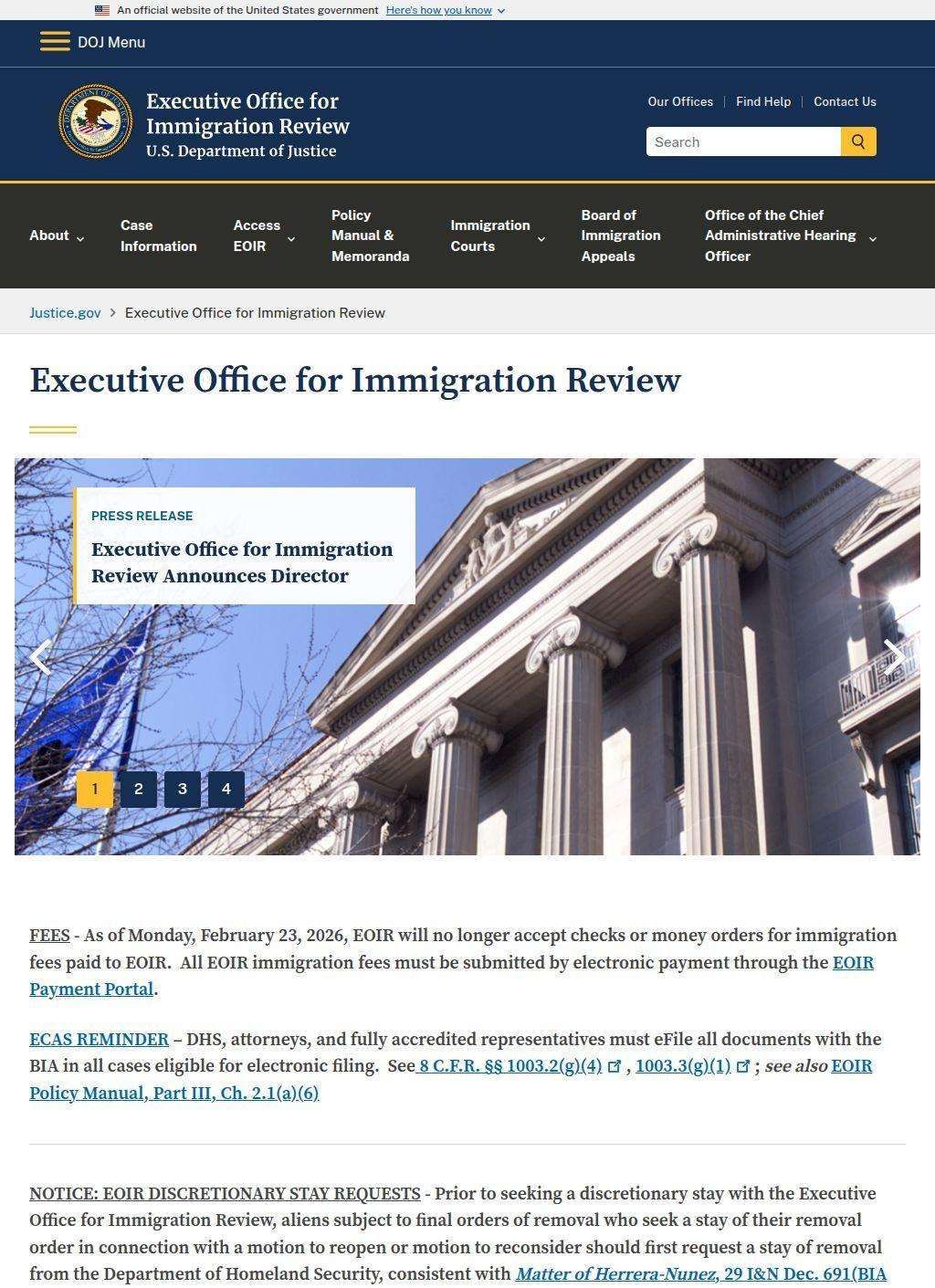
Deciding whether someone facing deportation gets to stay in the United States falls to a specific court, and the where matters as much as the who. Inside the Executive Office for Immigration Review, the Justice Department component that runs the country's immigration courts, a body distinct from both the federal district courts and the Department of Homeland Security. The Executive Office for Immigration Review is the agency behind the bench, and this site is the public front door to that whole apparatus, and it is built for the people who work inside the system as much as for the respondents whose cases move through it. Anyone trying to understand how a removal case is heard, appealed, and resolved will find the structure laid out here in plain administrative terms.
Three court components
The core of the operation is a nationwide network of immigration courts where judges hear removal proceedings, asylum claims, and related matters. Sitting above those courts is the Board of Immigration Appeals, the highest administrative appellate body for immigration cases in the country. The Board reviews decisions handed down by immigration judges and by certain DHS officers, which makes it the place where a court loss can be challenged short of taking the fight into the federal circuit courts.
A third and less visible component, the Office of the Chief Administrative Hearing Officer, handles a narrower docket: employer sanctions, document fraud, and the anti-discrimination provisions of the Immigration and Nationality Act, decided by administrative law judges. Most people arrive thinking of immigration court as a single thing, and the value of the Executive Office for Immigration Review site is that it pulls these three pieces apart and shows what each one does.
Filing and paying fees online
A large share of the site is given over to the mechanics of actually filing. The EOIR Courts and Appeals System, ECAS, is the electronic filing platform, and it is mandatory for DHS, attorneys, and fully accredited representatives on all cases eligible for Board review. A practitioner cannot treat electronic filing as optional; it is the required channel, and the site documents exactly who falls under that rule. The portal is documented here alongside the rules that govern who must use it and for what.
Money moves through a separate channel. The EOIR Payment Portal now handles filing fees electronically, and the site is explicit that checks and money orders have been discontinued, with a stated cutover date in early 2026. A busy office can easily miss a payment-method cutover buried in an internal memo, and publishing it on the public pages is the right call. Practitioners who still mail paper payments would otherwise find filings stalled.
Locating courts and checking status
For anyone who needs to find the right courtroom, there is a court locator tool, and the site also publishes immigration court operational status updates, which tell filers when a particular court is closed or running on a modified schedule. These are unglamorous utilities, but they are the things a representative checks before a hearing date, and the Executive Office for Immigration Review keeps them current rather than letting them rot.
Legal reference materials
Beyond filing, the reference material runs deep. A Virtual Law Library collects the legal sources that govern these proceedings. The EOIR Policy Manual and the published memoranda spell out how the agency expects its judges and staff to operate, and they sit next to forms and fee schedules, regulatory materials, and FOIA request information for those seeking records. Statistics and reports, litigation notices, and fact sheets round out the picture for researchers, journalists, and advocacy groups who need numbers and official positions more than individual case help. It is a wide collection, and it is organized for people who already know roughly what they are looking for.
Recent precedent on stay requests
The policy notices are where the site stops being a static reference and starts reflecting live law. One current example is guidance on discretionary stay requests aligned with Matter of Herrera-Nunez, a 2026 Board precedent decision. A respondent's lawyer watching for how the agency treats a request to pause removal would want exactly that signal, tied to the citation, and the Executive Office for Immigration Review publishes it where it can be found rather than leaving practitioners to learn it secondhand.
Who is this site for?
Who is this really for? The honest answer is that it is not a self-help site for a frightened person facing a hearing next week, and it does not pretend to be. The audience is immigration judges, practicing attorneys, accredited representatives, DHS personnel, and, to a degree, respondents who can navigate administrative language. A pro se respondent will find the court locator and the operational status pages on the Executive Office for Immigration Review site genuinely useful, but the policy manual and the Board's precedent decisions assume a reader who already speaks the vocabulary of removal proceedings. That is a fair design choice for an adjudicatory agency, though it does leave the least-resourced users leaning on the parts of the site that are plainest.
What you get from the Executive Office for Immigration Review, then, is the authoritative version of how immigration adjudication works in the United States, straight from the body that runs it. The forms are the real forms, the fees are the current fees, the precedent is the controlling precedent. For practitioners, that authority is the entire point; there is no second-guessing whether a memo is the operative one when it comes from the agency that wrote it.
Set against a secondary resource such as the American Immigration Lawyers Association practice library, the difference is one of role. AILA gives members analysis, strategy, and practitioner commentary on what these rules mean and how to work them. The Executive Office for Immigration Review gives the rules themselves, the filing systems, and the binding decisions, with no interpretation layered on top. A working immigration attorney ends up needing both, but only one of them is the source the other is interpreting, and that is the Executive Office for Immigration Review. For checking what the system actually requires today, this is the page to consult first.
Business address
Executive Office for Immigration Review
5107 Leesburg Pike,
Falls Church,
VA
22041
United States
Contact details
Phone: 703-605-1007