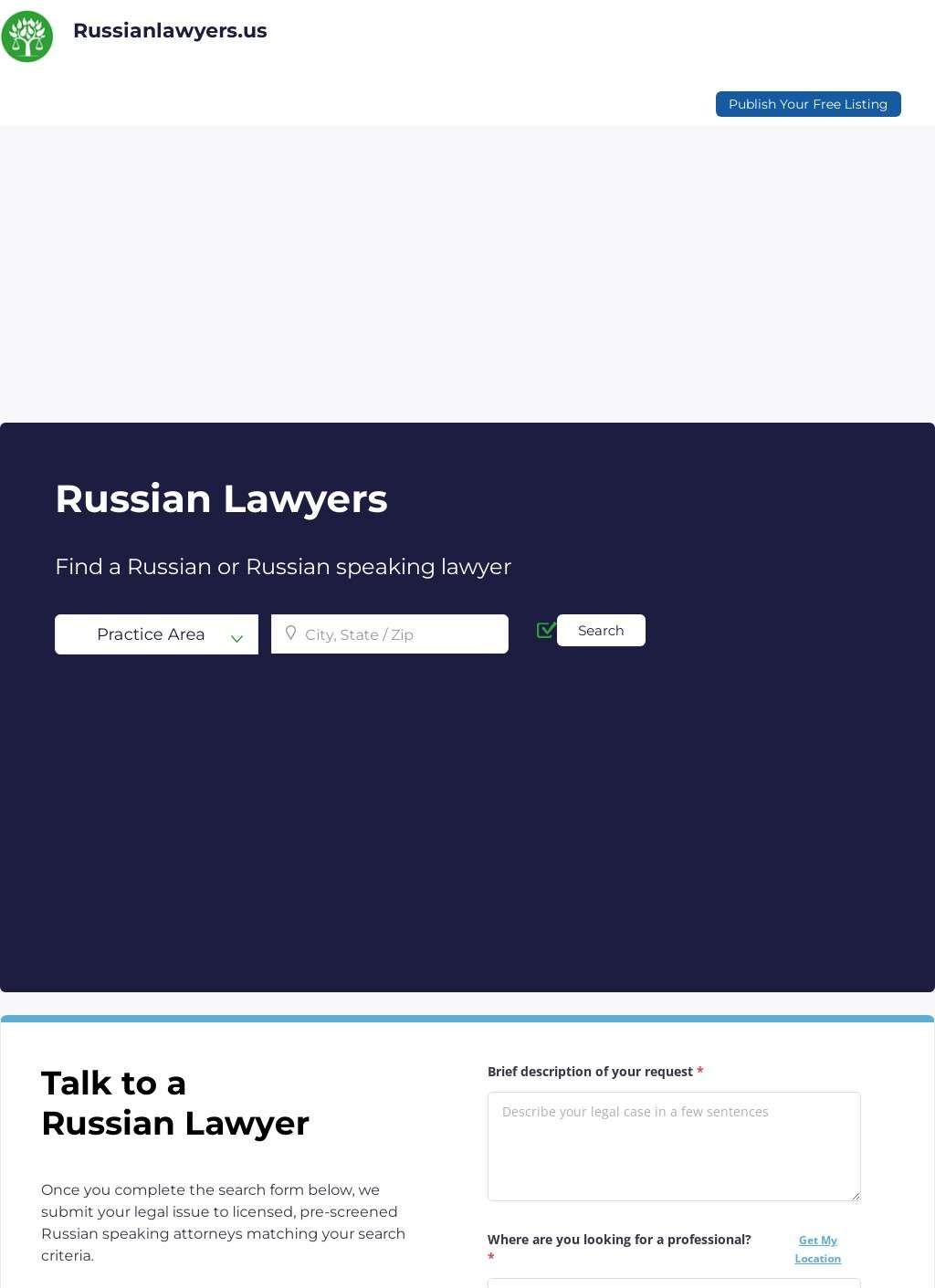
Where does a Russian-speaking immigrant turn when they need a divorce lawyer who can take instructions in their own language, in a city they may have only recently moved to? Russian Lawyers answers that specific problem directly. It is an online attorney directory and referral service built around one shared trait between client and counsel: fluency in Russian. A user fills in a legal request describing their matter and location, and the site routes that request to pre-screened, licensed attorneys who practice the relevant area in the relevant place. The match is the product. You are not handed a phone book and left to cold-call strangers; the form does the filtering for you.
Sixty practice areas across legal specialties
The breadth on offer is wider than the niche framing might suggest. The site claims coverage of more than sixty practice areas, and the list is not padded with vague headings. Family law breaks down into divorce, custody, and adoption. Immigration runs from visas and citizenship to asylum, which is a meaningful inclusion given the audience this site is clearly built for. Criminal defense covers everything from DUI charges to white-collar cases. There is personal injury work that names car accidents and medical malpractice, plus business law, bankruptcy, real estate, and tax. For a service organized around language first and specialty second, that is a serious spread of legal need. It points to an understanding that the Russian-speaking client is not a single legal problem type but a population with the same range of troubles as anyone else.
Immigration, family law, criminal defense
Geography is handled with similar care. The United States is the core, with dedicated city-level pages for New York, Los Angeles, Chicago, Seattle, and others. Legal licensing is state-bound, and a lawyer admitted in California is no use to someone facing a court date in Illinois, so city-level structure is not decorative; it is the minimum required for the matching to mean anything. Coverage extends to Canada and to Russia itself, which hints at cross-border matters: estates, family disputes, and business questions that straddle two jurisdictions and two legal traditions.
City-level pages and cross-border coverage
A client untangling something that touches both Moscow and Brooklyn is exactly the kind of person who would struggle to find help through a general listing, and Russian Lawyers is plainly designed for that gap. That specificity is a sign that Russian Lawyers was built by people who actually understand this audience.
Why geographic structure matters for licensing
The most important promise Russian Lawyers makes is also the hardest to take on faith, so it deserves scrutiny. The site says attorneys are pre-screened and licensed, and that it verifies lawyer licenses annually against state licensing agencies. That is a concrete, falsifiable claim, and concrete beats reassuring. Annual re-verification against the actual issuing bodies is more than many referral sites bother with; plenty simply let a lawyer enter a bar number once and never check again. If Russian Lawyers genuinely re-runs those checks every year, a client gains real protection against being matched to someone whose license has lapsed or been suspended.
Annual license verification against state agencies
The honest caveat is that a visitor cannot confirm the screening from the outside. You take the directory's word that the annual audit happens. There is no public log, no badge linking to a state bar record on each profile. That does not make the claim false, and a prospective client can always verify any specific attorney through the relevant state bar, which takes minutes. But the value of the screening promise rests on trust in the operator, and a referral site earns that trust through its record, not its tagline. Russian Lawyers asks for it up front, which is the structural weakness of any matching platform: the user commits before the proof arrives.
Screening claims lack public documentation
Attorneys can claim their Russian Lawyers listings free of charge, which shapes the incentive picture in a way worth understanding. A free-to-join model grows coverage quickly, since there is no paywall keeping lawyers out, and broad coverage is what makes a matching service useful in the first place. The flip side is that free listings put more of the quality burden on the screening process. The two features depend on each other, and the annual verification promise is what stops that dependency from becoming a problem.
Free listings and messaging channels
Beyond the matching engine, the site adds attorney profiles, a direct messaging channel so a user can contact a lawyer through the platform, and a newsletter signup. The messaging feature is the most practically useful of these. It lets someone open a conversation without immediately surrendering a phone number to a stranger, which suits a client who is nervous, unsure whether their issue even needs a lawyer, or simply more comfortable writing in Russian before picking up the phone.
The public-facing contact picture deserves a fair look. The homepage shows no phone number and no physical address. Contact runs through the legal-request form and a general Contact link in the footer, with no prominent email. For a referral service this is partly by design: the form is the front door, and the whole model assumes you arrive with a legal matter to submit rather than a quick question to ask.
Limited contact information on homepage
Still, the absence of a posted phone line or street address gives the operation less of an anchor than some users will want before sharing details of a sensitive legal matter. A site asking people to describe a custody dispute or an asylum case is held to a higher standard on visible accountability than one selling software, and Russian Lawyers sits a little below that standard on transparency. The footer link partly closes the gap, but only just.
Minimal independent reviews and user ratings
Reputation outside the site is the other area where the record is limited, and it should be stated plainly. A search for independent commentary on Russian Lawyers turns up very little: the site's own pages, and unrelated attorney-rating platforms such as Best Lawyers, Avvo, and Martindale-Hubbell that do not cover Russian Lawyers specifically. No aggregate star rating from real users, no body of third-party reviews, nothing that lets an outsider gauge how the matching actually performs once a request goes in. This is not evidence of anything bad. It is an absence of evidence, which is different, but for a service whose entire pitch rests on trust and verification, a prospective user should weigh it honestly.
This is a well-built specialist service that does something a generic listing site cannot: it starts from the language barrier and builds the practice-area and geographic structure outward from there. Sixty-plus practice areas, city-level pages that respect how licensing works, a screening claim that, if genuine, beats the norm for referral platforms, and a messaging channel that lets a nervous client open a dialogue in writing. Russian Lawyers does its best work in that setup, and few competitors aim this squarely at one language community.
The reservations, limited public contact details and a near-absent outside reputation, stand, but they do not cancel the core utility. A bilingual client facing immigration paperwork or a family-court date, who would otherwise be scrolling general listings hoping to spot a Russian surname, has a concrete reason to try the form and then verify the returned attorney's license independently. The published evidence is enough to support giving it a try.