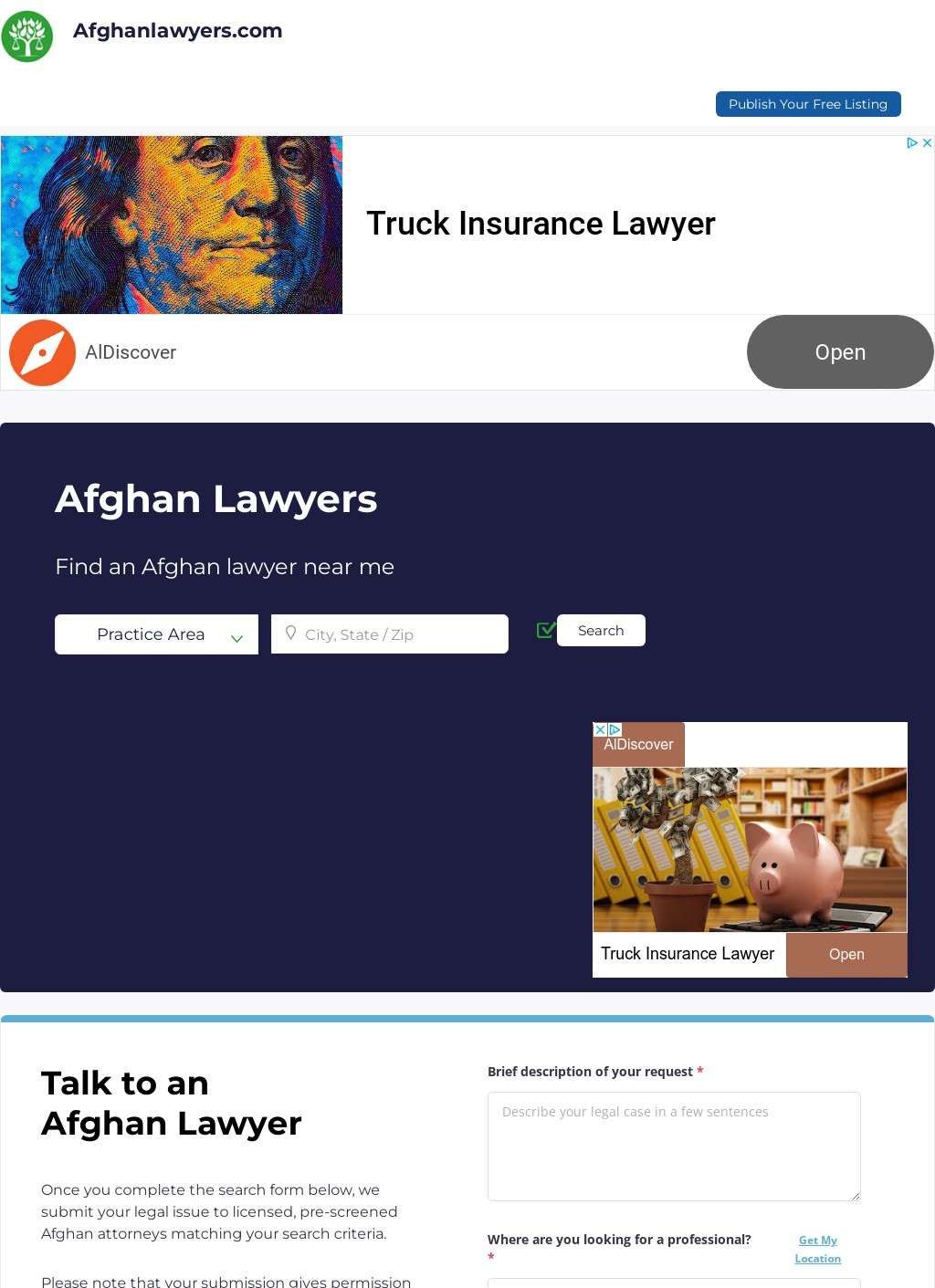
Afghan Lawyers is a US-based attorney-matching service that connects people, mostly within the Afghan diaspora, with licensed lawyers who share Afghan heritage. The premise is narrow and clear: someone facing a legal problem can search for a lawyer who understands their background and language, and the site exists to make that introduction. Visitors either search the directory by practice area and location or fill out a request form describing their situation, after which the platform routes them toward a suitable match.
Practice areas and search capabilities
The range of legal work it claims to cover is wide. The site lists more than sixty practice areas, and the categories pull in most of the situations a private individual or small business is likely to run into: family law and divorce, immigration, asylum, visas, criminal defense, personal injury, bankruptcy, and general business law. For a community-focused service, that breadth makes sense, since the same population dealing with immigration and asylum questions is also going to need help with the ordinary legal events of settling into a new country, from a car accident claim to incorporating a business. The search lets you filter by both specialty and geography, spanning US cities and a handful of other countries.
The gap between scope and roster
Where the claim of breadth runs into trouble is the actual roster. At the time of my visit only three attorneys were profiled and active. Wali Raheen practices out of Chantilly, Virginia, handling family, immigration, and personal injury matters. Marjan Kasra, based in Stamford, Connecticut, works on immigration, visas, and citizenship. Sliman Nawabi covers criminal law from Los Angeles, California. Three lawyers in three states is a shaky foundation under a business directory that advertises sixty-plus practice areas and a national, even international, search. A person in Texas or Florida searching for, say, a bankruptcy specialist is going to come up empty, and that gap between the promise of the search tool and what it can currently return is the most honest thing to say about Afghan Lawyers as it stands.
Three lawyers across three states
That said, the three profiles that exist are specific and geographically spread, which gives the model some credibility. These are practitioners in real cities with stated specialties, and the matching idea itself is sound. Someone navigating an asylum case who would rather speak with a lawyer who knows the cultural and linguistic context has a genuine reason to prefer a service like this over a general search engine. The structure is built to scale: if more attorneys join, the same search and request mechanism would serve a much larger population without any change to how it works. Afghan Lawyers has the framework in place ahead of the people to fill it.
Platform infrastructure and design
Beyond the directory and the request form, the site keeps things simple. There is a monthly newsletter signup, which fits a service trying to stay in front of a community that may not need a lawyer today but will eventually. The practice-area pages and the search interface are the core of the experience, and there is not much decoration around them. For a tool whose entire job is to connect a person to a lawyer, a lean design is defensible, though the emptiness behind many of the search categories means a visitor can click into a specialty and find nothing waiting there.
The platform appears to run on the HeritageWeb network, with a support portal sitting at help.heritageweb.com. That detail places Afghan Lawyers as one node in a wider set of ethnicity-based attorney directories, not a standalone build, which explains both its polish and its sparseness. The infrastructure is shared and presumably mature, while the Afghan-specific population of listed lawyers is still being assembled. It is a sensible way to launch a niche directory, since the heavy lifting of the platform is done elsewhere and the local operator focuses on recruiting attorneys.
Finding contact information
Reaching the people behind Afghan Lawyers is harder than it should be. No phone number, email address, or office address appears anywhere in the site content. Contact runs entirely through the request form or through direct messaging to the individual attorney profiles. The footer carries a "Contact" link, but it sends you to the HeritageWeb support portal, not to anyone responsible for Afghan Lawyers itself. For a service whose whole value is trust between a vulnerable person and a legal professional, that absence of a visible, accountable point of contact is a real weakness. A user with a question about how matching works, or about the service rather than a specific case, has nowhere obvious to turn.
Can you verify the service through reviews?
Outside reputation does not fill the gap. A search turns up no meaningful third-party reviews or ratings for the site. The results that do surface point to unrelated directories such as Lawzana, Chambers, and Legal 500, all of which cover lawyers physically based in Afghanistan, which is a different proposition from a US diaspora matching service. So there is no independent body of user feedback to confirm whether the matching actually works well, how responsive the listed attorneys are, or what happens after a request goes in. Afghan Lawyers has to be judged on its structure and its stated roster alone.
Afghan Lawyers is a clear concept resting on a foundation that has not yet been built out. The idea of pairing diaspora clients with heritage-matched, US-licensed lawyers addresses a real need, and the search and request tools are competently put together on a shared platform. The shortfalls are concrete: three attorneys against sixty practice areas, no direct contact route to the operator, and no outside track record to draw on. Someone whose specific need lines up with one of the three listed lawyers could find genuine value here, particularly the immigration and asylum work that sits at the center of all three profiles.
For now the site reads as a framework waiting to be populated. Afghan Lawyers has a working premise and three attorneys who look like legitimate practitioners in their respective states, but the distance between what the search promises and what it can deliver is wide, and there is no review history or direct contact path to close it. That is a fair summary of where Afghan Lawyers stands: a good idea, a functional shell, and a roster that has a long way to grow.