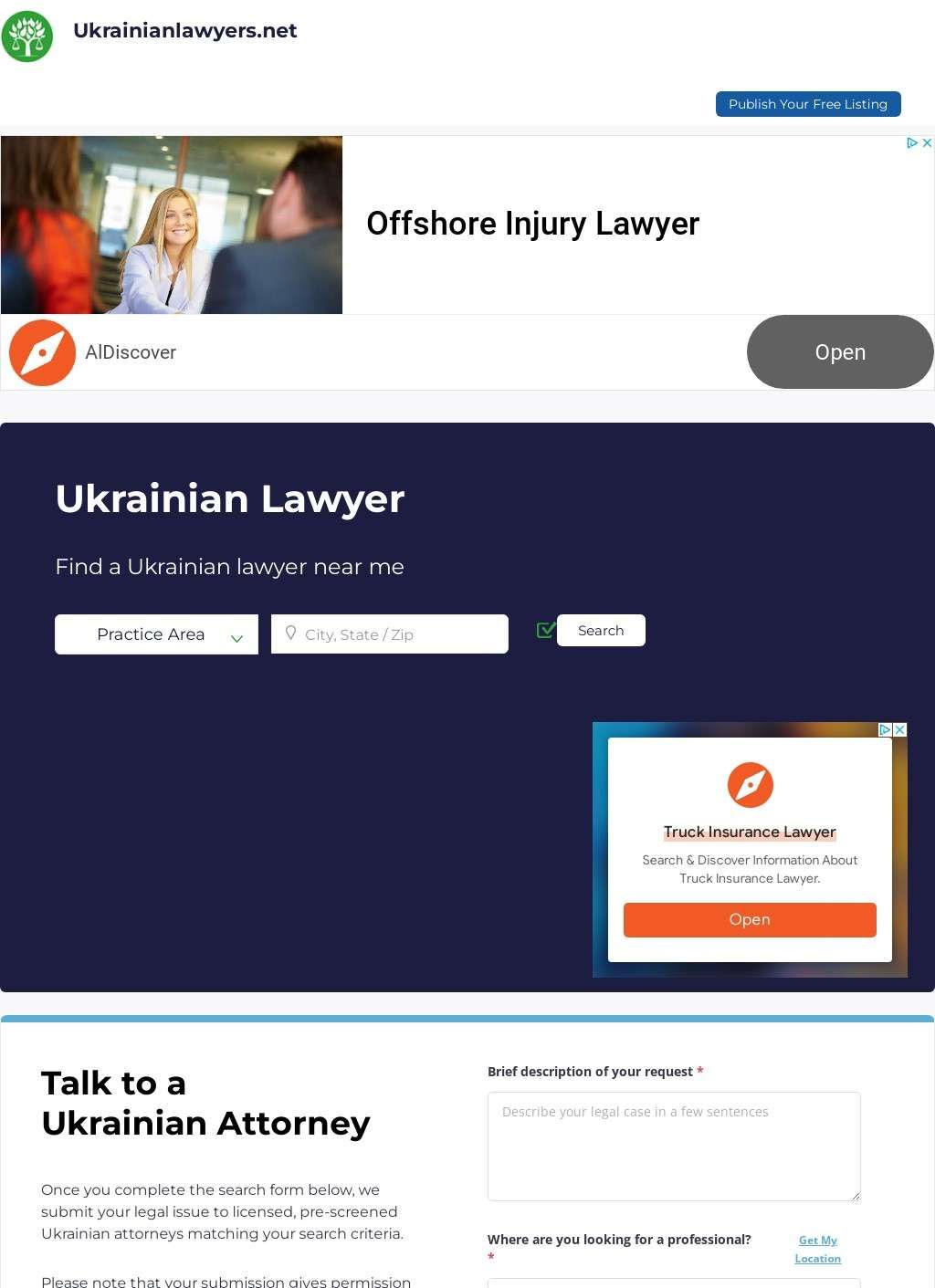
Most legal directories do not survive geographic and linguistic niche that tightly drawn. Ukrainian Lawyers indexes attorneys who speak Ukrainian or serve Ukrainian-heritage clients across the United States, Canada, and Ukraine simultaneously, a three-jurisdiction scope that no general directory addresses for this community. That geographic reach, combined with a stated annual licensure-check policy, places Ukrainian Lawyers several steps beyond the typical pay-to-appear model, which is where the interesting questions begin.
Sixty practice areas indexed by specialty
Ukrainian Lawyers lists over sixty practice areas. What distinguishes the catalog from a catch-all index is the subdivision of family law into adoption, custody, and divorce as separate categories, so a lawyer whose work is entirely in adoption does not get buried under every family practitioner. The list extends into company formation, advertising law, agricultural, and aviation. That last group points to an honest expansion logic: the categories reflect what the listed attorneys practice, not a product team's decision about what looks clean. An emigre who needs an aviation attorney with Ukrainian-language capability is unlikely to find that match in a general U.S. directory, and the catalog appears built around the reality of who eventually lists there.
Browse by city and practice area
Browsing on Ukrainian Lawyers runs by city and practice area. A visitor can reach individual profiles and contact attorneys through either a legal inquiry request form or an internal messaging system that keeps the exchange on the platform. For someone who has never hired a lawyer and is unsure how to frame a legal question in English, that on-platform channel lowers the friction of a first contact considerably. The site also carries an articles section, with pieces attributed to listed attorneys and contributors in the field. Directory content sections are routinely built for search traffic and written by no identifiable person; having the articles tied to attorneys who also appear in the index gives a visitor a way to read someone's thinking before deciding whether to send a message, which is a different proposition from filler copy.
Free listings with optional paid tiers
Attorneys enter Ukrainian Lawyers for free; paid tiers add a "Verified Listing" badge and elevated placement. A separate pay-per-referral model is described as exclusive per lead, with no long-term contract and no monthly minimums. The no-lock-in condition is one that platforms tend to omit from their pitch copy, so its explicit statement is notable. Selling each referral exclusively also limits the experience of multiple simultaneous callbacks on a single inquiry, which affects the client as much as the attorney.
Annual licensure verification process
The platform runs annual checks against judiciary licensure records in each attorney's state, looking for grievances or formal disciplinary actions. That is a defined and specific process, not a vague quality commitment. A clean disciplinary record is not a measure of skill or fit for a particular matter, and annual frequency leaves a window between checks. Still, most comparable indexes perform no described screening at all, which is a meaningful distinction here. Ukrainian Lawyers operates within the HeritagWeb network, with support routed through a help center. For a marketplace that processes legal inquiries and referral payments, an identifiable organizational structure behind the operation is relevant to how seriously the screening commitment can be taken.
No external review aggregation
No independent scores for Ukrainian Lawyers appear on Google, Trustpilot, Yelp, or the BBB. What surfaces instead is the site's own pages and its listing in external indexes. A niche marketplace at this scale rarely accumulates the review volume needed to register on those platforms, so the absence is not automatically disqualifying. It does mean each attorney profile has to be evaluated on its own terms, without the shortcut of aggregate external opinion. That is the condition a visitor enters with, and Ukrainian Lawyers does nothing to change it.
Contact options and transparency gaps
Contact to the Ukrainian Lawyers operator is available through a form and through social profiles on Facebook, X, LinkedIn, and Instagram, all in the footer. No main phone number or physical address appears on the homepage where a first-time visitor would look. For a platform handling legal inquiries and referral payments, the gap between what is accessible and what is prominently visible is a reasonable point of hesitation.
Cross-border matters and niche coverage
For the specific problem Ukrainian Lawyers addresses, the architecture holds together. Cross-border matters, immigration issues touching both Ukraine and a U.S. state, or estate questions spanning two jurisdictions, have no practical home in a domestic-only general index. The practice-area depth is more granular than the typical niche directory manages, the inquiry tools function, and the annual licensure check provides a baseline that a fee-only listing model does not. State bar databases exist for independent licensure verification and should be used alongside any directory, including this one.
What remains unresolved is the enforcement side of the vetting commitment. The annual check against disciplinary records is stated but not audited by any named third party, and there is no published mechanism for reporting a listed attorney who does not meet the standard. The platform's credibility rests on that process working as described, and nothing on the site allows a visitor to confirm it does.