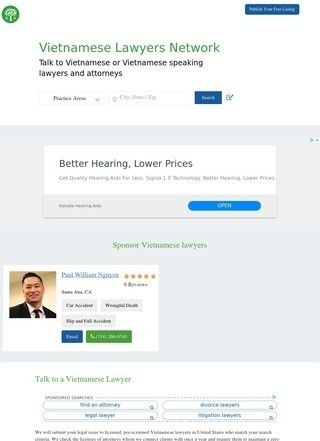
Fill out a short form, name your location, describe your legal matter, leave a phone number and email, and Vietnamese Lawyers routes that package to matched attorneys who are supposed to respond within one to two business days. That is the whole mechanism. No call, no intake interview, no human gatekeeper you can question before you hand over your details. Vietnamese Lawyers sits entirely between you and the attorney until a match is made, at which point it steps aside and leaves you to evaluate whoever calls back on your own. Whether that person is right for your situation is a judgment you will have to make without the platform's help.
How the matching process works
The practice-area list is genuinely wide for a niche connector. Family law is front and center: divorce, custody, adoption. Immigration follows, with visas, citizenship, and asylum all named. Those two cover the situations most acute for Vietnamese-speaking clients, where a wrong word at a hearing carries real consequence. Beyond them, Vietnamese Lawyers lists criminal defense and appeals, personal injury, real estate and foreclosure, bankruptcy, business formation, employment, and intellectual property. ZoomInfo categorizes Vietnamese Lawyers as operating in the ethnic and nationality-based attorney niche alongside similar connectors for other communities. Within that frame the breadth makes sense; as a standalone general-purpose legal referral site, breadth without depth is a concern, and that concern applies here when the platform offers no way to filter matched attorneys by years of experience, case volume, or record of outcomes in your specific area.
Practice areas available
The About Us page says Vietnamese Lawyers verifies each attorney's license and checks the relevant state bar for disciplinary history before a listing goes live. That is a meaningful public commitment. Attorneys can list for free, which keeps the supply side open but also means the incentive to join is low-friction; the stated vetting is what stands between that open door and a listing that does a user harm. No outside audit of that process exists, and the platform offers no way to confirm it has been applied to any specific attorney in the directory. A stated screening policy and a demonstrated screening process are not the same thing, and for a service routing vulnerable clients into legal representation, the distance between those two is not small.
Stated verification of attorney licenses
Users who receive a match from Vietnamese Lawyers are advised to spend five minutes on the relevant state bar website verifying the attorney's license status and checking for any public disciplinary records independently. That check takes minutes and costs nothing, and it is the only reliable verification step available given what the platform does and does not publish.
Verify attorney credentials yourself
There is one aggregator entry on globalizethis.org that attaches a four-star figure drawn from over sixteen hundred ratings to the Vietnamese Lawyers domain. That entry is auto-generated, not sourced from a platform like Google or Trustpilot, and carries no real weight as user testimony. No meaningful third-party reviews tied specifically to Vietnamese Lawyers are visible on the major review sites. The platform must be judged entirely on its design and its own statements, because no scrollable user history exists to check against.
Absence of user reviews and ratings
That absence is not neutral. Legal referral is a high-trust category. A client navigating asylum proceedings or a custody dispute has little margin for a mismatch. For that kind of referral, a platform with no publicly accumulated track record from actual users asks for a level of trust it has not yet earned. The free-listing model compounds the issue: when there is no cost to appear and no visible user feedback to lose, Vietnamese Lawyers's stated vetting is the only mechanism controlling quality, and no one outside the platform can check whether it is being applied.
From form submission to in-platform messaging
Phone and address are absent from the landing page. Everything routes through the inquiry form and an in-platform messaging feature once a match is made. The disclaimers Vietnamese Lawyers publishes are honest: the site states it does not provide legal advice and that submitting an inquiry creates no attorney-client relationship. That transparency is one of the few things the platform handles well. But if a match goes quiet or the matched attorney turns out to be wrong for your case, there is no support contact visible on the site. A user who sends an inquiry and never hears back has no obvious path for follow-up inside the platform itself.
Better alternatives for Vietnamese-speaking clients
Vietnamese Lawyers addresses a genuine gap: Vietnamese-speaking clients with urgent legal needs and no existing attorney relationship do face a harder search than English-only clients, and a connector that pre-filters for language and checks state-bar standing in principle helps. But a platform with no documented vetting record, no user reviews from anyone who has used the service, free listings with no cost barrier to entry, and no support contact for when things go wrong is not a reliable place to route a serious legal matter. The State Bar of California, the American Bar Association's lawyer referral service, and Vietnamese community legal aid organizations all provide referrals with credentials attached and accountability structures this platform lacks entirely. Use those first.