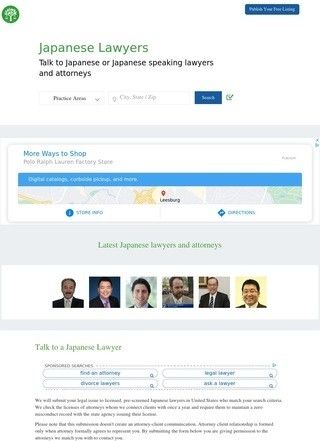
Japanese Lawyers is an attorney-matching directory built exclusively around Japanese-language legal help, operating across the United States, Canada, Japan, and a wider set of countries and cities. That narrow focus is its strongest argument and, depending on whether the stated procedures are followed, the thing it cannot yet prove.
How the matching process works
Submit a description of a legal matter through an on-site form and Japanese Lawyers forwards that request to licensed attorneys whose practice area and geography match what was described. The platform commits to responses within two business days, which is specific enough to treat as a real promise rather than an aspirational gesture. Visitors can also browse individual attorney profiles directly and read spotlights on specific lawyers, so someone who wants to evaluate a name before submitting anything can do that. Both paths are accessible without forcing a choice between them.
Practice areas covered
Coverage spans more than 100 practice areas: bankruptcy, business law, criminal defense, family law, immigration, intellectual property, personal injury, real estate, and tax, among others. Filtering by legal matter and then by geography is available. For a Japanese speaker navigating a cross-border immigration case or an international business dispute, standard English-language legal directories offer no language filter at all, which means sorting through many irrelevant results before reaching anyone who can help with both dimensions of the problem. Japanese Lawyers addresses that directly. The scope is functional and the filtering design works.
Annual judiciary record checks
The About page states that Japanese Lawyers checks judiciary records in each listed attorney's state of licensure annually, confirming no grievances or disciplinary actions are on file. That is a specific procedure, not a vague quality pledge. Annual re-checking matters here because a clean record at the moment of listing can change, and a directory that only looks once gives a weaker guarantee than one that revisits on a fixed schedule. Most competing directories say nothing specific about how they screen; inclusion may simply mean the attorney paid a listing fee.
No attorney-client relationship created
The platform also states plainly that submitting a request does not create an attorney-client relationship. That disclosure belongs upfront before someone describes their legal situation to a web form, and many matching services omit it entirely. Its presence here is worth noting, even if it does not confirm anything about execution.
Vetting claims lack independent verification
Trust in the vetting process rests entirely on Japanese Lawyers carrying it out, because no external body audits the procedure independently. The specificity sets it apart from competitors who publish nothing, but specificity is not the same as proof of performance.
Support infrastructure through Heritage Web
The support infrastructure behind Japanese Lawyers runs through Heritage Web, routed via help.heritageweb.com, pointing to an established operator with more infrastructure behind it than a one-person project. Social profiles on Facebook, X, LinkedIn, and Instagram appear in the footer, along with a contact page link. A newsletter is available for anyone still researching and not ready to act.
Missing contact details undermine transparency
What is absent: a phone number or a physical address anywhere prominent. A platform whose entire proposition involves routing sensitive legal information through its form could afford more transparency about who is running the other end. Social presence is not a substitute for operational accountability, and for a service handling immigration or criminal defense inquiries, the omission is a real weakness.
No third-party reviews or feedback
Searches for independent feedback on Japanese Lawyers return the site's own pages and competing listings. No reviews appear on the usual platforms. None. That is not a minor footnote for a service asking users to describe sensitive legal problems to an unfamiliar intermediary. For a consumer legal directory, the complete absence of third-party feedback makes it impossible to distinguish a well-run matching service from one that has simply never attracted enough volume to generate public commentary either way. The stated vetting process and the attorney-client disclaimer are structurally sound, but they are entirely self-reported and uncorroborated from outside.
From stated procedures to unproven execution
Japanese Lawyers has built a credible-looking framework: practice breadth, geographic range, a two-day response commitment, an annual judiciary-record check, the upfront disclaimer, and a newsletter. The framework is more deliberate than competing directories in the same space tend to offer. The problem is that the framework's trustworthiness depends entirely on execution that no one outside the company has independently observed or reviewed. Whether the annual judiciary checks happen on schedule, and whether the attorney matches arriving in two business days are genuinely vetted or simply whoever is available in the network, cannot be answered from the listing. For a service routing legal inquiries involving immigration, criminal defense, or cross-border business matters, that is not something a careful user should dismiss.
Japanese Lawyers occupies a legitimate niche: there is no other widely known English-language directory built specifically around Japanese-language legal representation across multiple countries. The niche exists. The question worth sitting with is whether Japanese Lawyers fills it well enough to trust with a sensitive inquiry, given that there is no external evidence either way. No phone number, no physical address, and no outside reviews together form a pattern of opacity that the quality of the stated procedures alone cannot overcome. A user with a time-sensitive legal matter and no alternative referral network may find Japanese Lawyers worth a contact attempt. A user who can get a referral from a Japanese consulate, a Japanese American bar association chapter, or a bilingual attorney in their own network should probably start there instead, where the accountability trail is shorter.