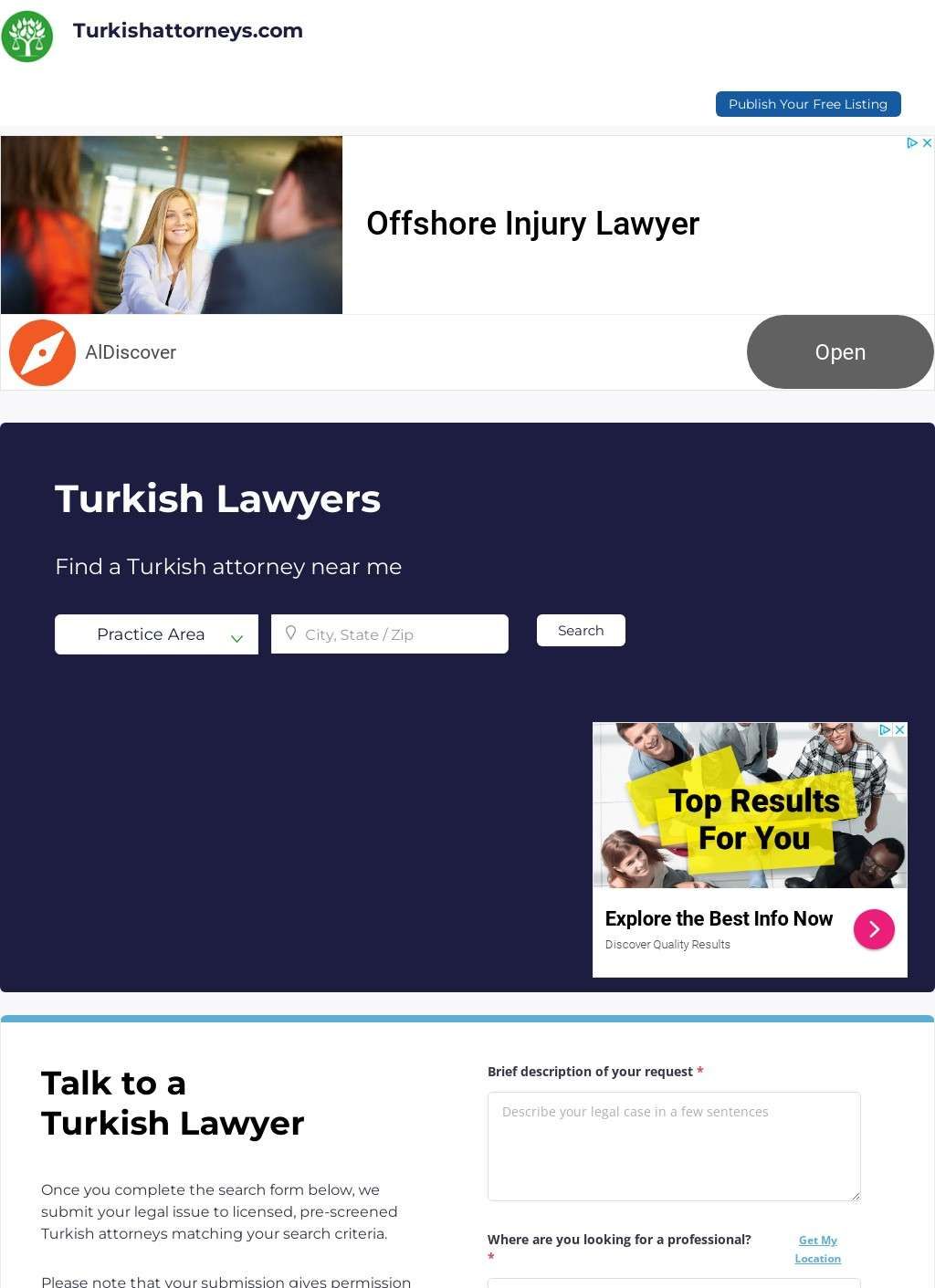
Turkish Lawyers is an attorney directory and matching service for Turkish-speaking lawyers and clients across the United States, Turkey, and Canada. It does not verify outcomes, publish settlement records, or guarantee bar standing; it locates attorneys and routes requests to them, and those three countries are the whole scope. Other jurisdictions with Turkish diaspora populations, such as Germany or the Netherlands, fall outside its scope entirely.
Browse and request matching paths
The platform gives a visitor two paths. One is a browse interface organized by practice area, US state or Turkish city, and country. Someone who already knows they need a real-estate attorney in Istanbul can reach that slice directly. The other is a request form: describe the situation, submit it, and Turkish Lawyers routes it to pre-screened licensed attorneys who fit the profile. Both paths draw from the same pool of attorneys, who can post free listings, so coverage is not restricted to whoever paid for placement. Paid-only directories routinely leave entire practice areas and cities unrepresented because the economics do not work for every specialty; the free-listing model avoids that gap. Because attorneys can list at no cost, smaller markets and less common practice areas stay populated in a way that a paid-placement model would not sustain.
Over one hundred practice areas
The listed practice areas on Turkish Lawyers run past a hundred. Immigration and family law appear prominently, which fits the audience: those are the areas where a shared language and a shared cultural frame of reference most directly affect the quality of representation a client receives. Criminal defense, personal injury, bankruptcy, business law, real estate, and trusts and estates are also covered, so the scope extends well beyond transnational matters one might assume from the name alone. Turkish Lawyers also carries attorney spotlight profiles and a newsletter signup. A fully automated aggregator does not typically bother with curated spotlights; their presence points to some editorial layer above pure database output, though how rigorously attorneys are screened before appearing in those spotlights is not disclosed.
Platform infrastructure and disclaimer handling
The platform operates under turkishattorneys.com and is also referenced as turkishlawyers.us. Help resources link to heritageweb.com, a third-party hosting platform, so the infrastructure is shared across services. The disclaimer is stated plainly before submission: sending a request to Turkish Lawyers does not create an attorney-client relationship, and it authorizes matched attorneys to contact you. That language appears as part of the flow, not buried in fine print, which is the appropriate handling for a matching service dealing with legal inquiries where expectations about representation can cause real harm if misunderstood.
Contact options and access friction
No phone number and no physical address appear on the main page or in the footer. Direct contact runs through a form at /contact. Social profiles on Facebook, X, LinkedIn, and Instagram exist, providing alternative channels, but for a service whose entire pitch rests on connecting people to legal counsel, routing human contact through a secondary form adds friction at exactly the moment a prospective client is most uncertain about whether to proceed.
Missing external verification of matching outcomes
The more significant absence is external confirmation of how the matching performs. No review-platform records, no star-rating aggregates, and no independent editorial coverage surfaced for Turkish Lawyers specifically. Searching turned up competitor listings, including an Istanbul-focused firm with documented client scores across multiple platforms, but nothing bearing on this platform's matching outcomes. The directory mechanics look structurally sound and the disclaimer is handled responsibly. Still, there is no published record of what happens after a request goes out: whether matches arrive promptly, whether they are well-calibrated to the described situation, whether attorneys in the pool respond at all. For a service built around trust in a high-stakes context, that missing record is the central limitation, not a minor gap.
Linguistic focus as structural advantage
The linguistic and cultural focus is the premise, not a feature layered onto a generic product: a general legal-referral platform cannot cleanly answer "Turkish-speaking family attorney in Ankara." Turkish Lawyers can, and the dual browse-plus-request structure is more practical than a single search box with no routing logic behind it. Those are genuine structural advantages.
Comparing Turkish Lawyers to Avvo ratings
But Avvo's attorney finder publishes client ratings, response time averages, and outcome reviews that let a prospective client calibrate trust before engaging. Turkish Lawyers offers no equivalent, and that asymmetry grows in proportion to how much a client is relying on the routing to do meaningful work. Niche scope and a free-listing model are not substitutes for a documented track record. Whoever Turkish Lawyers returns as a match should be verified independently through state bar records and any available peer or client feedback before any engagement begins.