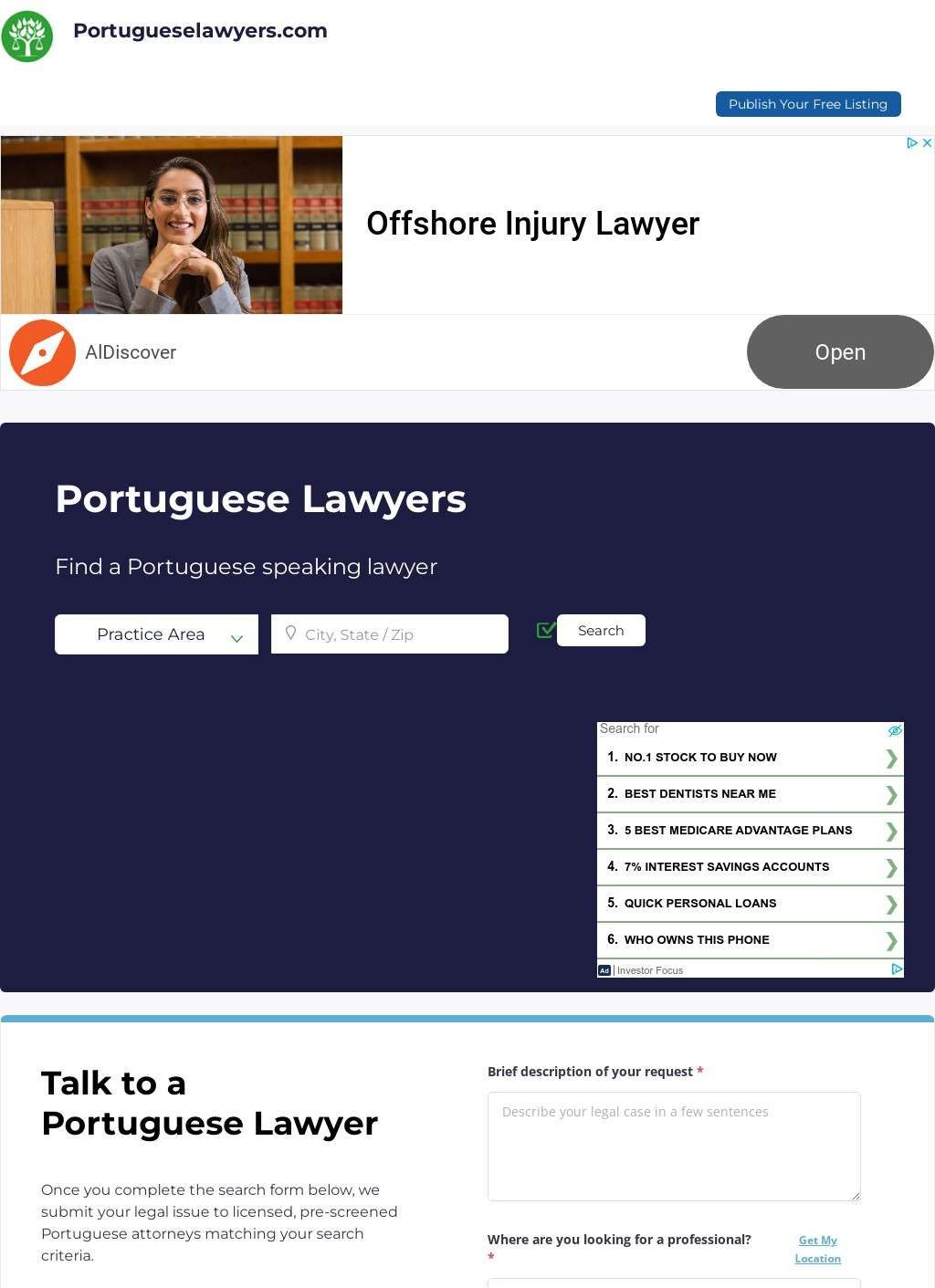
Once a year, someone behind Portuguese Lawyers pulls up the judiciary and bar disciplinary records in each attorney's state of licensure and confirms the license is still valid. That single habit, stated plainly on the site, tells you more about the operation than any of the marketing language around it. Plenty of legal directories take a name, a headshot and a fee, and never look again. Here the claim is that listings get rechecked against the official record, and the people being checked are lawyers who either speak the language or hold Portuguese nationality, scattered across the world.
Geographic reach and practice areas
The reach is the first thing worth understanding. Portuguese Lawyers runs as a referral service and directory aimed at clients who need a Portuguese-speaking attorney, with the heaviest coverage in Portugal and the United States. On the Portugal side you find cities like Porto, Lisbon and Viana do Castelo; on the U.S. side, states including New York. The geographic filter is paired with a practice-area taxonomy that runs deep. Bankruptcy and debt work is split into credit repair, debt collection and personal bankruptcy. Business law fans out into formation, litigation, and then narrower lanes for aviation, advertising, agricultural, communications and corporate matters. Real estate and immigration sit alongside, and there are many more sub-categories beneath those headings.
The breadth here is one of the real arguments for Portuguese Lawyers, since a single search through this business directory can surface counsel for a problem most general legal listings would never categorize this finely. For an immigrant family or an expatriate trying to find counsel who can take instructions in their own language, that combination of where and what is the practical thing they are searching on.
How does the directory verify lawyers?
On money, the site is unusually specific. A lawyer can claim a free listing on Portuguese Lawyers, which lowers the barrier for attorneys to appear at all and keeps the database fuller for clients. Above the free tier sits a paid membership, laid out on a Pricing page, built around qualified referrals that are sold exclusively once, with no long-term contract and no monthly minimums. Selling a referral a single time is a meaningful detail. It means the lawyer who buys it is not competing against five others handed the same lead, and the pricing structure suggests the site is interested in genuine introductions rather than farming the same prospect repeatedly. That model is easier to trust than the usual pay-to-rank arrangement, even if the brief does not say what the referrals cost.
Pricing and referral model
There is an Articles section too, carrying content written by the professionals who are listed. That cuts both ways. It gives Portuguese Lawyers some substance beyond a grid of names, and it lets a prospective client read how a particular lawyer thinks before reaching out. It also means the writing is coming from people with an interest in being hired, so a reader should treat it as informed marketing more than neutral analysis. To its credit, the site is upfront about incentives elsewhere: the Legal Disclaimer states outright that reviews or endorsements may be compensated. Disclosing that is the responsible move, and it is the sort of line many comparable sites bury or skip entirely.
Articles and transparency
This is where Portuguese Lawyers gets harder to vouch for, and there are two gaps worth naming plainly. From what is visible, the site publishes no phone number and no physical address. There is an About page that lays out the goal, a searchable global database of Portuguese-speaking attorneys kept free for clients, and the standard Terms and Disclaimer pages a site like this needs. What was not confirmed is a clear way to reach the people running it. For a service whose entire job is connecting clients to attorneys, that absence is an odd hole, and a cautious user will notice it.
Contact information gaps
It matters less for a client than it might first appear, because the point of the directory is to put you in touch with a lawyer, not with the operator, and the listings themselves carry the contact paths that count. Still, when something goes wrong with a referral or a listing looks out of date, you want a channel back to the source, and the brief does not show one. That sits against the otherwise sensible structure of Portuguese Lawyers rather than beside it, but it is not enough on its own to dismiss the service.
Independent reviews absent
Independent opinion is scarce. A search for reviews of the site turns up its own pages and a scattering of unrelated Portuguese law firm directories, names like Lawzana, Advocate Abroad, Legal 500 and Chambers, but nothing that rates Portuguese Lawyers itself. No Google profile, no Trustpilot or Yelp presence, no BBB file surfaced. That is not evidence of anything bad. It is simply silence, and silence is harder to read than a pile of complaints would be. A directory can be perfectly sound and still fly under the review radar, especially a niche one serving a specific language community.
So the credibility of Portuguese Lawyers rests almost entirely on what the site publishes about itself, and those indicators are a mixed but mostly encouraging set. The annual license verification against bar disciplinary records is the strongest point in its favor, because it is verifiable in principle and most directories skip that step entirely. The exclusive-sale referral model and the compensation disclosure point in the same direction, toward an operator who has thought about how these arrangements usually go wrong. Set against that you have the limited contact information and the absence of any independent track record a newcomer could consult.
Who should use this service
Who is Portuguese Lawyers for, concretely? Someone in Lisbon or New York who needs a lawyer they can talk to in their first language, who knows roughly which practice area their problem falls under, and who is comfortable doing their own diligence on whichever attorney they end up contacting. The taxonomy will get such a person to a shortlist quickly. The license check gives a baseline of comfort that the names are not stale. What the site cannot do is hand over an established reputation, so the work of vetting the individual lawyer still lands on the client.
One detail keeps the whole thing in proportion. Portuguese Lawyers is free to clients and free for lawyers to list, with revenue coming only from the optional paid referrals and membership. A model that does not charge the people searching tends to align the operator with the searcher's interest in breadth, and the wide city and practice coverage is consistent with that. The verification cadence is once per year, drawn from the official disciplinary record in each lawyer's licensing state, and that is the detail a skeptical reader should start with.