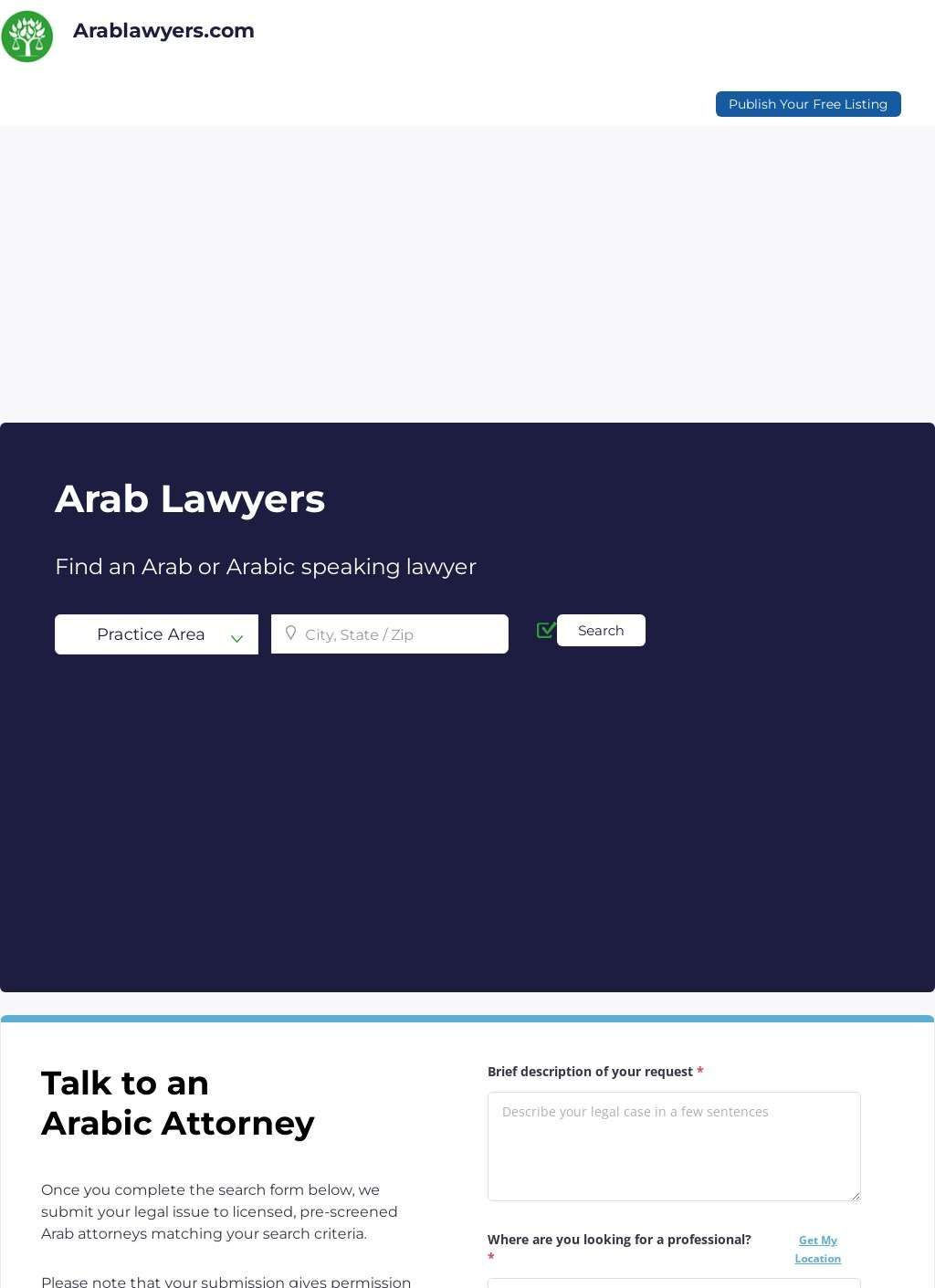
Some people need a lawyer who speaks Arabic and understands the cultural weight of their case. Arab Lawyers answers that with a focused directory and lead-matching service: a person submits a legal request, and the platform routes it to licensed Arab and Arabic-speaking attorneys whose specialties and location match what was asked. Arab Lawyers is operated by Heritage Web LLC, and the matching concept sits at the center of everything the site does.
Practice areas and geographic reach
The coverage is wider than the niche framing might suggest. More than forty practice areas are listed, running across immigration, family law, bankruptcy, criminal defense, and personal injury, among others. That breadth is genuinely useful for a population whose legal needs rarely stay in one lane. An immigrant family might need help with a visa one year and a divorce the next, and a single entry point that already filters for language and background removes a lot of cold searching. Search itself works on two axes most people will reach for first: practice area and geography. The geographic reach is mostly US cities, but it stretches to Canada, France, and Germany too, which fits the diasporic audience Arab Lawyers wants to reach, spread across several countries instead of one.
How attorney listings work
On the attorney side, the model is a familiar two-tier directory. Lawyers can create free listings or pay for upgraded ones, and there is a paid-leads system layered on top, so attorneys can buy the inquiries that come in matching their criteria. That arrangement is worth understanding as a user, because it shapes who shows up and how prominently. A paid-leads marketplace can be perfectly fair, but placement is partly commercial, and Arab Lawyers does not pretend otherwise in how the platform is put together. The flip side is that an attorney paying for leads has an incentive to actually respond, which is more than can be said for some free-for-all listings elsewhere.
Licensure verification process
What gives the directory more credibility than a bare list of names is the screening it claims. The About page states that the platform verifies state licensure and checks for disciplinary actions or grievances before an attorney is listed. If that vetting is carried out consistently, it raises the floor on quality in a way that a self-serve sign-up page never could, and it is the single feature that most distinguishes Arab Lawyers from a plain roster of contacts. The promise is exactly what a worried client wants, and it is also easy to claim and hard to confirm from the outside. There is no visible audit trail or third-party certification shown to back the screening, so a cautious user is left taking the statement at face value while still checking a chosen lawyer's bar standing independently.
Beyond the matching engine, the supporting material is what you would expect from a directory that wants repeat visits. Individual attorney profile pages give each lawyer a place to present credentials and focus areas, and the site runs spotlight profiles for specific attorneys, naming people such as Mehdi Cherkaoui, Sherif Rizk, and Nisreen Snober Mousa. Those named profiles do more for trust than a generic grid of headshots, because a reader can search those names and form an opinion before reaching out.
Dashboard for messaging clients
Arab Lawyers also runs a legal articles and resources section, a knowledge base with FAQs, and a logged-in dashboard that handles messaging and notifications between users and attorneys. The dashboard is the piece that turns this from a phone book into something interactive: an inquiry does not vanish into an email inbox, it lives somewhere both sides can track.
The articles and FAQ layer is easy to undervalue. Someone unsure whether they even need a lawyer, or unsure which kind, can read first and submit a request later, and that softens the intimidation that keeps many people from seeking legal help at all. For a service aimed partly at recent immigrants navigating an unfamiliar system, plain-language explanation is close to a feature in its own right. The structure to support it is there; how deep the writing goes is something a visitor will judge by clicking through.
Where are the reviews?
This is where the picture gets harder to read, and it is worth being plain about it. A search for outside reviews of Arab Lawyers turns up almost nothing. There are no Google, Trustpilot, Yelp, or BBB review counts for the directory itself, and the one social trace that surfaces is a Facebook page tied to the Arab Lawyers email and attributed to a Saudi-based entity, sitting at zero reviews and marked "Not yet rated." That absence does not prove the service is bad.
Plenty of legitimate platforms run quietly without a review footprint, and a directory that mostly hands users off to individual lawyers may collect its reputation under those lawyers' names rather than its own. Still, a prospective user has very little outside signal to lean on, and that is a real limitation for a service whose entire pitch rests on trust and vetting.
Contact details left vague
Contact transparency adds to the unease. The homepage shows no phone number, no email address, and no physical company address. There is a generic Contact link tucked in the footer and a Help link that sends you off to an external Heritage Web LLC support portal, so reaching a human means navigating away from the main page and into a parent company's system. For a directory where the day-to-day interaction is meant to happen through the dashboard and the lawyers themselves, that is not fatal.
But the lack of a visible address or a direct line to the operator means that if something goes wrong, a billing dispute, an unanswered request, a lawyer who turns out to be a poor fit, the path to the people running Arab Lawyers is indirect, and that indirection rests uneasily against a service that asks for trust up front.
Strengths of the matching service
Put the strengths together and there is a genuinely useful proposition here. A specialized audience, real search filters, named attorneys, an interactive dashboard, supporting content, and a stated vetting process give Arab Lawyers more substance than a thrown-together listing site. Someone in the Arab or Arabic-speaking community who wants a lawyer who shares their language and context has a plausible reason to start with Arab Lawyers, given the spread of practice areas and the multi-country reach. The mechanics Arab Lawyers has put together are sound, and the intent behind the platform is clear.
What lingers is the gap between what Arab Lawyers promises and what an outsider can confirm. The screening claim is the heart of the value, yet it is unverified, the operator keeps itself at arm's length behind a parent company's support portal, and there is no body of user feedback to show whether the matches land well in practice. For a low-stakes purchase that gap would be a footnote. For choosing a lawyer, where the cost of a bad referral is measured in money and outcomes, it is a gap that the published evidence alone cannot close.