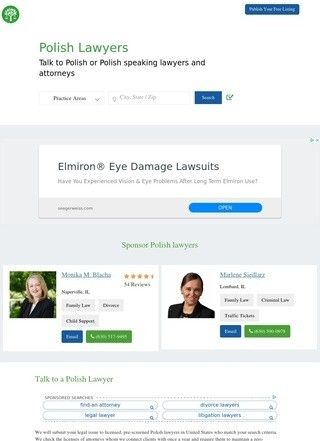
You have a legal problem, it is serious, and English is the language you reach for last when you are frightened. That is the exact moment Polish Lawyers is built for. The site is a free directory and matching service that connects people with Polish-speaking attorneys, so instead of cold-calling firms and praying someone on staff shares the language, you describe your situation once and get pointed toward lawyers who already speak it.
The mechanics are simple. A visitor submits a legal request, and Polish Lawyers matches it to pre-screened attorneys in their area. Lawyers, for their part, can request a free listing to join the pool. No charge to the person searching is the headline, and for someone already staring down legal costs, a no-fee front door lowers the barrier to simply asking the first question.
How the matching works and where it reaches
What lifts Polish Lawyers above a plain list of names is the machinery wrapped around the match. Attorney profiles state experience levels, so you are not choosing blind. There is direct messaging to talk with a lawyer before anything is agreed to. Listings are marked as verified, and the site says it runs annual license checks against the issuing state agency, which is the single most reassuring detail on offer, because a lawyer whose license lapsed or was pulled is precisely the person you do not want steering an immigration case.
There is a quiet efficiency to how Polish Lawyers frames the exchange. The visitor is not asked to become an expert in choosing counsel; they state the problem, and the burden of matching shifts onto the platform. For an immigrant navigating an unfamiliar legal system in a second language, that inversion is most of the value, because the hardest part is often not affording a lawyer but knowing which one to trust and how to reach someone who understands the context you are arriving from.
Coverage is broad, sometimes almost comically so, and Polish Lawyers seems to want every base covered. The practice areas run deep: immigration and family law, the full spread of bankruptcy work from personal and business filings through credit repair, debt collection, and debt settlement, then criminal defence, personal injury, real estate, tax, and employment, before reaching out into advertising, agricultural, and aviation law, with the site claiming more than 50 specialties in total. Almost nobody needs the exotic end of that list, but its presence signals a directory trying to be genuinely comprehensive instead of thin.
Practice areas and the map they cover
Geography gets the same expansive treatment. Polish Lawyers spans the big American cities where Polish communities cluster, Chicago, New York, Los Angeles, and Boston, and it does not stop there. Smaller places like Hamtramck and Grand Rapids get their own attention too, which is telling, because those are exactly the towns a Polish speaker actually settles in and a national directory usually forgets. State-specific pages for Illinois, New York, and New Jersey add another layer, and there are references stretching to Canada and Poland.
That combination, the major metros plus the overlooked mid-size towns, is the practical strength of the service. A directory that only listed attorneys in Manhattan and the Chicago Loop would be close to useless for most of the people it means to help. Reaching Hamtramck is the detail that suggests the people behind Polish Lawyers genuinely thought about who is doing the searching.
Verified listings and the annual license check
The verification story is worth dwelling on, because it is where a directory either earns trust or coasts on appearances. Polish Lawyers says it checks licenses every year against the state agency that issued them, and marks the listings that pass. If that is done as described, it is a real safeguard and further than plenty of referral sites bother to go. The honest caveat is that a visitor cannot audit the process from outside, and I would treat the verified badge as a promise to test with a direct question, not a guarantee already delivered to your door.
Contact is the softest spot in the whole Polish Lawyers setup. Everything routes through a request form and a contact page; there is no direct phone number and no customer-service email, while a separate help centre is referenced at an outside web address, and social links to Facebook, X, LinkedIn, and Instagram round things out.
For a service people may reach mid-crisis, form-only contact is a real limitation, and it is fair to name it plainly. The counterweight is that the entire model runs on submitting a request anyway, so the form is not a dead end, just the only door in.
Independent reputation is where the picture goes blank, and that is worth stating without spin. No outside reviews of the directory itself turned up. What surfaced instead were the site's own pages and reviews for unrelated, differently named Polish-speaking attorneys and rival directories. In a crowded business directory of referral sites, that leaves the service without a third-party track record to point to, so a first-time user is trusting the design and the stated safeguards more than any crowd of prior verdicts.
It is fair to ask how a free service pays for itself, since the person searching is charged nothing and lawyers receive their listings without a fee either. The site does not spell that out, and the help centre sitting on an outside domain hints that Polish Lawyers is part of a larger network running several directories of this kind. None of that is damning, but it does set expectations: this is a lead-generation platform first, and the polish of the matching should be read with that in mind.
Someone staring down an immigration matter, a bankruptcy, or a family case, who would simply rather explain the whole thing in their own language, will find Polish Lawyers a sensible first stop. The concrete next step is easy: fill out the request form with the details of the situation, and when a lawyer responds, ask them directly when their license was last verified and how many similar cases they have actually handled. Their answers, not the directory's promises, are what should decide it.