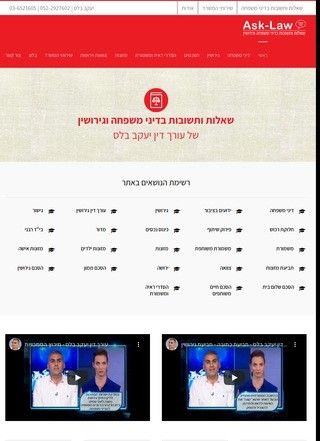
Running entirely in Hebrew, Asklaw - Divorce and Family Law FAQ is built around the questions Israeli families ask before they ever phone a lawyer. It is run by an Israeli attorney, Jacob Bles, and the FAQ format is not a side feature here. It is the spine of the thing.
Topics covered in the FAQ
What you get on the page is a working map of Israeli family law as a regular person would hit it. Divorce procedure and representation sit at the front, which makes sense given the category, but the coverage spreads well past the obvious. There is material on child custody and visitation arrangements, on spousal and child support, and on how property and finances get split when a marriage ends. Wills and inheritance get their own treatment. So do mediation, adoption, and guardianship. The mix tells you the author of Asklaw - Divorce and Family Law FAQ is thinking about a family across its whole arc, beyond the moment a couple decides to separate.
Property division and financial settlement
Property division and financial agreements get more room than a casual reader might expect, and that choice is sensible. Money is what most divorces fight about once the emotional dust settles, and the questions around how assets are valued, what counts as shared, and how a settlement is drafted are the ones that follow people for years. Giving that ground real attention steers Asklaw - Divorce and Family Law FAQ toward the practical end of the subject.
Rabbinical courts and civil jurisdiction
One stretch of the content deserves singling out, because it is specific to Israel and easy to undersell. Asklaw - Divorce and Family Law FAQ addresses rabbinical court proceedings, the beit din, alongside the civil track. Anyone who has dealt with divorce in Israel knows the dual-jurisdiction problem is the part that confuses people most: which court hears what, and how the religious and civil systems interact. Treating that head-on, in plain Hebrew, is more useful than a generic overview of "divorce law" would ever be. It reads as written by someone who argues these matters in court, not someone summarizing a textbook.
How the site works as a business
This is where the site has to be read carefully, because it wears two hats. On one side it is a FAQ that pulls in search traffic. On the other it is the front door to a practising attorney who takes consultations, files cases, and stands up in both civil and rabbinical courts. The two are wired together: you read about alimony, and Asklaw - Divorce and Family Law FAQ invites you to book a consultation about your own situation.
Free answers versus paid representation
That dual nature is honest enough as long as a visitor keeps it in mind. The free answers are general by necessity. Family law turns hard on the particular facts, the exact agreement, the specific court, the timing, and no public FAQ can substitute for advice on a real case. The informational content does the job of orienting someone and building trust; what the attorney sells is the representation behind it. A reader who treats Asklaw - Divorce and Family Law FAQ as a starting point will get more out of it than one expecting it to resolve a dispute on its own.
The model is common among lawyers who understand search, and it works in the client's favour up to a point. A person reads three or four answers, sees that the explanations are sober, and arrives at the consultation already half-informed. That beats a cold call where the lawyer spends the first half-hour explaining what a beit din is. The caveat is remembering that the page is selling something. Clarity in an FAQ is not the same as a track record in a courtroom, and the two should not be confused.
Services offered beyond the FAQ
It is worth noting how much of the offering is advocacy rather than paperwork. Asklaw - Divorce and Family Law FAQ does not present itself as a document mill churning out template agreements. It points toward consultation and toward representation in court and before the beit din, which is the harder, higher-stakes end of the work. Mediation sits in the lineup too, for couples who would prefer to settle without a courtroom. That breadth, litigation on one end and mediation on the other, is a reasonable spread for a family law practice and it keeps Asklaw - Divorce and Family Law FAQ from looking like a single-service shop.
Attorney identification and contact information
Two phone numbers are published on the site: a mobile line and a Tel Aviv area landline, along with contact forms for booking a consultation. The attorney is named outright, so a visitor to Asklaw - Divorce and Family Law FAQ knows exactly who would be handling their matter. Family law sites can hide behind a brand and never tell you which lawyer you would deal with. Here the answers carry a name, Jacob Bles, and that name attaches to the consultation offer and the courtroom work alike. For someone choosing who to trust with a custody fight, that distinction counts.
Evaluating credibility without outside reviews
Outside the four corners of the site, the picture changes. A search for independent commentary on Asklaw - Divorce and Family Law FAQ turns up nothing genuinely about this practice. The results that surface belong to other entities with similar names, mostly American firms and legal platforms, none tied to this Israeli attorney. There is no body of third-party reviews to weigh, no Google rating, no client testimonials on a neutral platform an outsider could check.
That absence does not mean the practice is weak. Plenty of competent solo and small family law attorneys, especially those working in a single national market and a single language, do not accumulate a visible review trail in the places an English-language search reaches. The content itself is substantive, and the contact path is personal. For someone who reads Hebrew and is dealing with an Israeli family matter, the FAQ alone is a genuine reason to land here, and the attorney behind it is identified and reachable.
Still, the gap is the gap. Without outside voices, a prospective client is left judging Asklaw - Divorce and Family Law FAQ almost entirely on what the site says about itself, and a site is always going to speak well of its own author. The quality of the legal explanations is reassuring as far as it goes, and putting a name and direct phone lines on display counts for something. But none of that tells you how a real case went for a real client, whether the representation matched the clarity of the writing, or how the practice performs when a matter turns contentious. The strongest thing Asklaw - Divorce and Family Law FAQ has is also its limit: everything credible comes from inside the house.