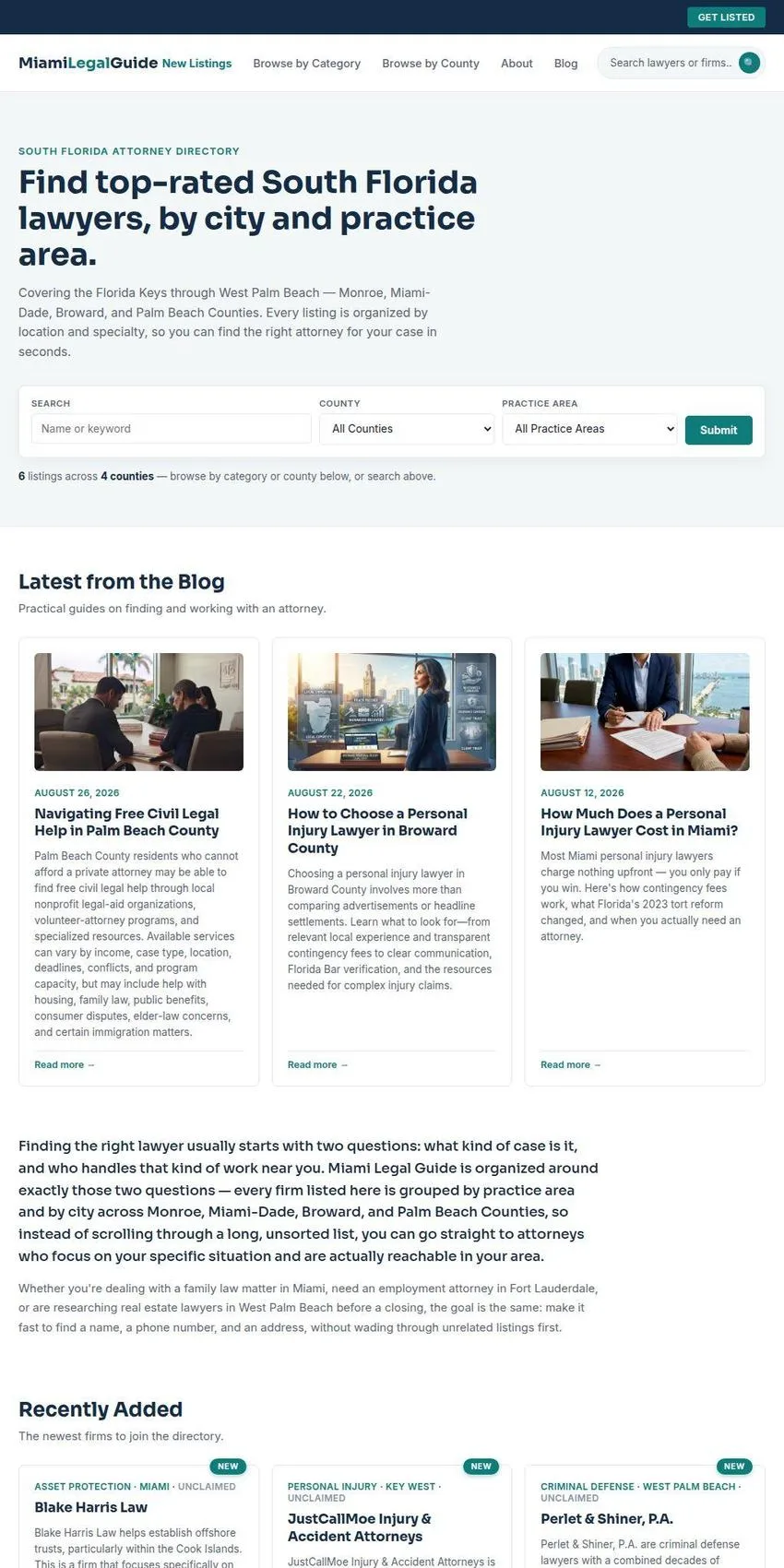
The Miami Legal Guide is an independent online directory dedicated to law firms and legal practitioners in South Florida, covering an area that stretches from the Florida Keys to West Palm Beach, including Monroe, Miami-Dade, Broward, and Palm Beach counties. Its niche is that of legal guidance tools, rather than referral services: the directory does not evaluate, rank, or act as an intermediary, but rather organizes. The organizing principle, explicitly stated, is twofold: area of practice and location, and the entire informational architecture of the site stems from this intersection.
What exactly gives such a directory a reason to exist, at a time when general-purpose search engines seem to answer any query? The answer proposed by the site, formulated in its own terms, stems from the observation that any search for a lawyer essentially boils down to two questions: what type of case is involved, and who handles such cases in the vicinity of the person searching. Given that unsorted lists force the user to scroll through them in a linear and tedious manner, the preliminary grouping by practice area and city constitutes the sole function the directory aims to perform, which precisely defines its purpose.
As for the taxonomy of practice areas, it includes estate planning, bankruptcy law, business law, civil law, criminal defense, labor law, estate planning, family law, immigration law, personal injury, real estate law, and traffic violations. Each entry is accompanied by a brief explanation in everyday language, such as Chapters 7, 11, and 13 on bankruptcy; wills, trusts, and probate proceedings in the context of estate planning; or visas, residence permits (green cards), and citizenship in the context of immigration. Thus, there is a definitional layer that translates legal terminology into the language of everyday experience, guiding the uninitiated user before they even reach any of the listings.
The geographic axis is organized around the four counties, each associated with a reference city: Fort Lauderdale for Broward, Miami for Miami-Dade, Key West for Monroe, and West Palm Beach for Palm Beach. The search interface combines a free-text field with two filters—county and practice area—and results can be browsed either by category or by location. This dual approach to searching, which may seem redundant, actually corresponds to the two initial questions, since some users know their problem first, while others know their location first. Both paths lead to the same listing.
The individual listing, viewed as a document, includes a description—in accessible terms—of the firm's activities, its classification within a primary practice area, and, where the firm has completed its profile, a series of sub-practice areas. In the case of an employment law firm, for example, these subcategories include discrimination, Family and Medical Leave Act (FMLA), noncompete clauses, severance agreements, sexual harassment, disputes regarding wages and working hours, whistleblower protection, workers' compensation, and wrongful termination. Also included are a link to the firm's own website, a section with additional links to its practice pages, and direct contact information, along with status markers such as "new listing," "claimed," or "unclaimed."
Regarding the differentiation of services offered to firms, there are two listing levels: basic and premium. The distinction lies in presentation and visibility, not in category: the premium listing adds a distinct badge and a representative image of the firm, while the descriptive structure remains the same. It is worth noting that each listing page features a mechanism for suggesting corrections, through which visitors can report outdated information, thereby introducing a collaborative feedback loop into the directory's operation. The contact model is one of disintermediation, as the user contacts the company directly, just as they would with any other entity listed in a registry.
The epistemic stance taken by the directory deserves special consideration, as it unequivocally states that it does not verify or endorse the listed attorneys, that it is neither a referral service nor an evaluation agency, and that inclusion in the directory does not constitute an endorsement. Users are expressly advised to independently verify the firm's license and professional standing, and the website specifies that it does not offer legal advice and that merely viewing a listing does not give rise to an attorney-client relationship. In the reviewer's opinion, this candor regarding its own status—that of an identification tool rather than an evaluation body—is one of the features that lends the directory a certain degree of credibility, as it clearly distinguishes what it offers from what it leaves to other sources.
The editorial section, presented in a blog format, consists of practical guides on finding a lawyer and working with one. Three recent articles illustrate this approach: one discusses free civil legal aid in Palm Beach County, provided through nonprofit legal aid organizations and volunteer attorney programs, with eligibility requirements that vary based on income, the type of case, and the programs' capacity; another addresses the criteria for choosing a personal injury attorney in Broward County, such as local experience, transparency regarding contingency fees, quality of communication, and verification with the Florida Bar; a third explains the mechanism of contingency fees, the changes brought about by the 2023 tort reform in Florida, and the situations in which retaining an attorney becomes necessary. The blog thus serves as an introductory guide, teaching users how to interpret the listings before using them.
Following the same guiding principle, the government and legal resources page compiles official links to agencies such as the Department of Labor (DOL), the National Labor Relations Board (NLRB), the Equal Employment Opportunity Commission (EEOC), and the Florida Bar. Through this section, the directory positions itself within an ecosystem of primary sources, and the user is directed to the authorities that hold actual authority over the information—from verifying a lawyer to filing an administrative complaint. The relationship between the directory and these sources is one of complementarity, with the directory identifying the information and the official sources confirming it.
From the perspective of law firms, the directory offers listing through the "Get Listed" feature, organizing listings by the firm's city and practice area; the firm's website address, if provided, appears directly on the listing page, generating referral traffic to the firm's own site. The argument put forward in favor of registration is that of consistency in the firm's identifying information across various directories—a principle that the website explicitly compares to how Google Business Profile works and which, in the field of local search (local SEO), is known as NAP consistency. Mutatis mutandis, this is the same principle that library science refers to as authority control: an entity designated identically in all catalogs thereby becomes easier to find and more trustworthy for the systems that index it.
The "Recent Listings" section provides insight into the directory's current stage of development—namely, a phase of corpus building, in which the taxonomic framework is complete and the list of entries is gradually expanding. The firms listed already cover a genuine diversity of specializations and locations, ranging from asset protection through offshore trusts in Miami to criminal defense in West Palm Beach and Fort Lauderdale, and from personal injury cases in Key West to labor and civil rights law in Miami. The reviewer notes that, in the case of a directory, structure necessarily takes precedence over volume, and it is the coherence of the framework that determines, in the long run, the usefulness of the accumulated content.
From a functional standpoint, the Miami Legal Guide resembles the index of a legal treatise or a library's card catalog more than it does a publication intended for continuous reading: it is a tool for specific, point-in-time consultation. The user enters with a specific question—a family law issue in Miami, a labor dispute in Fort Lauderdale, a real estate transaction in West Palm Beach—and exits with a name, a description, and contact information, the entire process designed to take as long as consulting a table of contents. The uncluttered interface, free of distracting elements, is consistent with its purpose as a reference tool.
The search for a lawyer usually occurs at a moment of confusion, when the problem is already urgent and the vocabulary needed to name it is lacking; having, at this moment, a clear map of areas of expertise and proximity means giving the problem an initial form—that of a question that can be answered. The Miami Legal Guide promises nothing more than such a map, in keeping with the role it has defined for itself. Ultimately, it retains the modest yet genuine virtue of any well-crafted index: to guide without deciding on behalf of the seeker, reducing the disorder inherent in the beginning to two questions that can be answered.