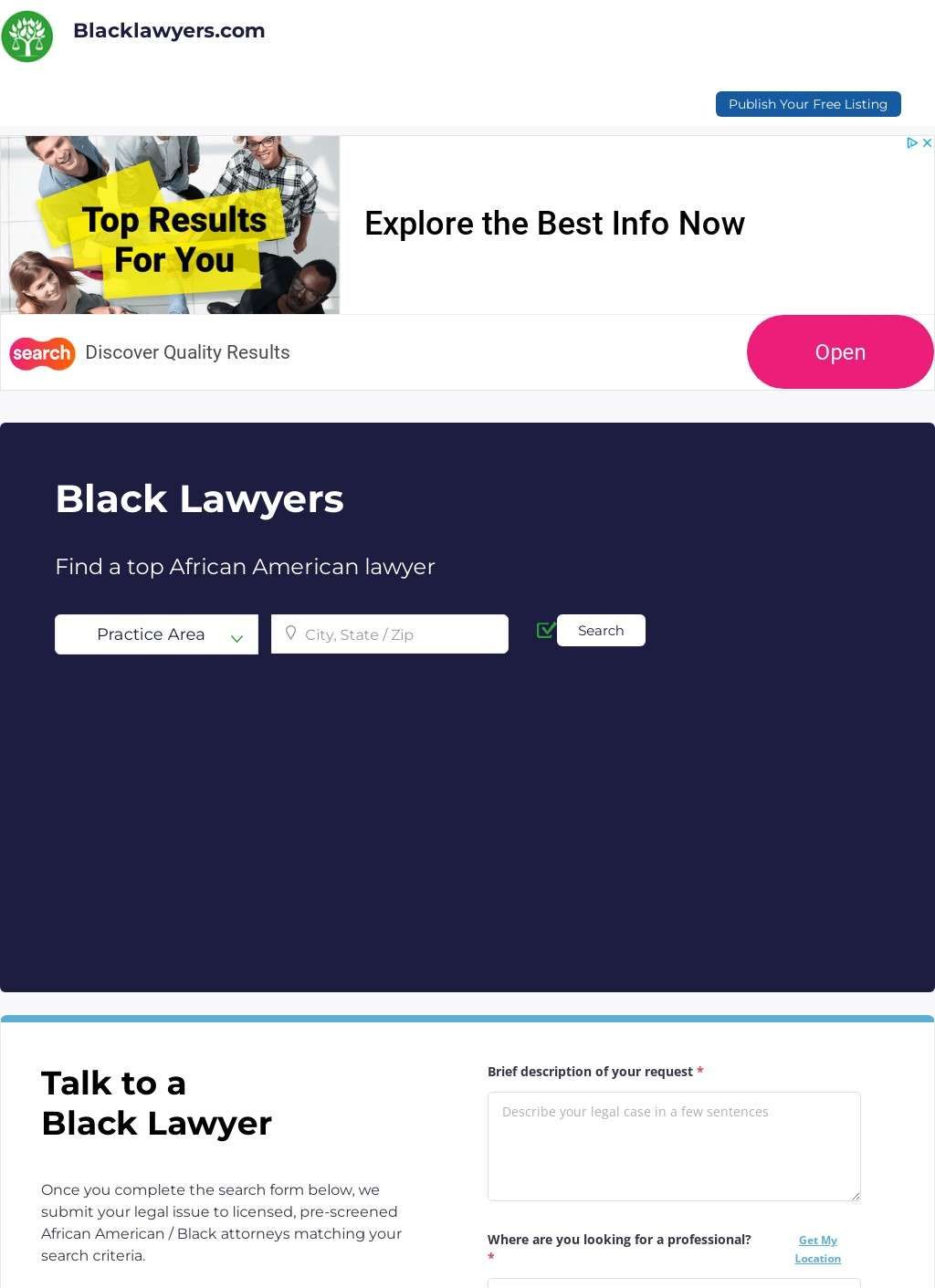
Finding a lawyer who understands your situation is hard enough; finding one who shares the cultural context you bring into that first meeting is a different search. That is the gap Black Lawyers sets out to close. Black Lawyers works as a national referral platform pairing people with licensed, pre-screened African American and Black attorneys across the United States. You fill in a legal request through a web form, describe what you need and where you are, and the service routes the request to attorneys who match those criteria, sparing you the work of cold-calling firms one by one.
National attorney matching by practice area
The practical reach is broader than the niche framing might imply. Black Lawyers spans more than sixty practice areas, and the list covers the things people actually face: bankruptcy, business law, civil rights, criminal defense, family law, immigration, intellectual property, labor and employment, personal injury, real estate, tax law, and trusts and estates. Search runs by city, state, or ZIP code, with coverage across thirty-plus major U.S. cities. Whether someone has a one-off question or a matter that will run for months, the structure points them toward an attorney in their own area instead of a name three states away. In law, local emphasis pays off, since the rules and the courts shift from one jurisdiction to the next, and a nearby attorney usually means easier scheduling and a quicker first meeting.
Attorney profiles and community features
Beyond the matching engine, there is more to explore. Individual attorneys get their own profile pages, so a person can read up on a specific lawyer and message them directly instead of going only through the central form. A "Black Attorneys Spotlight" section puts faces and stories front and centre, which suits the mission better than a flat list of names would. There is a monthly newsletter for people who want to keep a thread to Black Lawyers, and an affiliate program aimed at attorneys. Worth flagging for the lawyers reading this: listings on Black Lawyers are free to publish, which lowers the barrier for a solo practitioner or small firm that might not buy into a paid directory.
Backing from a larger publisher network
Black Lawyers does not stand alone. It is run by a company that operates more than three hundred other professional publications, each built to connect a community with professionals who share their language, culture, faith, or lived experience. That operating context counts for a visitor: the matching model here is one instance of a system the operator has applied across hundreds of sites, with the experience that implies. For someone trying to gauge whether an established organization sits behind the domain, that track record is worth something.
Black Lawyers also states that its data handling meets HIPAA standards, which is a sensible commitment given that a legal request can carry medical or otherwise sensitive details, especially in personal injury or family matters. Support is routed through a parent help center at help.heritageweb.com, the same hub that presumably backs the wider network of publications. People with a problem mid-process therefore land in a shared support system instead of a dead inbox.
Checking contact and support options
On reaching a human, the picture is more mixed and it deserves an honest note. There is no phone number, no email address, and no physical mailing address shown on the homepage. Contact runs through the request form, direct messaging through attorney profiles, and a /contact page, with the parent help center sitting behind all of it.
For the core use case this is fine, since the entire point of Black Lawyers is that the form forwards you to an attorney who then reaches back out, and a missing public email is no real fault when a form does the same job without inviting spam. Someone who wants to phone an office with a question before doing anything else, though, will not find that option here. It is a fair caveat to keep in mind, not a reason to walk away.
Searching for outside reviews
Reputation data is the weak point in the picture. I went looking for outside verdicts on Black Lawyers and came up close to empty. No Google, Yelp, Trustpilot, or BBB ratings turned up for the site itself. Searches mostly surfaced competing directories like Justia and Justis Connection, plus an unrelated documentary site at a similar-sounding address, none of which tells you anything about how this particular platform performs. That absence is not evidence of a problem; plenty of legitimate referral services never accumulate review-aggregator scores because most users rate the lawyer they were matched with, not the matchmaker.
But it does mean a newcomer has no crowd of prior users to lean on. You are taking Black Lawyers on its own presentation and the credibility of its operator, with no third-party scorecard available. For a service handling something as consequential as legal representation, that is worth acknowledging, even if it stops short of a red flag.
So who is this genuinely for? Someone who specifically wants a Black attorney, values that shared context as part of the working relationship, and would rather describe their case once and be routed than scroll endless firm pages. For that person the proposition Black Lawyers makes is clear, and the practice-area depth backs it up. The free-to-list model for attorneys is a quiet plus too, since it should help the roster grow rather than skew toward whoever paid the most.
Comparing Black Lawyers with Avvo
Weighed against a general platform like Avvo, the trade is straightforward. Avvo carries a deep bank of attorney ratings, peer endorsements, and client reviews that let you assess a specific lawyer before you ever make contact, which is exactly the layer missing here. What Avvo does not offer is the cultural filter that defines Black Lawyers, where every attorney in the pool fits the criterion you came for from the first click. If detailed public ratings are what would make you comfortable, Avvo wins on that single axis. If the shared-experience match is the thing you actually care about, Black Lawyers is built squarely for it, and the breadth of practice areas and cities means the narrower focus rarely costs you reach. On the published evidence, Black Lawyers makes a coherent case for what it is.