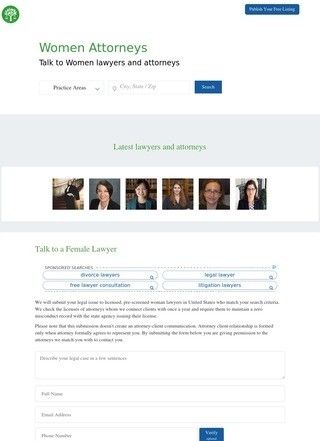
Women Lawyers, hosted at womenattorneys.com, is a United States legal-directory and lead-matching service built around one filter: the attorney you connect with is a woman. That premise runs through everything on the site. A person with a legal problem describes it, and the platform points them toward female attorneys who practice in the relevant area and location.
The practice-area coverage is wide. More than fifty specialties are listed, spanning family law, criminal defense, personal injury, immigration, bankruptcy and debt, business law, appeals, and divorce. That breadth means Women Lawyers is not limited to the handful of categories most directories lean on. Someone facing a niche appellate matter and someone dealing with a routine divorce both have a lane here.
How the matching and search work
On Women Lawyers, search runs on two axes: what you need and where you are. Location filtering drills down from state to city, so listings surface for Illinois, Florida, California, and Oregon, then narrow further to places like Los Angeles or Eugene. You can browse attorney profiles directly, or hand the work to the platform.
The request form is the second route, and it is the more distinctive of the two. A user writes out the legal issue, submits it, and the platform matches them with women attorneys it describes as licensed and pre-screened. The team says each request gets reviewed, with a reply promised inside two business days. That is a concrete, checkable commitment, and it sets a clearer expectation than the vague "we'll be in touch" language many intake forms settle for.
The spotlight and newsletter
A section called Women Attorneys Spotlight profiles individual lawyers, giving names and cities: Kim Parker in Baltimore, Rachel Karchemsky in Los Angeles. This is a smart touch.
It turns an otherwise faceless matching engine into something with actual people attached, and it gives a prospective client a sense of who might be on the other end. A monthly newsletter signup sits alongside it for anyone who wants to follow Women Lawyers without an active legal need.
Accounts for people seeking help
Registered users of Women Lawyers get a dashboard rather than a one-off form submission. Inside it are notifications, profile management, saved listings, referrals, and direct messaging with attorneys.
Direct messaging is the standout piece of it, since it lets a conversation start on the platform instead of forcing an immediate phone call or a cold email. For someone nervous about reaching out to a lawyer, that lower-stakes first contact is genuinely useful.
What attorneys get
Women Lawyers works both sides of the exchange. Female attorneys can publish a free listing, which explains where the supply of profiles comes from and keeps the barrier to being found low. A free listing is a reasonable pitch to a solo practitioner or a small firm testing whether the referrals justify more effort.
It also means the directory can grow without every listing being a paid placement, which tends to keep coverage more honest.
Trust signals and where the record goes quiet
On paper the legal housekeeping at Women Lawyers is thorough. The footer carries a privacy policy, terms, a disclaimer, a security page, and HIPAA compliance statements, along with social links to Facebook, X, LinkedIn, and Instagram.
For a platform where users type out sensitive details of a legal problem, spelling out security and HIPAA posture is the right instinct, and it is more than a lot of comparable sites bother to publish.
Contact routes and the missing outside proof
Contact is where the site gets quieter than it should. A contact page lives in the footer at /contact, and a help center is linked through help.heritageweb.com, so there is a route to reach someone. But the landing page shows no phone number, no physical address, and no email up front. You have to click through to find any of it. For a service asking people to trust it with private legal matters, more visible contact detail on the front page would do a lot of reassuring work.
None of that is disqualifying. A working contact page and a staffed help center clear the bar. The quibble is placement, not absence, and it is the sort of thing a redesign fixes without touching the substance underneath.
Outside validation is the real blank spot. A search for independent reviews of this specific site turns up nothing usable. There are no Google, Trustpilot, Yelp, or BBB ratings tied to womenattorneys.com, and the results that do surface belong to other things entirely: Washington Women Lawyers judicial ratings, a Forbes list of top women lawyers, unrelated firm pages. So a prospective user cannot lean on a crowd of prior experiences here. The pre-screening claim and the two-day reply promise have to be taken largely on the platform's own word, at least for now.
That does not sink the proposition, but it does shape how to use Women Lawyers. The concept is clear and the feature set is real: broad practice areas, geographic drill-down, named attorney spotlights, on-platform messaging, and a free path for lawyers to join. What is missing is the external track record that would let a stranger arrive with confidence already built.
Set against a general-purpose directory like Avvo, which layers peer endorsements, client reviews, and a rating score onto every attorney profile, Women Lawyers trades that depth of public feedback for a sharp, single-purpose focus that Avvo does not offer. If the specific priority is finding a female attorney and starting a low-pressure conversation quickly, this site does that job directly, and the honest move is to treat the matched attorney's own credentials and your own first exchange as the real screening step.