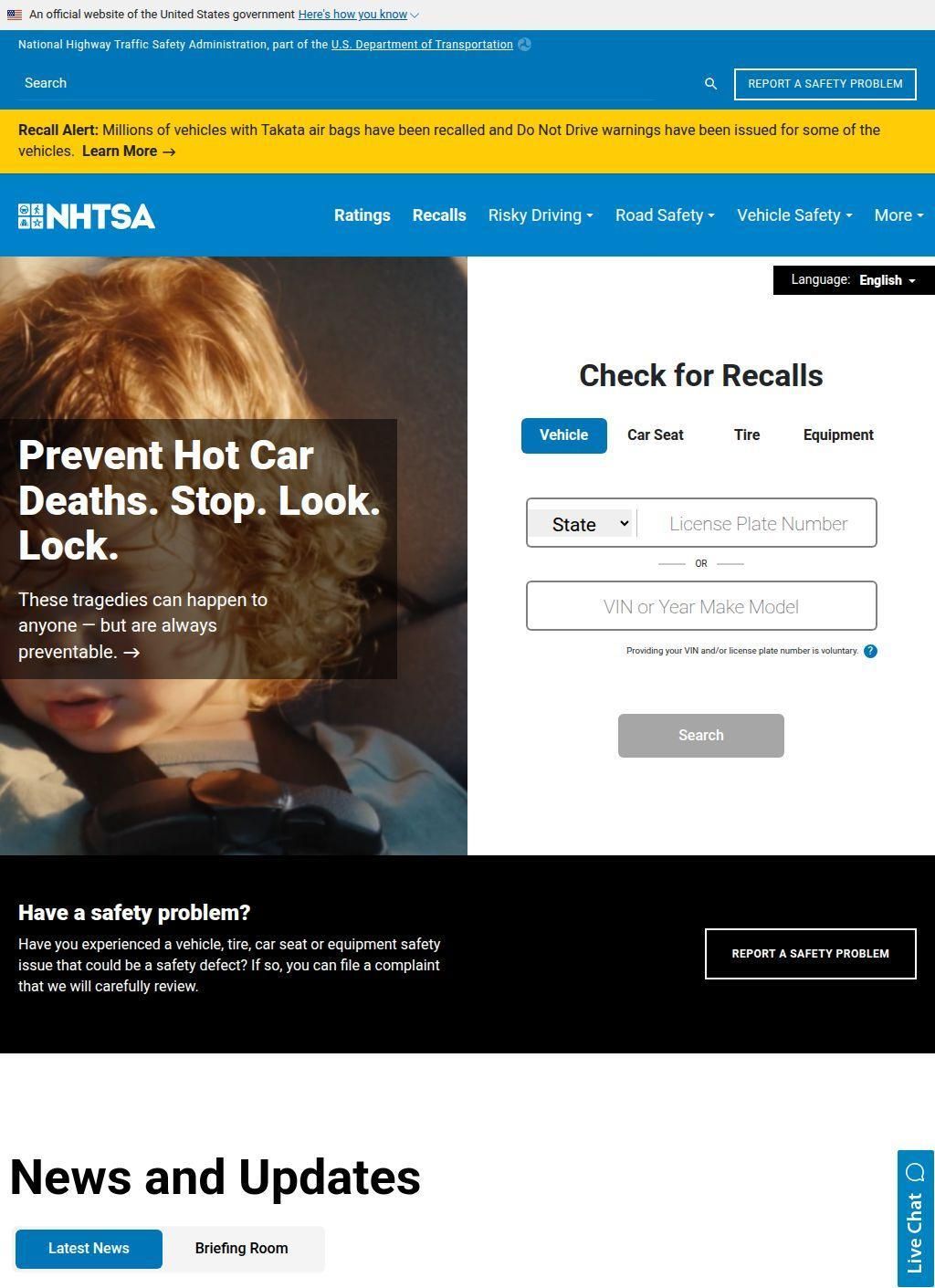
Type a vehicle identification number into one field and the National Highway Traffic Safety Administration (NHTSA) will tell you, in seconds, whether the car in your driveway is under an open safety recall that the manufacturer is obligated to fix for free. That VIN lookup covers cars, tires, car seats, and other equipment, and it is probably the single most useful thing a member of the public can do on the site. For a listing filed under car accident law, that same tool is a starting point rather than a curiosity, because an unrepaired recall can sit at the center of a liability question.
Vehicle recall lookup tool
This is the federal agency, housed within the Department of Transportation, charged with cutting deaths, injuries, and the economic damage that follow motor vehicle crashes. The scope is wide, and the site reflects it. Consumers, vehicle owners, manufacturers, researchers, and the attorneys who build accident cases all pull different things from the same set of resources, which is part of why the National Highway Traffic Safety Administration (NHTSA) is worth knowing even if you never plan to file a complaint.
Safety ratings and crash testing
The 5-Star Safety Ratings program is the piece most people have seen without knowing the source. Those crash-test scores that show up on dealership window stickers and car-shopping sites trace back here, generated from frontal, side, and rollover testing. Being able to read the ratings straight from the National Highway Traffic Safety Administration (NHTSA), alongside the recall history for the same model, gives a car buyer a fuller picture than any single review site manages.
Complaints and investigations
Recalls run in both directions. Owners can look up defects, and consumers can file a complaint reporting a problem they have experienced, which is the raw material the agency uses to open investigations. That feedback loop is doing real work: a cluster of complaints about a stalling engine or a failing airbag inflator is often what triggers a formal probe. The site also carries Technical Service Bulletins and a record of open and closed investigations, so someone can trace how a suspected defect moved from scattered reports to an official inquiry.
For a lawyer preparing a case, that trail is gold. Knowing whether a vehicle model was already under investigation, or whether a specific component had a bulletin issued against it, changes the shape of a claim. The National Highway Traffic Safety Administration (NHTSA) publishes the Federal Motor Vehicle Safety Standards and the rulemaking behind them, which is where the compliance questions in a crash suit tend to live.
Safety data for researchers
On the research side, the agency runs FARS, the Fatality Analysis Reporting System, a census of fatal crashes on U.S. roads. Researchers and policymakers download this data to study how, where, and why people die in traffic, and the National Highway Traffic Safety Administration (NHTSA) makes bulk data files available for exactly that kind of analysis. I have found government statistics portals that promise open data and then bury it behind broken links, so an agency that actually ships usable downloads earns some quiet respect.
Child seats, teen driving, safety campaigns
The public-facing safety work is broad and practical. There is child car seat guidance, including how to install a seat correctly and a locator for inspection stations where a certified technician will check the work in person. Teen driving resources sit alongside the long-running campaigns against distracted driving, drunk driving, and driving unbelted. None of this is flashy, and it does not need to be. The value is in the specificity: a parent who cannot tell whether a seat is anchored properly can find a nearby station and get a real answer.
Newer vehicle technology gets its own coverage too, from airbags to advanced driver assistance systems, along with the tire and equipment standards that manufacturers must meet. Industry users get compliance and reporting guidance written for their obligations, while the press releases and safety alerts keep the whole thing current. It serves a genuinely mixed audience, and the material is organized around what each group needs rather than around how the agency is structured internally.
What holds the National Highway Traffic Safety Administration (NHTSA) together as a resource is that the consumer tools and the regulatory backbone are the same body of information seen from different angles. The recall a driver looks up is the same recall a manufacturer had to report and the same event a researcher counts. That coherence is hard to build and easy to underestimate.
The limitation, if you want to call it one, is that depth cuts both ways. Someone hunting for a quick yes-or-no answer can get pulled into rulemaking documents and standards language that assume a working knowledge of the field. The National Highway Traffic Safety Administration (NHTSA) is a reference collection more than a guided experience, and it rewards visitors who know roughly what they are after, whether that is a single recall check or tracing how a defect turned into a federal standard.
Business address
National Highway Traffic Safety Administration
1200 New Jersey Avenue SE, West Building,
Washington,
DC
20590
United States
Contact details
Phone: 1-888-327-4236