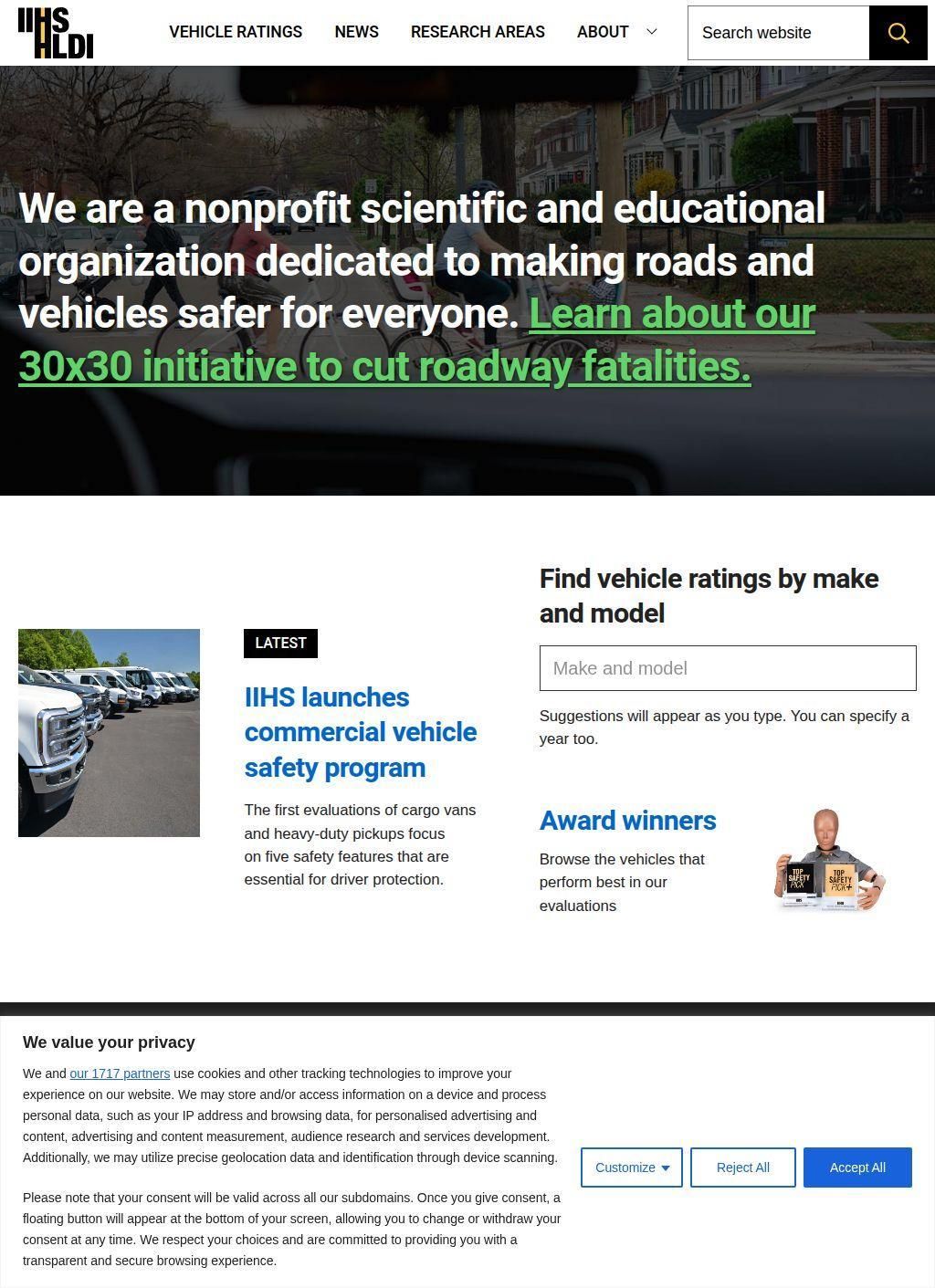
Funded by auto insurers and operating alongside the Highway Loss Data Institute (HLDI), the Insurance Institute for Highway Safety (IIHS) is a nonprofit research and testing organization that studies how to cut deaths and injuries on American roads. Its best-known output is independent crash testing, with vehicle ratings issued model by model and the TOP SAFETY PICK and TOP SAFETY PICK+ awards that many car buyers now treat as a benchmark when shortlisting a model. That single function shapes most of the site, and it is the reason a category about car accidents leads someone here in the first place.
Vehicle ratings and shopping guides
The ratings search sits at the center of the experience. You pick a make and model, and the site returns how that vehicle performed across the crash and safety evaluations the Insurance Institute for Highway Safety (IIHS) conducts. For anyone weighing a purchase, that is the practical payoff, and it is paired with shopping guides aimed squarely at buyers who want safety folded into the decision instead of treated as an afterthought. The numbers come from the organization's own labs, which is what separates this from a site repackaging other people's figures. A buyer can move from a single model lookup to a wider comparison without leaving the site, and the awards function as shorthand for the full set of test results, so the shopping guides and the ratings reinforce each other instead of duplicating effort.
Eleven research areas covering road safety
Beyond the ratings, the Insurance Institute for Highway Safety (IIHS) organizes its work into eleven research areas, and the breadth is genuinely wide. The list runs through advanced driver assistance systems, alcohol and drug impairment, distracted driving, large trucks, motorcycles, pedestrians and bicyclists, red-light running, seat belts, speed and traffic safety, teenage driver safety, and child passenger safety. Each is a real subject of study with its own findings behind it, and together they map most of the ways people are hurt or killed in traffic. Some areas, such as advanced driver assistance systems and speed, sit close to current policy debates, while others, like seat belts and child passenger safety, address risks that have been studied for decades and still need attention. The spread signals that the organization is not chasing a single headline issue.
How HLDI loss data confirms crash tests
The data side belongs to HLDI, which compiles and publishes insurance loss figures by vehicle model. That pairing is worth pausing on. One body crash-tests cars in controlled conditions, the other tracks what actually happens to those same models once they are insured and on the road, and the two streams check each other. I find that combination more convincing than either would be alone, because a strong lab result contradicted by real-world loss data would not survive long under this structure. The Insurance Institute for Highway Safety (IIHS) presents both sides openly, so a reader can see the controlled test alongside the messier evidence of insurance claims and judge how well they line up.
Peer review standards behind published studies
The Insurance Institute for Highway Safety (IIHS) also publishes peer-reviewed research, which raises the bar on what it puts its name to. Peer review means outside experts have scrutinized the methods before anything is presented as a finding, and for a topic where commercial interests run high, that filter keeps the findings credible. A car accident sits at the intersection of vehicle design, driver behavior, and road conditions, and the research areas listed above cover all three. Someone trying to understand why a particular collision type keeps recurring, or whether a given safety system measurably reduces crashes, will find studies addressing exactly those questions instead of vague reassurance. The work of the Insurance Institute for Highway Safety (IIHS) tends to be cited precisely because it carries that scrutiny, and the site does not hide the methodology behind a headline.
Guidance for parents and young drivers
The audience here is broader than car shoppers. The Insurance Institute for Highway Safety (IIHS) builds guidance for parents around two of the riskier groups on the road, young drivers and children in car seats, and the teenage driver material in particular speaks to a demographic with outsized crash rates. This is the kind of resource a family can use directly, not a report written only for specialists. Alongside it sits a free K-12 classroom curriculum called Crash Science, which takes the same body of testing and research and turns it into teaching material.
Crash science curriculum for schools
Schools rarely get vehicle-safety content from a source that does the underlying testing itself, so the curriculum is a real contribution, not a token education page. Educators are listed among the groups the Insurance Institute for Highway Safety (IIHS) serves, and because the material draws on actual crash work, students get something closer to primary evidence than a generic safety lesson, and a teacher can hand it out knowing where every figure originated.
Policy advocacy through the 30x30 initiative
On the policy front, the Insurance Institute for Highway Safety (IIHS) runs a "30x30" initiative aimed at cutting U.S. roadway fatalities thirty percent by 2030. Whether that target is met is an open question, and the site does not pretend the number is guaranteed. A media resources section serves journalists who need figures and context, and policymakers and researchers draw on the same published work. The Insurance Institute for Highway Safety (IIHS) is clearly positioning its findings to influence decisions well above the level of an individual car buyer.
What this resource does not offer
It is worth being clear about what the Insurance Institute for Highway Safety (IIHS) is not. Despite the category this listing sits under, it is not a law firm and offers no legal representation, no claims help, and no advice for someone pursuing a case after a crash. Anyone who arrives expecting an attorney will leave empty-handed. What they will find instead is the evidence base that lawyers, insurers, and regulators lean on, which is a different and arguably more durable kind of usefulness.
No consumer review platforms carry ratings for the Insurance Institute for Highway Safety (IIHS) as they would for a commercial service, but its reports appear regularly in legal filings, federal rulemaking records, and academic citations. An attorney building a case about a defective restraint system or a vehicle that performed poorly in testing might well cite the Insurance Institute for Highway Safety (IIHS) directly, so the connection to the legal world is real even though the service is not.
For its actual purpose, the verdict is straightforward and positive. The Insurance Institute for Highway Safety (IIHS) does original crash testing, publishes ratings that buyers and the industry treat as a benchmark, backs the lab work with real insurance loss data through HLDI, and spreads the results across research, parent guidance, classroom teaching, and policy advocacy. The breadth could feel scattered, yet the through-line holds: every section traces back to reducing harm on the road.
The mismatch with the car accident category is the one caveat, and it is a categorization issue, not a flaw in the resource. The depth runs deeper than a casual visitor might expect, from a single model lookup down to the peer-reviewed studies and loss data underneath it, and that depth is the point. The Insurance Institute for Highway Safety (IIHS) earns the trust placed in it by doing the testing itself and standing behind the numbers it reports.
Business address
Insurance Institute for Highway Safety
4121 Wilson Boulevard, 6th Floor,
Arlington,
VA
22203
United States
Contact details
Phone: 1-703-247-1500