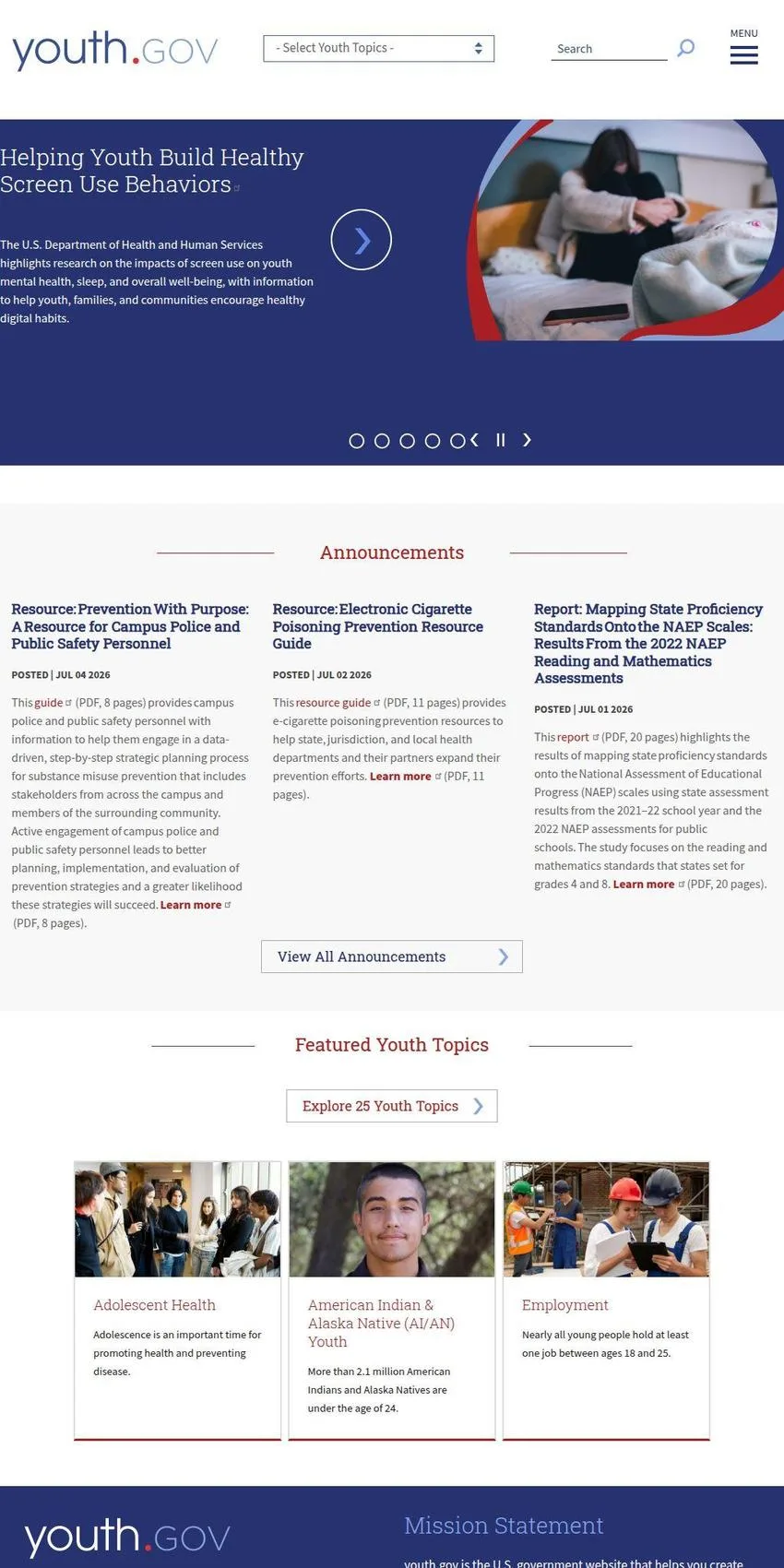
Youth.gov is the United States government's interagency website on young people and the programs that serve them. The Interagency Working Group on Youth Programs produces the site, a body of representatives from federal departments and agencies with the Department of Health and Human Services as chair. Its pages pull together research summaries, program tools, data, and funding pointers that would otherwise sit scattered across dozens of separate agency websites. An earlier federal portal called FindYouthInfo.gov preceded it.
Most of the material is written for the adults who plan, fund, or staff youth programs. A fair amount remains readable for teenagers themselves, especially the pages on employment, money, and driver safety, and parents can use the site to understand issues their children meet at school and online.
Twenty five youth topics
The heart of the site is a set of 25 topic sections. Subjects include adolescent health, civic engagement, dating violence prevention, disabilities, driver safety, employment, family engagement, financial capability and literacy, gang involvement prevention, homelessness and housing instability, juvenile justice, mentoring, school environment, substance use and misuse, suicide prevention, trafficking prevention, and violence prevention. Bullying prevention has a section of its own, built on the federal government's dedicated anti-bullying materials. Each topic lays out what research says about the issue, identifies risk and protective factors, and describes the federal programs and data sources attached to it.
Topic pages cite federal studies and agency publications rather than commercial sources. A preparedness and recovery section covers the part young people can play before and after disasters, and a mentoring section reviews what formal mentoring programs have achieved in evaluations.
Sections for particular groups
Several topics concentrate on populations rather than issues. There are sections for American Indian and Alaska Native youth, for children of incarcerated parents, and for expectant and parenting young families. Opportunity youth, the federal term for 16 to 24 year olds who are neither in school nor working, receive pages of their own. Another section follows the transition to adulthood, including what happens to young people aging out of care.
Positive youth development
One topic doubles as the site's working philosophy. Positive youth development is an approach that builds on adolescents' strengths and gives them a genuine say in the programs meant for them. Success is measured by skills gained and connections formed as much as by problems avoided. The section reviews the research behind the approach and lists practices that youth-serving organizations can adopt.
Map My Community and funding pointers
Map My Community is the site's main interactive tool. A visitor enters an address or zip code, and the map returns organizations in that area that receive federal funding for youth programs. Program planners use the results to find partners for collaborations, while community groups use the same map to spot gaps where no service exists. Parents can check what federally supported mentoring, afterschool, or health programs operate close to home.
The underlying data spans many agencies at once. That gives the map a wider view of local youth services than any single department could offer on its own.
A separate funding area explains which departments issue grants for youth work and points to current announcements on the main federal grants portal. Home page announcements track new federal activity as it happens; recent items have covered research on how screen use affects youth mental health, sleep, and overall well-being, along with the launch of a federal resource hub for new and expecting parents.
The working group behind the site
Members of the Interagency Working Group on Youth Programs include the Departments of Agriculture, Commerce, Defense, Education, Homeland Security, and Housing and Urban Development, together with agencies such as the Environmental Protection Agency, the Small Business Administration, and the Social Security Administration. The Department of Health and Human Services chairs the group. Its purpose is to line up youth policy across the executive branch so that grant programs reinforce one another instead of duplicating effort.
A strategic plan called Pathways for Youth sets the group's direction. The plan commits member agencies to coordinate strategies with one another and to spread evidence-based approaches to state, local, and tribal governments. It also asks agencies to bring young people into the design of the programs that affect them, a commitment the site carries out through youth engagement material and first-person features.
Collaboration profiles on the site document how individual communities combined funding streams from different agencies to serve local youth. Each profile works as a case study for other towns weighing the same approach.
Youth.gov maintains no separate public office. Postal correspondence goes through the chairing department in Washington, and questions about content go through an online form. Updates arrive through the year as member agencies add announcements, feature articles, and new topic material, which makes the site a running record of federal youth policy as well as a reference for anyone raising or working with teenagers.






Business address
Interagency Working Group on Youth Programs
200 Independence Avenue SW,
Washington,
DC
20201
United States
Contact details
Phone: 1-877-696-6775