The Office of Population Affairs is a program office of the United States Department of Health and Human Services, based at the department's headquarters on Independence Avenue in Washington. Its adolescent health section assembles guidance, data, and program information about young people from about age 10 to age 24. The office also runs two long-standing federal grant programs, which ties the written material to services that teenagers actually receive. A separate reproductive health area of the same site covers contraception, fertility, sexually transmitted infections, and HIV prevention, while the adolescent pages keep their focus on the teen years.
Parents, clinicians, teachers, and program staff are the main audiences. Some campaign material speaks to young people directly through social media channels. Clinical guidance is left to professional bodies; the office's own role is information, funding, and coordination.
Guides for parents and caring adults
Adolescent Development Explained, the section's central guide, walks through physical, cognitive, emotional, social, and moral development from the start of puberty into young adulthood. It was written in ordinary language for parents and other adults who spend time with adolescents rather than for specialists. The guide describes what changes to expect at each stage and offers suggestions for staying connected with a teenager while independence grows. Adults who mentor, coach, or teach teens are named as intended readers alongside parents.
Health topic pages
Companion pages cover the health subjects that come up most often during the teen years:
- Mental health, including how families can find treatment and support
- Substance use and its prevention
- Physical health, covering checkups and recommended clinical preventive services
- Sexual and reproductive health, with national trends in teen pregnancy and childbearing
- Healthy relationships during adolescence
The clinical preventive services material explains which screenings and vaccinations professional guidelines recommend for adolescents and how insurance typically covers them. National teen birth rates have fallen substantially over the past three decades, and the trends pages document that decline with federal birth statistics. The mental health and substance use pages take the same approach, summarizing what federal research says and pointing families toward treatment resources.
Positive youth development
The office promotes positive youth development, a strengths-based way of working with young people that emphasizes their meaningful engagement in the programs that serve them. The pages set out key practices for youth-serving organizations along with the research behind the approach. The same framework appears across other federal youth sites, which makes the office's version part of a wider government approach to adolescence.
Grant programs the office runs
The Teen Pregnancy Prevention Program awards competitive grants to organizations working with adolescents across the country. Congress first funded the program in 2010. Funding supports replication of program models that produced results in earlier evaluations, together with the development and testing of new approaches. Grantees have included health departments, school systems, universities, and community organizations, and evaluation findings from their projects feed back into the office's research pages.
Title X and the clinic locator
The office also administers Title X, the federal family planning program created by statute in 1970 and the only federal grant program devoted entirely to family planning services. Title X service grants support a national network of clinics that provide confidential contraception, testing, and related preventive care, with charges scaled to income. Adolescents are among the patients served, with confidentiality protections that apply to them as well as to adults. A locator tool on the site finds Title X funded clinics by address or zip code, which gives the adolescent health material a practical endpoint: a teenager or parent reading about preventive care can find an actual clinic nearby.
A smaller effort, the Embryo Adoption Awareness and Services program, also sits with the office.
Data, observances, and research
Adolescent health data pages present federal survey findings in interactive form. A resource called America's Diverse Adolescents profiles the demographic makeup and health of the adolescent population, and featured reports have included federal survey results on adolescent behaviors and experiences. All of it is free to read and reuse, since federal publications carry no copyright. Researchers, journalists, and students treat the data pages as a starting point for national figures on adolescent health.
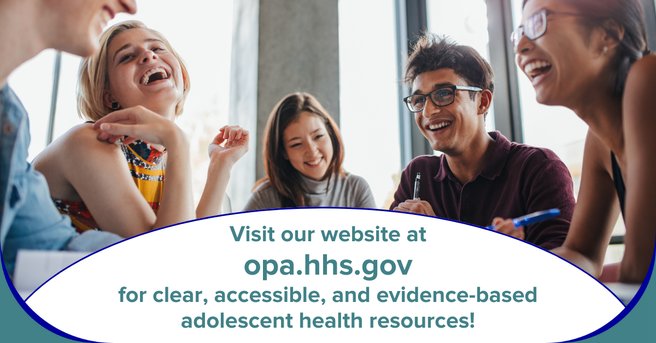
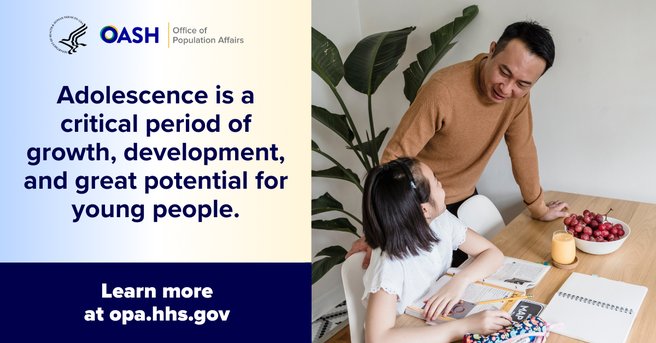
Each May the office leads National Adolescent Health Month, an annual observance that emphasizes young people's strengths and their engagement in health activities. Organizations that work with teens time local events and social media campaigns to the month, and the office supplies graphics and suggested messages.
A related effort, Take Action for Adolescents, is the office's standing call to action for adolescent health and well-being. It pairs research on improving the health of people ages 10 to 24 with ready-made material for social media, so that schools, clinics, and community groups can repeat consistent messages.
A research and evaluation area archives publications and evaluations from the grant programs, and open funding announcements appear under the grants section. Questions reach the office by phone during business hours or through its online contact form. The publication archive goes back years, so program staff can trace how federal adolescent health priorities have shifted over time.

Business address
Office of Population Affairs
200 Independence Avenue SW,
Washington,
DC
20201
United States
Contact details
Phone: 240-453-2800