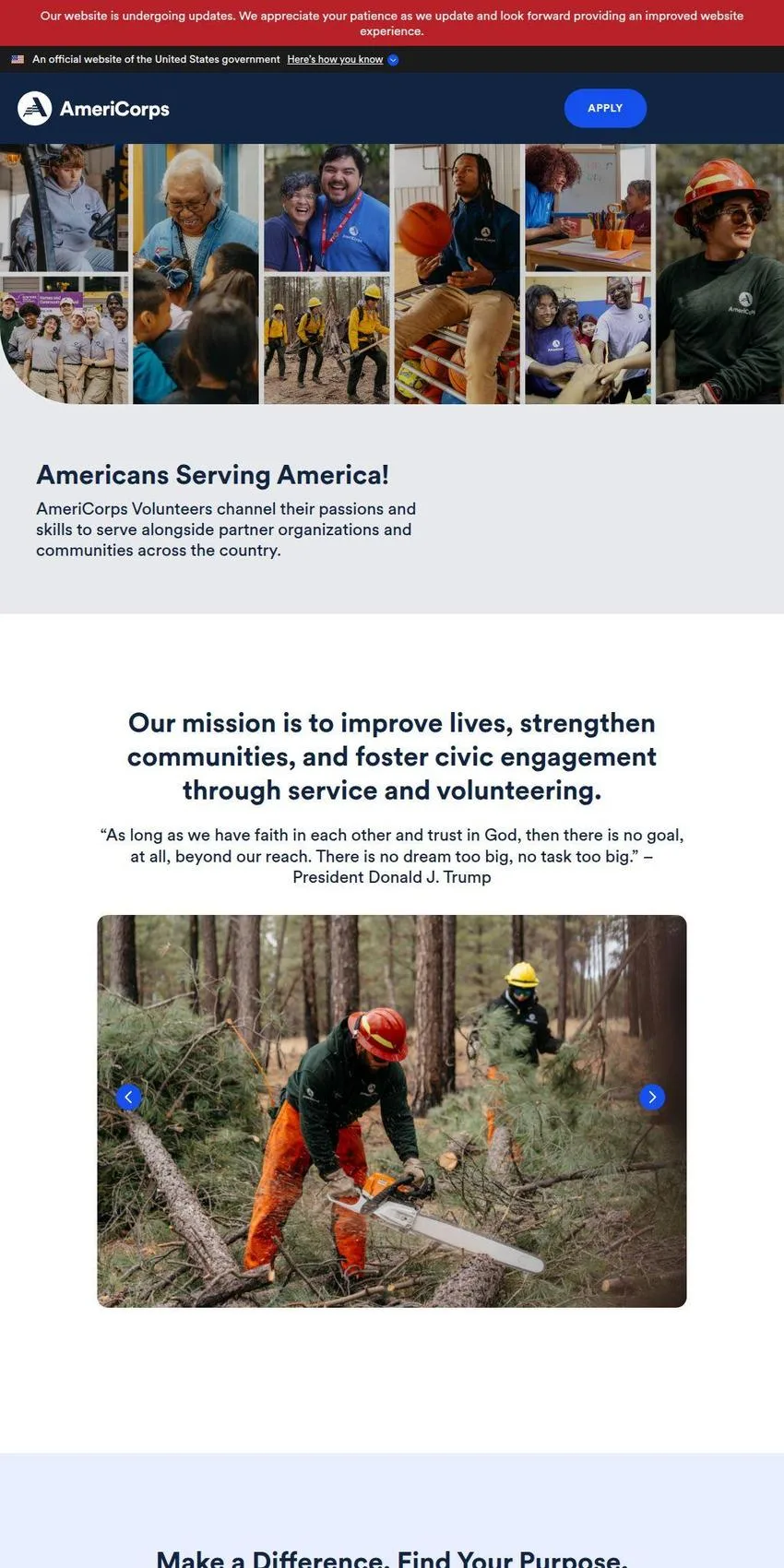
AmeriCorps is an independent federal agency of the United States government that organizes national service, placing people in full-time and part-time positions with nonprofits, schools, public agencies, and community groups. The agency's legal name is the Corporation for National and Community Service, and it began using AmeriCorps as its operating name in 2020. Through its programs it engages hundreds of thousands of people each year in paid service terms and connects millions more to volunteering, with attention to education, disaster response, economic opportunity, health, and support for veterans and older adults.
Origins and legal basis
The agency was created by the National and Community Service Trust Act of 1993, which President Bill Clinton signed on September 21, 1993. The corporation was established on October 1 of that year and brought together two earlier bodies: the Commission on National and Community Service and the agency called ACTION, which had run domestic volunteer programs since the early 1970s. The first class of AmeriCorps members, about twenty thousand people, was sworn in during September 1994 and began work in more than a thousand communities.
Because it is an independent agency rather than part of a cabinet department, AmeriCorps is governed by a board of directors whose voting members are appointed by the president and confirmed by the Senate, along with several ex officio members drawn from federal departments. Its headquarters are in Washington, and it works through state service commissions and grant recipients rather than by running most programs directly from the capital.
What national service means
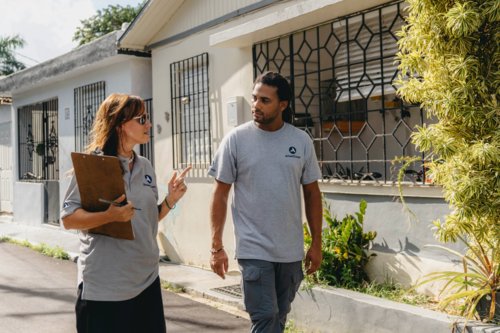
National service refers to a paid term of work, usually a year, in which a person commits to a set number of hours addressing a public need in exchange for a modest living allowance and, at the end, an education benefit. It sits between unpaid volunteering and regular employment. A member is not a federal employee and is not paid a market wage, and the allowance is meant to cover basic costs while the person serves. The country gains work in schools, shelters, parks, and disaster zones, while the individual gains experience and help paying for education.
The programs
AmeriCorps runs several distinct programs, each with its own history and rules.
- AmeriCorps State and National, the largest, which gives grants to organizations that then recruit and place members
- AmeriCorps VISTA, focused on building the capacity of groups that work against poverty
- AmeriCorps NCCC, a residential program for young adults organized in teams
- AmeriCorps Seniors, for volunteers aged fifty-five and older
Full-time service programs
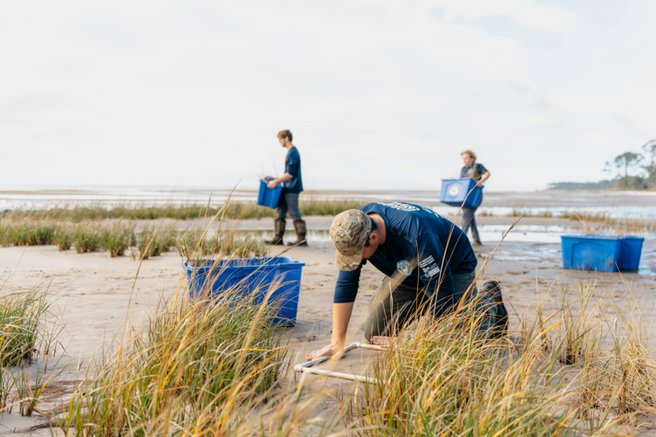
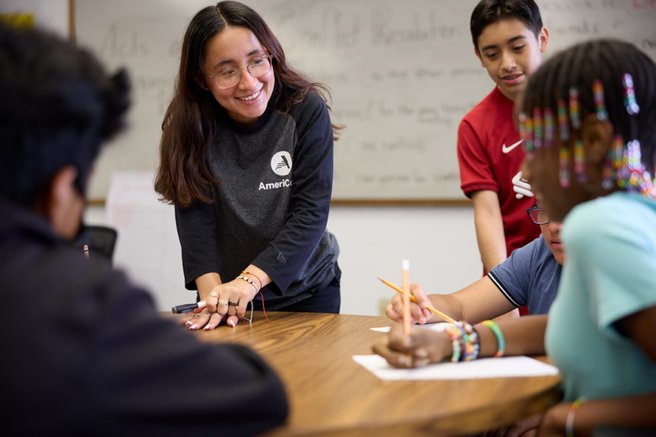
AmeriCorps State and National does not usually place members itself. Instead it awards grants to nonprofits, schools, faith-based groups, and public agencies, which use the money to support members working on their own projects, such as tutoring students or rebuilding after storms. A full-time member in this program typically completes seventeen hundred hours over about eleven months and receives a living allowance, health coverage, and in some cases help with child care. AmeriCorps VISTA, which traces its roots to a 1965 anti-poverty program, places full-time members with community organizations to build lasting programs rather than to deliver direct service, working on tasks like writing grants, training volunteers, and setting up systems. AmeriCorps NCCC, the National Civilian Community Corps, is a residential program for people roughly eighteen to twenty-six who serve in teams from regional campuses and travel to projects in disaster relief, conservation, and infrastructure, modeled in part on the Depression-era Civilian Conservation Corps.
AmeriCorps Seniors
AmeriCorps Seniors, known for many years as Senior Corps, engages people aged fifty-five and older in three long-running programs. Foster Grandparents pairs older adults with children who need mentoring and tutoring. Senior Companions matches them with other adults, often frail or homebound, who need help staying independent. The Retired and Senior Volunteer Program, usually shortened to RSVP, places older volunteers in a range of local projects chosen to fit their skills. These programs let people continue to serve well past the usual working years.
Education award and member benefits
The benefit that ties the service programs together is the Segal AmeriCorps Education Award. Introduced in 1997 and named for Eli Segal, the first head of the agency, it is a sum a member receives after finishing a term of service. The amount is tied to the maximum federal Pell Grant for the year the service is approved, so it changes over time. A recipient can use the award to pay tuition at eligible schools or to repay qualified student loans, and in some cases the award can be transferred to a child or grandchild. For many young members, this benefit is the practical reason they can afford a year of low-paid service.
Place in a society and people directory
AmeriCorps belongs in a directory of society and civic organizations because it is the main federal structure for organized national service in the United States. It connects the government, thousands of local sponsoring organizations, and the individuals who choose to serve a term, and it directs public funding into education, poverty relief, disaster response, and help for children and older adults. A young person considering a service year, a nonprofit seeking members to staff a program, a school looking for tutors, or a retiree wanting structured volunteer work can all begin with this agency and follow it to a specific program and local sponsor.


Business address
AmeriCorps (Corporation for National and Community Service)
250 E Street SW, Suite 4100,
Washington,
District of Columbia
20525
United States
Contact details
Phone: (202) 606-5000