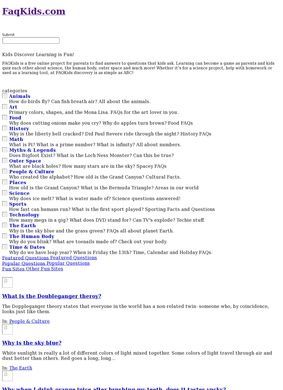
FAQ Kids is a free online question-and-answer resource aimed at children and the parents fielding their questions, running under the tagline Kids Discover Learning is Fun. The premise is simple and old-fashioned in a good way: a child has a question, and the site has an answer written for a child to read. Where a search engine would hand a seven-year-old a wall of adult results, this one keeps the reading level and the subject range pointed at the person actually asking. That single editorial decision is the whole reason a site like this exists.
A parent can hand over a keyboard without first bracing for whatever a general search might dredge up, and a child gets an answer they can actually read instead of a page of jargon they will bounce off. It is a small kindness built into the design, and it runs through everything else the site does.
The homepage sets the tone by leading with real sample questions, the sort a kid genuinely asks. Why does Santa wear red. Who invented the Internet. Those featured pairs do more work than any mission statement, because they show a visitor in one glance what kind of answers to expect and at what pitch. A parent sizing up the site can tell within a couple of examples whether the tone fits their child, and the two on show suggest a mix of the seasonal, the silly, and the genuinely educational.
How the questions are organized
The backbone of FAQ Kids is a set of topic categories broad enough to catch most of what a curious child throws at it. The list runs across Animals, Art, Food, History, Math, Myths and Legends, Outer Space, People and Culture, Places, Science, Sports, Technology, The Earth, The Human Body, and Time and Dates. That spread covers the school subjects and the dinner-table curiosities in equal measure, which fits the site's double role as homework helper and general family diversion.
The categorization goes a layer deeper where a single heading would be too blunt. The structure is sensible, and for a resource meant for young readers, structure is close to everything, because a child who cannot find the answer gives up faster than an adult would. Breadth without navigation is just clutter to a kid, and the topic list here reads like it was arranged by someone who pictured an actual child scrolling it.
A parent can point a child at Science or Sports and trust that the click lands somewhere sensible, which is the quiet difference between a site a family uses twice and one they return to.
From outer space to the human body
The subcategories are where FAQ Kids shows some thought. The Earth breaks down into Ocean and Weather, so a question about tides sits apart from one about thunderstorms. The Human Body splits into topics on health, growing up, and skin, which quietly handles the reality that a lot of a child's questions are about their own changing body and are better met with a plain answer than an awkward silence. Time and Dates folds in Holidays, which is likely where that Santa question lives.
None of this is flashy, but it means a parent handing a child the site is not steering them toward a dead end.
The interactive pieces
Beyond the categories, FAQ Kids leans on a few features that turn passive reading into something a child will poke at. A random-question generator throws up an answer unprompted, and that button is the part I would hand a bored eight-year-old first, because it converts idle clicking into accidental learning. An Ask A Question tool lets a child submit their own, which is a nice loop: the site grows from the questions its readers bring to it.
There is also a browsable archive of every question the site has answered, which is the feature that separates a real reference from a homepage of a few samples. A child chasing a science-project topic can dig through the archive instead of hoping the category page happens to surface the right thing. An archive also quietly proves the site has been answering questions for a while, since a sparse catalogue would show its age the moment a curious kid started clicking. Here the depth is the reassurance: the more a young reader digs, the more there is to find.
Ask a question and the archive
Taken together, the submission tool and the archive give FAQ Kids a shape closer to a living reference than a static page. The random generator supplies serendipity, the archive supplies depth, and the Ask A Question form supplies the human element that keeps the content from going stale.
For homework help or a school science project, that combination is genuinely useful, and it asks nothing of the family beyond a browser and a question. There are no logins, no fees, and no barrier between a kid and an answer, which for a children's site is the correct set of choices.
Reach, contact, and what stands behind it
FAQ Kids is a modest operation by the numbers, and it helps to be clear-eyed about that. A third-party traffic estimator puts its global rank somewhere around 3.18 million and its audience at roughly 974 visitors a day, which is a small readership by the standards of the wider web. Those figures are outside estimates, not anything the site publishes, so they are best read as a rough gauge of a niche site with a steady trickle of visitors, not a heavyweight destination.
A readership that size can still be perfectly good at its job; it just means FAQ Kids is a small, quiet corner of the web, not a name most families would already recognize.
Contact is the weakest part of the offering. There is an About FAQ Kids page and the Ask A Question form, but no phone number, no email, and no physical address on the page, and nothing beyond that submission tool for reaching anyone directly.
Most listings on a business directory get judged partly on how easy they are to call or visit, but a free educational site aimed at kids plays by different rules: nobody is walking through a door or booking an appointment, so the missing phone line is a smaller concern than it would be for a shop, and a submission form does give a parent a way to raise something.
Even so, a little more transparency about who runs FAQ Kids would help a cautious parent decide whether to trust it, and that gap is fair to flag.
What the search turned up
On outside opinion, the honest report is that none was found. A search for reviews or ratings specific to FAQ Kids came back empty, with the results dominated by unrelated names: general kids-media review platforms such as Common Sense Media and DOGO Books, and a separate English-tutoring company called Qkids that has its own employee reviews and nothing to do with this site.
No third-party review of FAQ Kids itself surfaced. That is worth stating plainly rather than dressing up, and it means a parent is judging the site on what it puts on the page, which is at least all visible and free to inspect.
Weighed as a whole, FAQ Kids does a specific job well. It answers children's questions in children's language, organizes them so they can be found, and adds enough interactivity to keep a young reader clicking, all without a paywall or a signup. The limits are equally clear: a small readership, sparse contact information, and no independent reviews to lean on. A parent comparing it against Wonderopolis, the better-known free question-of-the-day site with a larger following and more polish, will probably find Wonderopolis the richer daily habit.
FAQ Kids holds its own as a quick, no-cost place to settle a specific question a child has right now, and for that narrow purpose it is worth keeping bookmarked alongside the bigger name, not in place of it.