A public television service for young children
PBS KIDS is the brand under which the Public Broadcasting Service distributes children's programming across the United States. It operates as a national service rather than a single station, carried by the more than 330 independent public television stations that make up the PBS network, each licensed to a community, a university, or a state authority. The programming is aimed at children between the ages of two and eight, the years before and during early elementary school, and the shows carry the educational and informative components that federal rules expect of children's television. PBS is a nonprofit membership organization owned by its stations rather than by shareholders, and it does not sell advertising inside the children's schedule.
The brand dates to 6 September 1999. It replaced an earlier package called PTV, introduced in 1993, which had gathered the network's existing children's shows under one on-air identity. Children's education had been part of public television long before that: Mister Rogers' Neighborhood began national distribution in 1968 and Sesame Street in 1969, and both ran for decades on the stations that now carry the PBS KIDS lineup.
Programming and how it reaches homes
PBS KIDS content moves through three channels that share one catalog. Member stations air a daytime block on their main broadcast signal, a separate PBS KIDS channel runs the same programming around the clock and was relaunched in its current form on 16 January 2017, and a set of free digital platforms streams episodes and a live feed on phones, tablets, and connected televisions. The PBS KIDS Video app, released on 12 May 2011, anchors that digital side, and none of these outlets requires a paid subscription. In February 2023 the broadcast daytime block was shortened from thirteen hours to eight at most stations, with the freed hours shifting toward the round-the-clock channel and the apps.
The programs
The schedule mixes animation and live action. Long-running titles include Sesame Street, Daniel Tiger's Neighborhood, which extends the world of Mister Rogers into animation, Wild Kratts, Arthur, Curious George, Dragon Tales, and Reading Rainbow. Each series is commissioned to teach a defined skill, among them early literacy, number sense, science observation, and social lessons such as naming feelings or taking turns. Music runs through much of the catalog as a teaching device rather than decoration. Daniel Tiger's Neighborhood builds each episode around a short sung strategy that children are meant to repeat, Sesame Street has produced thousands of original songs across its run, and other titles rely on recurring theme music and musical segments to fix routines and vocabulary in memory.
Games and the website
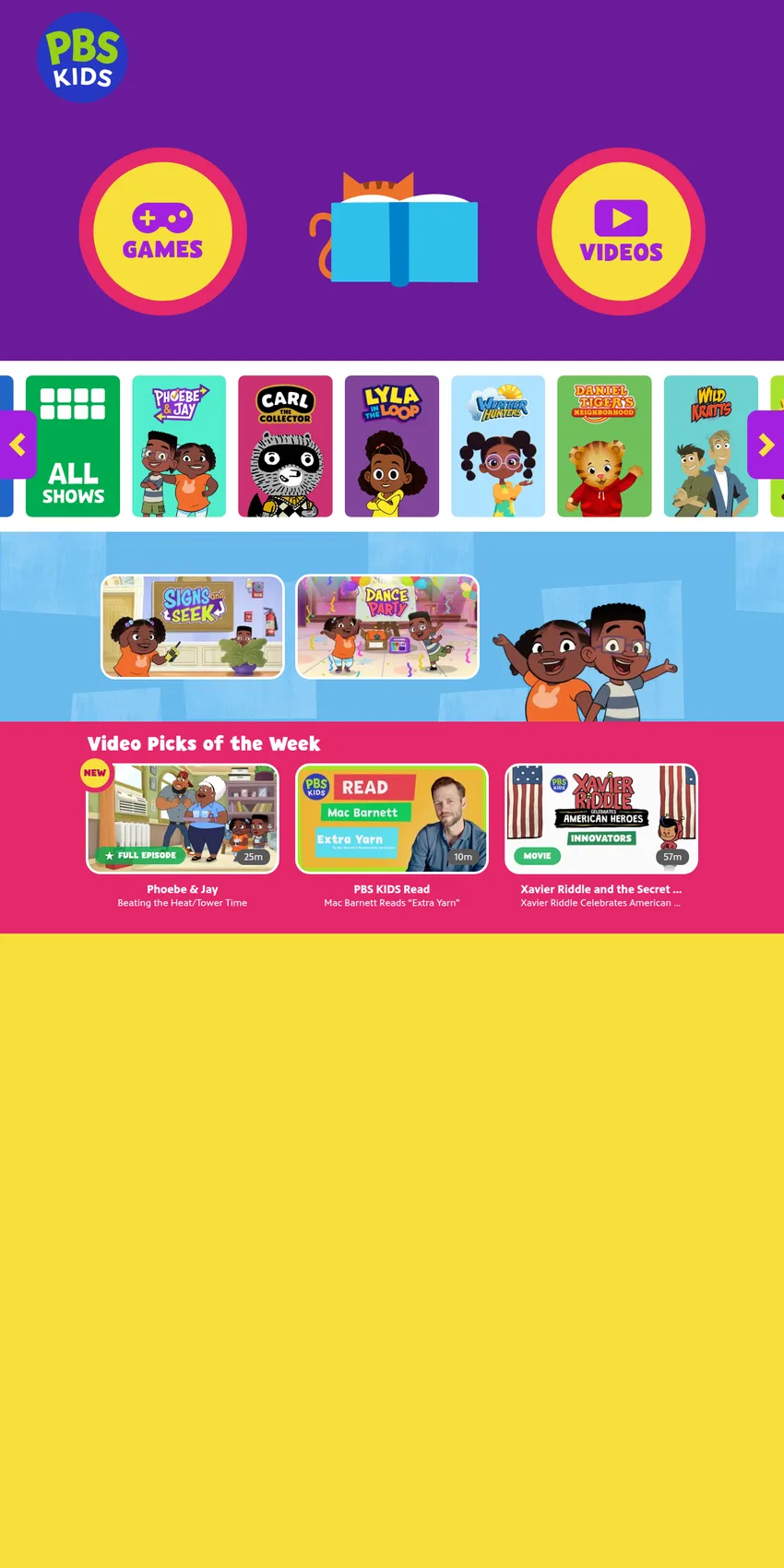
The service's website is built around games rather than a program grid. Every show has a section of browser games tied to its subject, so a science series links to sorting and observation activities and a literacy series to letter and rhyming games, and the same titles appear in the separate PBS KIDS Games app. Companion sites for parents and for teachers publish activity guides, printable materials, and short articles on child development, keeping the home and classroom resources apart from the children's play area.
Funding, partners, and local reach
Production money comes from several sources at once. The Ready To Learn initiative, a grant program of the United States Department of Education administered together with the Corporation for Public Broadcasting, has funded much of the network's early-learning content for more than two decades, with a stated priority of reaching children in low-income households. Individual series add corporate underwriting, foundation grants, and station contributions. The Corporation for Public Broadcasting, created by federal law in 1967, passes the federal appropriation for public media to PBS and to the stations, and later PBS KIDS material has been produced under Ready To Learn cooperative agreements tied to specific literacy and critical-thinking goals.
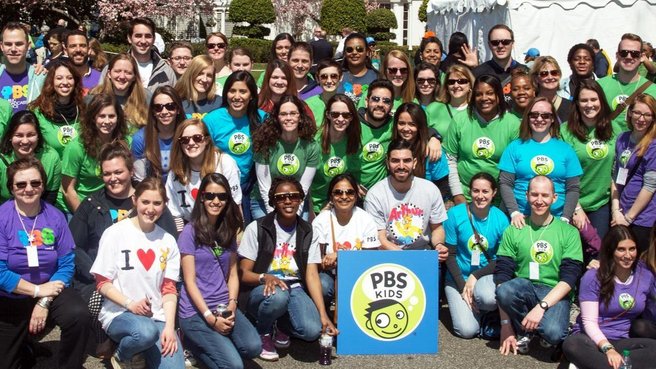
Because delivery runs through local stations, PBS KIDS also works at community level. Stations organize Ready To Learn learning neighborhoods, run family workshops, and carry out outreach in libraries and childcare centers, at times lending tablets loaded with the apps in areas where home internet is limited. This local layer sets the service apart from a purely national cable channel, since the same episodes reach a child through an institution rooted in that child's own town. PBS KIDS describes itself as the most-used educational media brand for American children, a claim that rests on the combined reach of its broadcast and digital audiences.
PBS works from its headquarters at 1225 S. Clark Street in Arlington, Virginia, across the Potomac River from Washington, and its main telephone line is +1 703-739-5000. Audience questions are handled through the online help center, while local broadcast times for the children's block are set by each member station rather than from a central schedule. Between its decades of children's television and the songs its programs use to teach, the service accounts for a large share of the early-learning media that American families reach through public broadcasting.

Business address
Public Broadcasting Service
1225 S. Clark Street,
Arlington,
Virginia
22202
United States
Contact details
Phone: +1 703-739-5000