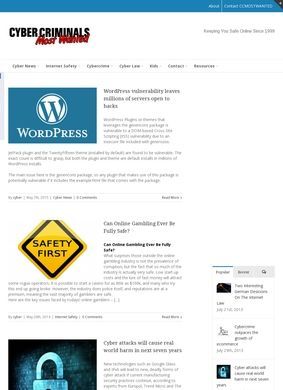
There is something odd about the name Cyber Criminals Most Wanted: it promises manhunts, and the actual job is closer to running a reference library. There are no original investigations here, no tracked-down fugitives, no reporting of its own. What the site keeps instead is an enormous, hand-built directory of links and short explainer pages about staying safe online, sorted into a category tree deep enough to wander around in for a while.
Cyber Criminals Most Wanted runs on WordPress and, by its own tagline, has been online since the late nineties. That age shows in both directions at once: a great deal of ground covered over the years, and a great deal of it left exactly where it was first put down. For a visitor arriving today, the site is less a live service than a museum of how the consumer web once tried to explain its own dangers.
A reference hub, not an investigation desk
The bulk of the site sits under a handful of large headings. Internet Safety gathers shopping guidelines, privacy, identity theft, netiquette, credit-reporting agencies, the digital divide, and pages aimed at families and seniors. Computer Security runs to network security, encryption, firewalls, intrusion detection, security tradeshows and even electronics recycling. A Downloads corner explains viruses, spyware and spam, and a scams-and-hoaxes section walks through the old standbys: the Nigerian letter, investment and consumer fraud, cyberstalking, cyberterrorism, hacking, and how to report a stolen computer.
None of it goes deep. These are primers and curated link lists, the sort of orientation a nervous newcomer or a worried parent might have gone looking for back when a search engine did not simply answer every question outright. As a single map of the territory, Cyber Criminals Most Wanted still holds together. As a source of current, checkable detail, far less so, because the ground it maps has shifted underneath the pages while they stayed put.
The breadth is genuinely wide, wider than a typical awareness site bothers to be. Whether that breadth is a strength or just accumulation depends entirely on how much of it still works, and a fair amount of it now points at a web that has moved on.
What Cyber Criminals Most Wanted assembled was closer to a card catalog than an encyclopedia, a way of pointing a reader toward the right agency, the right definition, the right official list, and that pointing job holds up better over time than any of its own explanatory pages do, because a good link outlives a paragraph of advice.
Reporting cybercrime and tracking the wanted
The most practical corner is the reporting apparatus. Cyber Criminals Most Wanted gathers Report Cybercrime links for the USA, Canada and worldwide, directories of computer-crime investigators and of national and global task forces, and law-enforcement reference lists that reach down to police precinct and county-sheriff level. Click one and I half-expected a dead end, yet the pointers toward where an actual complaint is meant to go are the part of this site that still feels built for a real purpose.
The Most Wanted section of Cyber Criminals Most Wanted itself mostly forwards on to the FBI's own material, its ten most wanted, its wanted terrorists and hijackers, and a roll of past cyber fugitives, so the drama in the title resolves into a tidy set of outbound links.
A kids and classroom corner
A children's section sits beside the adult material and covers internet safety, netiquette, email safety, an early lesson in what hacking actually is, and how a young user can report cyberbullying, with companion resource pages written for parents and teachers. It reads like a school-project handout from an earlier stretch of the web, plain and earnest, the kind of thing a teacher might once have printed off for a lesson.
There is also a Cyber Law shelf pointing to US and international statutes, attorney and law-enforcement references, forensic specialists and expert witnesses, which gives Cyber Criminals Most Wanted a more legal-minded backbone than an awareness blog usually bothers with. That legal section, alongside the reporting directories, is where the site comes closest to being a genuine reference a person might return to rather than a page they read once and leave.
Signs of a site frozen in time
The dating is the catch, and it is a real one. The sampled blog posts stop years back, the newest of them close to a decade old, so the news feed across the front of Cyber Criminals Most Wanted is really an archive, not a headline reel, and guidance about spyware and firewalls from that far back has aged unevenly. Some of the safety fundamentals still hold. The specifics have moved on without the site.
Contact takes some hunting too. There is no phone number or public email on the front page, and the contact form lives at a URL a visitor would never guess, filed under an awkward path instead of the obvious one, though it does carry a genuine business postal address in Galway, Ireland. So Cyber Criminals Most Wanted can be reached, it just does not seem eager to be, and a page that spends so much effort telling people how to report crimes has made itself oddly hard to write to.
The address at least suggests a real person stands behind the archive, even if that person stopped tending it long ago.
Looking for outside opinion turns up nothing about Cyber Criminals Most Wanted itself. The search hits all concern the FBI's official cyber list or unrelated third-party rankings of famous hackers, none of which say a word about how good or trustworthy this hub is, so there is no independent verdict to borrow. What is left standing is a thorough but frozen map of online safety, built for a web that has since moved past most of what it describes.