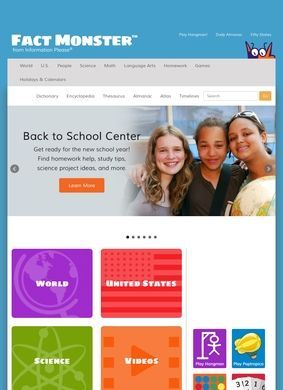
Where does a ten-year-old go when a homework question needs a quick, reliable answer and a full adult encyclopedia feels like too much? Fact Monster is built for exactly that gap. It is an online reference and homework-help site pitched at K-12 students, with parents and teachers as the second audience, and it pulls the tools a young researcher needs into one place instead of scattering them.
The core of Fact Monster is a set of classic reference works remade for children: an almanac, an atlas, a dictionary, and an encyclopedia. Around those sits a homework center that sorts material by school subject, plus a layer of games, quizzes, and flashcards meant to make what a child learns actually stick.
A whole reference shelf in one place
What Fact Monster gathers under one roof is the reference shelf a school library used to hold in print. A student can look up a country, define a word, or check a single fact without leaving the site.
The writing sits at a level a child can manage without an adult reading over their shoulder, and that self-serve quality is the point of the whole design.
The almanac and atlas
The almanac is the backbone. It is the format Fact Monster is modeled on, a dense store of facts, figures, records, and lists that a student dips into for a date, a statistic, or a name. The atlas handles geography through maps and country information, so a report on Brazil or Kenya has a place to start that does not send a child off to a separate mapping site.
Sports, history, and general trivia all suit this structure well, since so much of that material is naturally list-shaped and easy to look up by category. The almanac rewards browsing as much as searching, so a curious child can drift from one entry to the next and pick up facts nobody assigned, which is a quiet part of the appeal.
Dictionary and encyclopedia lookups
Sitting next to the almanac, Fact Monster keeps a dictionary and an encyclopedia for the two things students reach for most: what a word means, and a fuller explanation of a topic. The dictionary pitches definitions at a child's reading level.
The encyclopedia fills in the paragraph of background that a quick almanac line leaves out. Between the two, a young researcher can move from a one-line fact to a short article without ever opening a new tab, which keeps a distractible reader on task.
How the homework center is organized
The homework center is where Fact Monster turns from a plain reference into a study aid. Instead of making a child guess which book to open, it groups everything by the subjects printed on a report card, then lets the student walk straight to the right shelf.
It is a small organizing idea, and it removes the friction that stalls a young researcher before they have even started. A subject-based menu matches how a student already thinks about an assignment, since the class comes with a name attached well before the specific question does.
Subjects from math to science
The subject sorting is the practical heart of the site. Math, history, science, geography, and sports each get their own lane, so a child working on a science assignment lands among science material without wading past everything else first.
That mirrors how school works, one subject and one task at a time, and it makes Fact Monster fast to navigate for a student who already knows which class the question came from. A parent helping with homework can point a child to a subject and trust that what turns up belongs there.
Games, quizzes, and flashcards
The other half of the promise is that learning should be entertaining, and Fact Monster leans on games, quizzes, and flashcards to deliver it. Math fact flashcards drill the basics through plain repetition. Quizzes turn reading into a small contest, which holds a young attention span far better than a block of text.
The games give the site a reason to stay open on a screen that a child does not experience as strictly homework, and that soft edge is a real part of why Fact Monster works for the age group it targets.
Who gets the most out of it
The site knows its audience. Fact Monster works best for elementary and middle school students who need a safe, readable, single-stop reference, and for the parents and teachers steering them through an assignment. For that band of users, the mix of a controlled reading level and a predictable layout is genuinely useful, because a child can get real work done without an adult standing over every step.
Older high school students will outgrow parts of it, because the writing aims young and the encyclopedia depth is deliberately shallow next to an adult reference. That is a design choice, not a defect, though it does put a ceiling on how long a growing student keeps needing the site.
Its strength is breadth in one tidy package. A child can research a country, drill multiplication, define a word, and take a quiz without hopping between five different sites, and everything on Fact Monster is filtered for a school-age reader. The cost of that convenience is depth. A student who needs a serious, citable source for a longer high school essay will run into the limits of what a reference built for children can offer.
Against a general resource like Wikipedia, Fact Monster makes a clean trade. Wikipedia goes far deeper and covers vastly more ground, but it is written for adults and comes with no guardrails, while Fact Monster hands a younger student a curated, age-appropriate take on the same basic questions, arranged the way school actually asks them. That narrower focus is exactly why a K-12 researcher gets more done here than with the bigger encyclopedia.