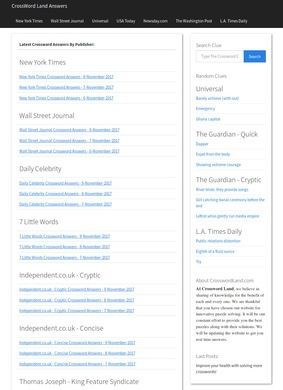
Crossword Buzz is a crossword site where you cannot solve a single crossword. It publishes answers, not puzzles.
That inversion is the whole idea. Someone stuck on a clue comes to Crossword Buzz to look up what fits, and the site hands over the solution, pulled from major puzzles like the New York Times, Universal, and others. There is no grid to fill in here, no timer, no daily puzzle to attempt. The product is the answer key, plain and simple, and the site never pretends to be more than that.
Answers instead of a puzzle to play
The format is simple and consistent. Every clue gets its own page, tagged with the puzzle it appeared in and the day it ran, and attributed to the source that supplied the answer.
Search a clue, land on its page, read the solution. For a solver who just wants to break one stubborn square and get moving again, that directness has a genuine appeal, and it is the reason a site like this exists at all.
Clue pages from the New York Times and Universal
The coverage aims wide. Crossword Buzz builds a page around each individual clue from the big syndicated puzzles, and the examples read like a cross-section of any given week: "Popular site for tech reviews," "Website with restaurant reviews," "Like some book reviews." One page is even built around the clue "Company with many reviews of itself," a fitting bit of self-reference for a tool whose entire job is answering questions.
Because every entry ties back to the puzzle it came from, a Times solver and a Universal solver each have a lane, and the attribution at least lets a user see where a given answer originated instead of taking it on blind faith.
The library is broad enough that obscure clues and everyday ones sit side by side, so a solver chasing a single word rarely has to work out which puzzle a clue belongs to before searching for it.
No searchable puzzle to solve
What the site does not do is let anyone play. No interactive grid appeared anywhere in the available content, no build-your-own feature, no solve-online mode. Crossword Buzz is a reference, opened the way you open a dictionary only when you are stuck. That narrows its audience sharply. People who want to sit down and work a puzzle have to bring the puzzle themselves and come here only at the moment they hit a wall, which is a fair description of how most of its visitors probably arrive.
There is a certain honesty to that limited scope. Crossword Buzz does not dress an answer key up as a puzzle experience. It tells a visitor plainly that its job is to supply solutions, and it leaves the question of whether looking them up counts as cheating to the person doing the looking.
A 24/7 promise and an anonymous team
Crossword Buzz makes a couple of sizeable claims about itself: nonstop uptime for a worldwide user base, and a stated mission behind the operation. Both sit right at the top of the site, ready for a visitor to take or leave.
They are worth taking at face value while noting, plainly, that neither one can be checked from the outside. What follows looks at each claim on its own terms.
Real-time updates for a global community
Crossword Buzz says it runs around the clock so that a worldwide community of solvers gets real-time updates, and it describes what it publishes as the "best answers for most crossword puzzles." The first half is believable. A database of clue pages does not sleep, fresh puzzles land every day, and continuous updating is exactly what this format needs to stay current. For a solver in a different time zone from a puzzle's publisher, that round-the-clock availability is a practical plus, since the answers are there whenever the grid is.
The second half is the bolder swing. There is no independent way to confirm how complete or how accurate that coverage really is, and "best answers for most puzzles" is the sort of line any lookup site could type into its own footer.
What the About page says
An About page lays out the mission, described as building tools that help users "find all the solutions for all the users." The phrasing is clumsy and slightly circular, and it tells a visitor almost nothing concrete about who runs the operation or how the answers are compiled.
The page's other main move is to encourage people to share Crossword Buzz with others. Beyond the stated mission and that nudge, there is very little face to the whole thing.
How much to trust it
This is where Crossword Buzz gets harder to grade, and being blunt about it serves a reader better than hedging.
Contact is the first gap, and it is a wide one. No phone number, no email, and no postal address surfaced anywhere in the available material, and while there is an About page, there is no contact page and no visible route to reach a person behind the site. For a free tool that mostly wants you to look something up and pass the link along, a lot of users will genuinely not care.
Even so, the total absence of contact detail keeps Crossword Buzz anonymous, and that anonymity is a fair mark against it for anyone who prefers to know whose work they are leaning on.
Then there is a housekeeping flag. A third-party site checker reports the domain's SSL certificate as expired, while at the same time giving the domain a clean bill on malware and phishing. On a site that asks for no logins and takes no payments, a lapsed certificate is a low-stakes fault. But it points to maintenance that has slipped somewhere, and slipped upkeep is an awkward look for a tool that wants to be trusted on the accuracy of what it publishes.
It is the sort of small neglect that a careful visitor tends to read as a hint about how the rest of the operation is run.
As for outside reviews, the search came up empty. No independent write-ups of Crossword Buzz turned up on the usual platforms, so there is no body of user feedback to weigh in either direction. The site is left to vouch for itself, and it does so almost entirely in claims about its own coverage and uptime.
Weighed honestly, Crossword Buzz is a functional, single-purpose tool wrapped in weak transparency. The lookup does what it says, the coverage of the major puzzles looks broad, and the answer-key format handles one narrow job cleanly. Set against that are an anonymous team, no way to make contact, a lapsed certificate, and no third-party reviews to back up the accuracy it advertises. None of those flaws breaks the tool; together they cap how much confidence it has earned.
The practical use is narrow: paste in the exact clue wording, take the answer it returns, and get straight back to the grid, which is exactly what someone stuck on one clue needs and nothing more. Playing an actual puzzle, or knowing who stands behind the answers before trusting them, calls for a different kind of site, one with more of a face behind it than this one shows.