The appointment ends with a name nobody in the family has heard before. The specialist spells it out, someone writes it on the back of a parking receipt, and the searching starts that same evening: two journal abstracts, a forum thread that went quiet years ago, a results page that thins out fast. Whatever answers exist are scattered across medical literature and specialist centers, and none of them were written for the kitchen table.
A rare disease brings that scarcity with it almost by definition. Few people have the condition and few clinicians have treated it, but the family needs something readable tonight.
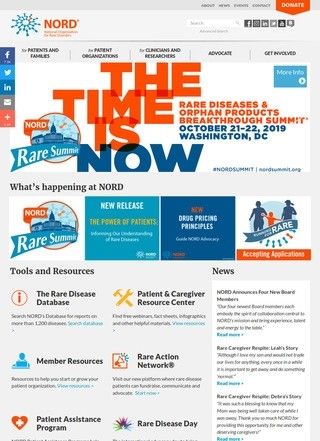
Rare Disease is the plain name on this listing, and the site behind it is the official web home of NORD, the National Organization for Rare Disorders, Inc. NORD is a 501(c)(3) nonprofit and a patient advocacy organization, and its principal public tool is pointed straight at that kitchen table: a searchable database of conditions, arranged A to Z, where an unfamiliar diagnosis can be typed in by name and read about at length. The advocacy identity and the reference tool are two halves of one operation, and the site makes more sense with both in view.
A nonprofit built around patient advocacy
The mandate is stated without decoration. NORD works for individuals living with a rare disease and for the caregivers around them, the people who land on a site like this in the first hard week after a diagnosis. It also works for the organizations that serve those individuals, which puts small patient groups inside its audience alongside families. Groups devoted to a single condition are treated as a constituency in their own right, and that says a good deal about how NORD positions itself: behind patients, and behind the groups that stand behind patients.
Everything else public on the site hangs off that advocacy mission, the rare disease database included.
The tax status is not a footnote. A 501(c)(3) runs on outside support, and this one says so on the site itself, in ways a visitor can act on.
Run on donations and volunteer time
NORD is a charity, and the site treats prospective donors and volunteers as part of its audience, on the same footing as readers. Donations are handled on the site itself, with Stripe and PayPal doing the payment processing, the same two processors a donor has already met everywhere else online. Volunteering is listed as the other way to support the work, for anyone whose contribution is time instead of money. None of that is exotic, and it does not need to be; the collecting happens where the reading happens, on the organization's own pages.
The overlap is the point. A reader who came for a single entry and decides to give can do so on the spot, and the rare disease patients that money supports are the same community the database serves. The pitch is unusually clean: the case for giving is the database itself, sitting right there to be judged.
Inside the list of rare diseases
The database anchors the site. It is an A to Z index of conditions, searchable by name, and each entry opens into a detailed reference page on one rare disease. Nothing about the arrangement is clever, and that is a compliment: an alphabet is the one structure that still works when a visitor arrives knowing nothing except a word copied down in a hurry. It is also a broad net by design, where the obscure entry gets filed under its letter exactly like the familiar one.
A visitor can search the name directly or walk the alphabet to it. The second route matters, because a condition heard once in a consulting room does not always get copied down correctly, and a letter can be browsed even when a search comes back empty, the sort of dead end a stressed family is likely to hit first.
Rare Disease Reports and outside sources
Entries are compiled in two layers. The first is NORD's own writing, the Rare Disease Reports it produces in house. The second is data drawn from other outside sources the organization treats as reliable, folded into the same entry alongside the house material.
For a rare disease, sourcing is most of the job. Case counts are small and the literature is thin, so a lone write-up can quietly drift out of date. Building each entry on house reports plus established outside data gives it more than one leg to stand on, and that editorial structure is the most convincing thing the site shows a first-time visitor. An entry backed by two layers can also survive the retirement of one author or the aging of one study, which matters in a field where a single condition may have only a handful of active researchers.
One entry format, four kinds of reader
The stated audience is wide: patients, caregivers, clinicians, and researchers, all pointed at the same reference entries on rare and orphan diseases. Those groups do not read the same way. A parent wants plain language and some sense of what happens next. A researcher wants precision and sources worth chasing. Asking one entry format to hold for all of them is a genuine editorial gamble, and the site takes it on every condition in the list, the well-studied and the barely documented alike.
The same rare disease entry is expected to answer a caregiver at midnight and a clinician between appointments. That is a lot to ask of one page. Some conditions will strain the format more than others, and a reader deep in one specialty may still end up in the primary literature; the entry at least gives that search a starting point and a vocabulary.
The word from that first appointment, whatever letter it starts with, goes into the search box like any other.