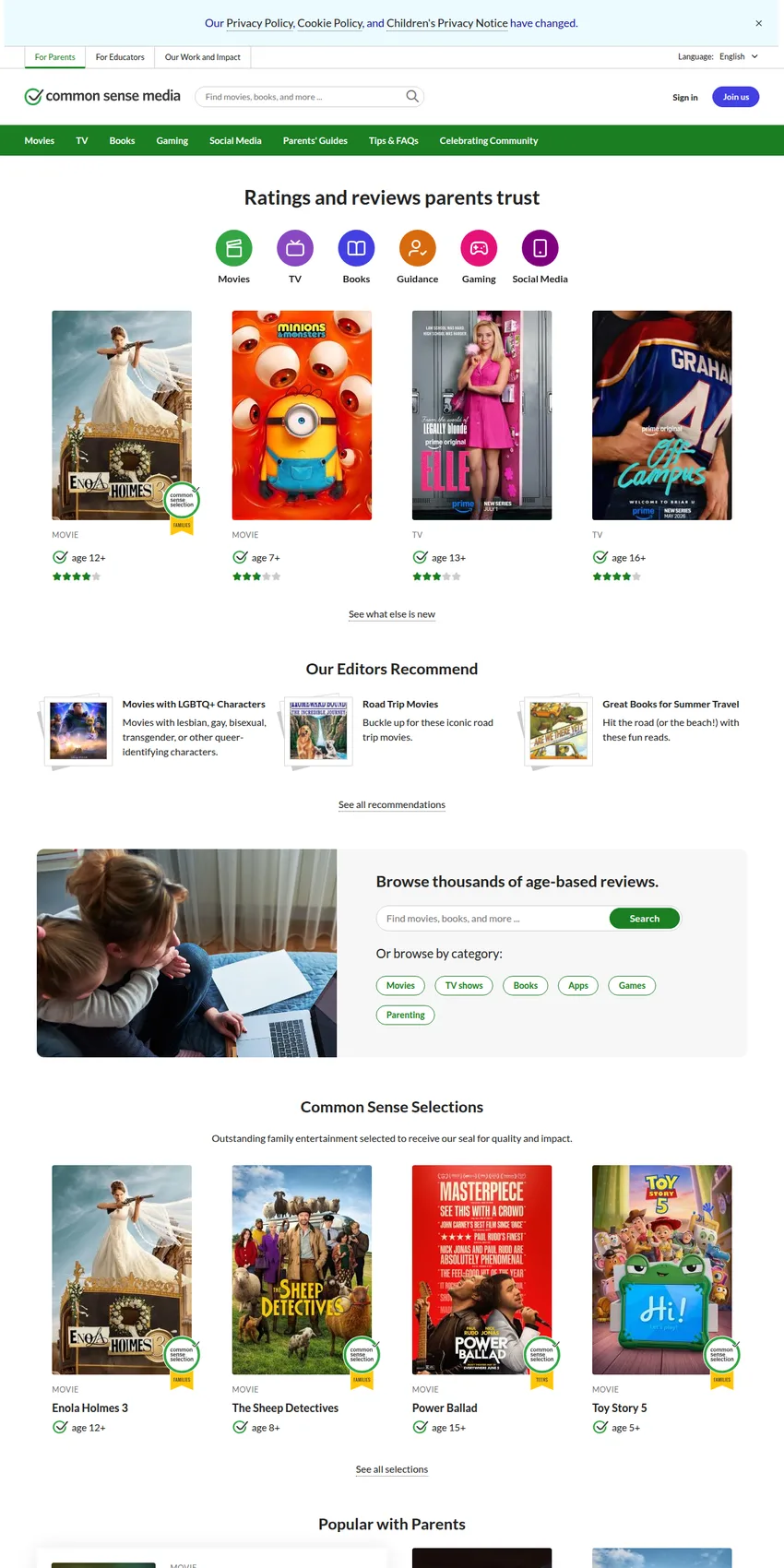
Common Sense Media is an independent nonprofit organization that maintains a large library of age-based reviews and ratings for the media and technology children use. Founded in 2003 by Jim Steyer, the group rates movies, television shows, video games, mobile apps, books, podcasts, and websites, and publishes each review with guidance on the youngest age for which a title is suitable. The catalog is organized so that parents, teachers, and older children can look up a specific title and read a structured summary of its content before deciding whether it fits a particular child.
Origins and organization
The organization was established in San Francisco as a 501(c)(3) charity and has grown into the reviewing arm of a wider group known simply as Common Sense. It operates on membership support, grants, and donations rather than advertising from the studios or publishers whose work it evaluates, and it states that its ratings are produced independently of those companies. Alongside the San Francisco headquarters it keeps regional offices in New York, Washington, Los Angeles, and Phoenix, which handle policy work, education outreach, and research in addition to the review operation.
Reviews are written by staff editors and trained reviewers who apply a shared methodology built with input from specialists in child development and media literacy. Parents and children also contribute their own ratings and comments on many titles, which appear separately from the editorial verdict. The result is a reference catalog rather than a news outlet, with each entry meant to stay useful long after a film or game is released.
How titles are reviewed and cataloged
Every reviewed title carries two distinct scores. The first is an age rating that names the youngest age at which the content is judged appropriate, on a scale that runs across childhood and into the teens, roughly from age two to eighteen. The second is a quality rating, shown as stars, that measures how good the title is on its own terms and is kept separate from the question of age. A film can therefore be marked suitable only for teenagers while still earning a high quality score, or be fine for young children yet rated as weak.
Age ratings and star quality
The age figure is not a copy of the industry rating from a body such as the Motion Picture Association. It reflects the reviewer's judgment about developmental fit, so a title rated PG by the film industry may receive a higher or lower age recommendation here. Because the two systems can disagree, the site explains its reasoning in the body of each review, letting a parent weigh the specific concerns rather than accept a single letter grade.
The content grid
Underneath the headline scores, each review breaks a title into a grid of content categories. These include violence and scariness, sexual content, strong language, drinking, drugs and smoking, consumerism, positive messages, positive role models, and the way the title represents groups by gender, race, disability, and background. A short paragraph under each heading tells the reader exactly what appears, for example whether violence is cartoonish or realistic and whether it carries consequences. This structured breakdown is what lets the catalog function as a searchable directory, because a family can filter titles by the issues that matter most to them.
Education and family programs
The organization runs a separate branch for schools under the name Common Sense Education, which distributes a free digital citizenship curriculum for kindergarten through grade twelve. The lessons cover online safety, privacy, cyberbullying, media balance, news literacy, and related topics, and the program reports reaching well over a million registered educators. Its design draws on the digital ethics research of Howard Gardner and the GoodPlay Project at the Harvard Graduate School of Education.
Curriculum and classroom tools
The curriculum is paired with interactive materials such as Digital Compass and Digital Passport, choose-your-own-path games in which students act out the perspective of characters facing online dilemmas and see how different choices play out. Teachers can download lesson plans, videos, and student activities, and the education site also reviews classroom apps and edtech products so that schools can check a tool before adopting it.
A privacy program evaluates apps and educational software against a set of questions about how they collect and share personal data, producing privacy ratings that sit alongside the content reviews. A research team publishes its own reports, including recurring national surveys of how tweens and teenagers use screens, which are cited by journalists, educators, and policymakers. Spanish-language reviews and family resources extend the same catalog to Latino families.
Place in a kids and teens directory
What ties these activities together is the underlying catalog. Common Sense Media is at its core a curated, searchable index of children's media, sorted by age, format, and content, with a consistent template applied to every entry. That structure is the reason it belongs in a directory of kids and teens resources rather than among general review blogs. A parent looking for age-appropriate films for a seven-year-old, a librarian building a reading list, or a teacher checking whether an app protects student data can all reach the same organized body of reviews and pull out the records that answer their question.






Business address
Common Sense Media
699 8th Street, Suite C150,
San Francisco,
California
94103
United States
Contact details
Phone: (415) 863-0600