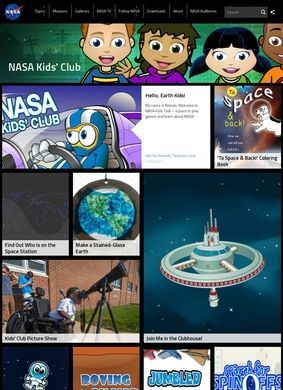
A space-themed clubhouse with a character called Nebula greets the youngest visitors here, and the games sitting inside it are built around real NASA missions: the Artemis program, the James Webb Space Telescope, Hubble, and the day-to-day operations aboard the International Space Station. Nasa Kids' Club aims squarely at children from pre-kindergarten through about fourth grade, roughly ages four to ten, and everything it offers stays free. The browser games are tied to national STEM standards across science, technology, engineering, and mathematics, which means a teacher can point a class at a single activity and trust that it lines up with what they are already meant to be covering.
Three core sections
The structure is simpler than the parent site, and that restraint suits the audience. Three sections carry most of the weight. Kids' Club Games holds the interactive pieces, where space concepts and mission ideas get turned into something a six-year-old can click through without reading dense text. Now in Space takes a cartoon approach to a genuinely current subject: the astronauts presently living on the ISS, presented in a way a small child can follow. Picture Show pulls from NASA's own mission imagery, so the galleries a child scrolls are the actual photographs the agency captured, not stock illustrations of what space might look like.
Real missions behind the games
What sets the games apart is their source material. Plenty of children's science sites invent a friendly cartoon planet and call it a day. The activities under Nasa Kids' Club draw on hardware and programs that are operating right now, which gives a parent an easy bridge from the screen to a news headline or a night-sky question. A child who plays through a mission game and then hears the words "James Webb" on the radio has a thread connecting the two, and that continuity is genuinely useful for the four-to-ten band, where attention is short and abstract ideas land hardest.
Keeping the interface simple
The interface keeps demands low. Reading is optional in the youngest activities, the navigation rarely buries a button two clicks deep, and the visual language stays consistent across the three sections so a child does not have to relearn the layout each time. None of this is flashy, and it does not need to be. A clubhouse built for a five-year-old succeeds when the child can find the next thing to do without an adult leaning over the keyboard, and on that test Nasa Kids' Club does well enough that a parent can step back after the first few minutes.
Guiding the youngest visitors
The pre-K end of the range is handled with some care. Activities meant for a child who cannot yet read lean on clicking, matching, and looking, and the space theme gives a unifying logic to it all instead of a grab-bag of unrelated mini-games. Keeping Nebula as a consistent guide is a sensible call, because a recurring character gives very young users a fixed point as they move between activities.
Scope and limits of the site
It is worth being plain about scope. This is a focused resource, not a deep curriculum. A fourth-grader near the top of the age band may move through the available games in Nasa Kids' Club faster than a kindergartner, and a family looking for sustained, level-by-level progression will find the offering shallower than a dedicated learning app. The trade is that nothing here costs money, asks for much, or wanders off into material unsuited to a young child. For a free resource carrying a national space agency's name, that is a fair bargain.
Linking to other NASA programs
One of the smarter aspects of Nasa Kids' Club is how openly it hands children off to siblings within NASA's education family once they outgrow it. NASA Space Place covers games, videos, and activities on space and Earth science for a slightly older bracket, so a child aging past the clubhouse has somewhere to go. Climate Kids takes the same approachable tone and applies it to climate change and Earth science, which is a subject many children's sites avoid or oversimplify. There are also grade-differentiated sections splitting content across K through 4 and grades 5 through 8, letting a parent or teacher match material to a specific year instead of guessing.
A path to older programs
That linking matters because it turns a small site into an on-ramp. A family that arrives for the games can follow a clear path outward as the child grows, and the destinations carry the same vetting and grounding in actual science. For a caregiver, the appeal is partly that decisions are made for them: the age tiers are spelled out, and the safe-environment framing is stated rather than implied.
Wider platform behind the clubhouse
The wider platform that holds Nasa Kids' Club extends well past anything a child needs, which is its own kind of reassurance for the adult in the room. NASA+ offers streaming video alongside a live mission-coverage channel, and there are podcasts, a searchable image archive, and virtual classroom programs connecting students with astronauts. Citizen science opportunities sit there too, for the rare young visitor who wants to do more than watch. None of that is aimed at a five-year-old, but it means the resource a parent trusts for the clubhouse is the same one feeding documentaries, real imagery, and classroom tie-ins for later.
Keeping the clubhouse safe online
Newsletter sign-up and social channels are there for parents and teachers steering the experience. The clubhouse at the center of Nasa Kids' Club stays deliberately walled off as a safe online space, with separate guidance for parents, teachers, and caregivers so the adults know what they are putting in front of a child.
What makes the sourcing different?
Set against most free educational content for this age, Nasa Kids' Club holds a clear edge in one respect: provenance. The pictures are NASA's pictures, the missions are NASA's missions, and the standards alignment is not a marketing line but a design constraint. A teacher hunting for a quick, on-topic activity for a primary class can lean on Nasa Kids' Club without doing their own fact-checking, which is more than can be said for a lot of the cartoon-science material floating around.
The flip side is that Nasa Kids' Club rewards a visit more than a stay. A child will exhaust the core games before long, and the real depth lives in the properties Nasa Kids' Club links to and in the broader nasa.gov material that a parent navigates on the child's behalf. Treated as a launching point rather than a destination, it does its job. The games are clean, the imagery is real, the age targeting is honest, and the handoffs to Space Place, Climate Kids, and the grade-banded sections are right there when a child is ready for them.
For a household with a curious four-to-ten-year-old, the practical value of Nasa Kids' Club is that it asks nothing and delivers content a parent can hand over without a second thought. The space framing gives even the simplest matching game a reason to exist, and the line running back to Artemis, Hubble, Webb, and the crew on the station means a child is playing with the genuine article instead of a watered-down stand-in. A kindergartner clicking through Picture Show is looking at photographs taken by spacecraft that are out there now.