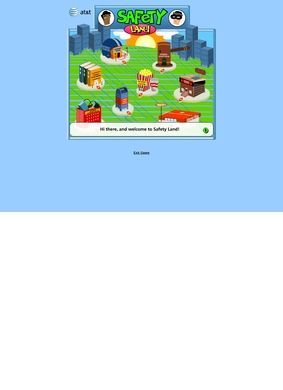
Safety Land was the centerpiece here: a browser-based game built for elementary school children, hosted on AT&T's own website, with the single job of teaching kids the basics of staying safe online. The AT&T Internet Safety Connections Game sat inside a wider program that paired this interactive piece with an online resource center and a printable companion guide aimed at parents and educators. The game was free to play, ran in the browser without anything to install, and was framed as part of a continuing effort tied to what was then AT&T Yahoo! High Speed Internet service. For a corporate site, the ambition was modest and clear: get young children comfortable with a handful of safety habits before they ran into trouble on their own.
How the game paired lessons with adult resources
The educational angle is the part that holds up best. Rather than dumping a wall of rules on a child, the AT&T Internet Safety Connections Game wrapped its lessons in a playable format, which is the right instinct for the age group it targeted. The accompanying PDF, titled "Internet Safety Connections," gave grown-ups something structured to work from, so a parent or a classroom teacher could reinforce the game with a lesson plan instead of leaving the child to absorb it all alone. That pairing of a kid-facing game and an adult-facing guide is a sensible piece of design, and it explains why the resource found a second life outside AT&T's marketing channels.
From educational platforms to school districts
That second life is worth dwelling on. The game's URL turns up linked from educational platforms like LessonPaths and from school district pages, including ESC Region 19, which points to genuine use in K-12 settings well beyond AT&T's own channels. When teachers and curriculum curators bookmark a free tool and pass it around, that is a stronger signal of usefulness than any blurb a company writes about itself. The AT&T Internet Safety Connections Game clearly landed on real lesson lists, and for a corporate giveaway that is a respectable outcome.
Current status and technical access
This is where the listing gets complicated, and where any honest assessment has to slow down. At the moment the page does not load cleanly. Direct requests return a 403 and a proxy fetch returns a 500, so the original Safety Land experience cannot be confirmed as live and playable right now. That alone would not sink a resource of this kind, since old promotional pages break for all sorts of technical reasons, but the surrounding evidence suggests something more permanent than a temporary outage.
Shifting toward ActiveArmor security suite
AT&T's safety offering has moved on. The whole ecosystem that once held the AT&T Internet Safety Connections Game has been folded into AT&T ActiveArmor, a security suite built around call screening, mobile threat defense, and home network protection delivered through the ActiveArmor app and the Smart Home Manager app. The old game URL now appears to redirect toward or overlap with ActiveArmor promotional material. The broken fetch and the corporate pivot point the same direction: the original children's game is most likely no longer maintained, and a visitor following this link is more apt to land on a modern cybersecurity pitch than on the cartoon safety lessons the listing describes.
That shift makes sense from AT&T's perspective. A simple browser game built for grade-schoolers a good while ago does not fit neatly into a present-day security product line, and ActiveArmor addresses a different, broader set of threats for the whole household. The trade-off is that the specific, child-focused teaching tool that gave this entry its identity seems to have been quietly retired in favor of something more commercial. It happens. Corporate priorities shift and old microsites get folded or killed, regardless of how useful they were to teachers.
So the value of the AT&T Internet Safety Connections Game today is mostly historical and contextual. As a record of how a large carrier approached children's online safety, and as a link still embedded in some teaching resources, it has documentary worth. As a working game a parent can sit a child down in front of this afternoon, it is shaky at best, and possibly gone. Anyone arriving with the second expectation should brace for disappointment.
It helps to be precise about who this still serves. A teacher auditing an old lesson-plan link will want to test it before assigning it, because a dead or redirected URL in a curriculum is worse than no link at all. A parent hunting for a current internet-safety game for a young child would be better served looking elsewhere, since fresher options exist and this one's status is uncertain. A researcher or anyone curious about the evolution of AT&T's safety messaging, on the other hand, will find the trail genuinely interesting: the path from a standalone game and a parent guide to a subscription-flavored app suite tells a small story about how online-safety thinking changed over roughly two decades.
What the AT&T Internet Safety Connections Game did well, while it was current, deserves credit. It was free, it required no sign-up, it spoke to children in their own register, and it gave adults a structured handout to back it up. Those are the marks of a thoughtful public-good gesture from a company that did not strictly need to make one. The initiative tied product enhancements to child and parental safety, which suggests the effort was more than a one-off marketing checkbox at the time it launched.
No third-party review trail turned up for the AT&T Internet Safety Connections Game on the usual rating platforms, which is not surprising for a free corporate education tool from this era. School adoptions and curriculum links are the real-world signal here, and those exist. The AT&T Internet Safety Connections Game was never the kind of product that generates Yelp reviews; it was the kind that ends up cited in a district technology committee's approved-resources list, which is a different kind of endorsement and arguably a more honest one.
The verdict on the AT&T Internet Safety Connections Game lands lukewarm, and the reason is availability, not quality. Judged on what it set out to do, the AT&T Internet Safety Connections Game was a clean, useful, free piece of children's education with a sensible parent companion and a real footprint in schools. Judged on whether it delivers that experience to someone clicking through today, it is a question mark leaning toward a no. If the AT&T Internet Safety Connections Game still loaded as built, this would be an easy recommendation for the early-elementary crowd. As things stand, verify the link works before counting on it for anything practical.