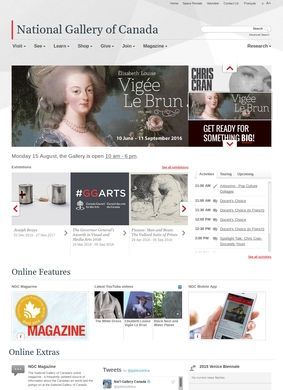
Asking what a national art museum actually holds, and whether its website is a useful way in, the National Gallery of Canada answers both questions without much ambiguity. The collection covers Canadian art from the historical to the contemporary, Indigenous work spanning First Nations, Inuit and Metis makers, European paintings and sculpture, photography, and multimedia installations. That is a wide brief, and the site sorts it into permanent galleries and rotating exhibitions so a visitor can tell what is always on view from what is passing through.
Location and hours
Founded in 1880, the Gallery sits on Sussex Drive in Ottawa in a building that is itself notable, all glass and granite near the river. The museum is open Tuesday through Sunday from 9:30 a.m. to 5 p.m., with extended hours on Thursday evenings, and from April through September it adds Monday to the rotation. Anyone planning a trip can read those details straight off the page, which spares the usual guesswork about whether a given day is worth the drive into the capital.
Events calendar and online magazine
Beyond the exhibition listings, the National Gallery of Canada runs a public events calendar that goes well past the standard guided tour: artist talks, plein air classes, and studio sessions where people make art rather than only look at it. There is an online magazine too, with editorial writing on current shows and the artists behind them, giving the collection context for readers who want to understand a work before they stand in front of it. Neither of these features is especially trumpeted on the homepage; you come across them by browsing, which is both a mild usability note and a sign of how much the site holds.
Lending art across the country
The touring exhibitions and loans program is one of the less obvious features and one of the more interesting. The National Gallery of Canada lends works to institutions across the country, so its holdings reach people who may never get to Ottawa. That outward reach says something deliberate about how the museum sees its role: a national collection in practice and in name together. For anyone tracking where a particular piece has travelled, the program is the thread to follow.
Library and archives access
Researchers get their own door. The Library and Archives are open to the public, with a reading room free and available Monday to Friday from noon to 5 p.m.; deeper archive access is arranged by appointment. That is a genuine resource for students, writers and historians, and the reading room costs nothing, lowering the barrier for anyone doing serious work on Canadian or Indigenous art history.
Admission fees explained
On the practical side, admission is charged for special exhibitions while general access follows standard museum policy. Free admission is offered to Indigenous Peoples, a point the National Gallery of Canada states plainly rather than burying in small print. The Canada Strong Pass, running June through September, opens up affordable seasonal access. A Boutique rounds out the on-site offering for those who want to take something home.
Media hub for press
There is also a media and press releases hub aimed at professionals, the kind of section journalists and arts writers reach for when a new show opens. It is built for a purpose, and its presence shows the National Gallery of Canada treats its public communications as part of the operation.
Indigenous art in the collection
The range is genuine, and that is what separates this from a museum site that is really just a schedule with a gift shop listed at the bottom. A person could come for a single blockbuster exhibition, settle in for an afternoon across centuries of painting and sculpture, or skip the galleries and spend the day in the reading room. The Indigenous art holdings are treated as a core part of the collection, not an addition. First Nations, Inuit and Metis work is named alongside the European and Canadian material throughout, which reflects a deliberate shape to what the museum collects and shows, not a retrofit.
Building return visits
The events programming is what turns a visit into something repeatable. A plein air class or a studio workshop is a reason to come back that a permanent collection alone does not give. Pair that with the editorial magazine and the National Gallery of Canada is clearly trying to keep people engaged with art on a continuing basis. The contact centre operating daily, holidays included, fits that same posture.
Checking online reputation
On outside reputation, a Google search for the National Gallery of Canada returns substantial press coverage, institutional reviews and visitor accounts across travel platforms, with the volume consistent with a major public institution. No meaningful negative pattern shows up in the results, and the Google rating reflects a high volume of visitor responses.
Is the website easy to navigate?
If there is a caution, it is the one that comes with any museum this large: the website carries a lot, and a first-time visitor may need a few minutes to find what they are looking for, whether that is a current show, a research request, or a class booking. The information is there. It rewards a little patience.
Taken together, the National Gallery of Canada is a deep resource, with the historical collection, the Indigenous holdings, the loans program and the open archive each doing distinct work. It is a destination for the art itself and a working resource for anyone studying it.