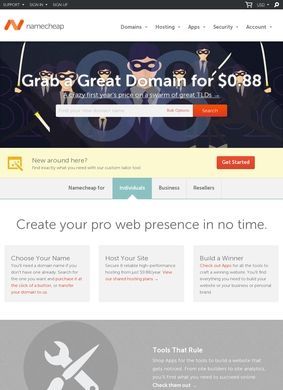
Namecheap is an ICANN-accredited domain registrar and web hosting company that has run out of Phoenix, Arizona since 2000. The name sets the expectation, and the catalog mostly lives up to it: domains across hundreds of extensions, from .com, .org and .net to .co, .me, .app and a long list of newer endings, all registerable for up to ten years at a stretch. That domain side is the historical core, and it still feels like the part Namecheap knows best.
Domain registration and hosting services
Hosting is the other half of the operation. Shared plans open at roughly $1.58 a month, which is about as low as the legitimate end of this market goes. Above that sit managed WordPress hosting, VPS plans for people who want a configurable slice of a server, dedicated machines for anyone who needs the whole box, and reseller hosting for designers and agencies who fold hosting into their own client billing. The range is wide enough that a hobbyist registering a first domain and a web shop running a dozen client sites can both find a plan without leaving the account.
Supporting tools for websites
Around those two pillars sits a stack of supporting tools. SSL and TLS certificates are sold here, private email hosting is available for anyone who wants mail tied to a custom domain, and DNS management is handled in-house. WhoisGuard adds free domain privacy, keeping a registrant's name and address out of the public WHOIS record at no extra charge, which some competitors still treat as a paid upsell. There is two-factor authentication for account security, a marketplace for buying and selling domains on the secondary market, and a logo and design maker for people building a brand from scratch.
Pricing structure
The audience is fairly clear from the product mix. Individual developers, small and medium businesses, and freelance designers and agencies get the most out of it. Pricing is the loudest selling point, and it cuts two ways. First-year promotional rates on both domains and hosting are genuinely aggressive, low enough to make signup almost an impulse decision. What separates Namecheap from a lot of cheap registrars is that renewal pricing stays comparatively sane, so the second year does not arrive with the brutal markup that catches people off guard elsewhere. TechRadar's editorial review landed on the same read, calling the pricing genuinely competitive rather than bait numbers.
Performance and user reviews
That is the fair worry with anything priced this low, and the outside evidence is reassuring without being spotless. HostAdvice ran an in-depth performance review and recorded 100 percent uptime on 29 of 31 tested days, a strong showing for a budget tier. A reputable editorial test counts for more here than Namecheap's own uptime guarantee, since the tester has no reason to flatter the result.
The crowd verdict is harder to summarize because it pulls in two directions. On Trustpilot, Namecheap carries around 21,000 reviews, which is the kind of volume that smooths out individual flukes and gives a rating real substance. TrustRadius adds a set of verified user reviews on top of that. Then there is Reddit, where a thread on r/Hosting ran to over a hundred comments with clearly mixed sentiment, some users loyal for years and others frustrated with support escalations or specific outages. That split is normal for any host operating at this scale, and it is more honest than a wall of uniform praise would be. A 2026 Cybernews editorial review pointed specifically to live chat as a strength of the Namecheap support experience.
Customer support options
Support is worth pausing on, because it shapes how the low price actually feels in practice. Help runs through 24/7 live chat and a ticketing system, backed by a knowledge base deep enough to answer most routine domain and DNS questions before a human is needed. One thing to set expectations on: there is no phone number posted on the main site, so anyone who strongly prefers talking to a person by voice will be steered toward chat instead. For a primarily online, self-serve product that is a defensible choice, and the round-the-clock chat coverage softens it, but it is a real difference from hosts that publish a hotline.
Operational transparency
Where Namecheap reads as trustworthy is in the small operational honesty of the offering. Free WHOIS privacy instead of a paywalled add-on, renewal rates that do not punish loyalty, and DNS kept under its own roof are the sort of details that tell you the company expects customers to stick around and read their invoices. None of that is glamorous. It is the unglamorous stuff that decides whether a host is a one-year fling or a place you park a domain portfolio for a decade.
Limitations of budget hosting
There are limits worth naming plainly. The bargain shared hosting is shared hosting, with the performance ceilings that implies, and a serious production site will eventually want the VPS or dedicated tiers. The mixed Reddit chatter means support quality is not perfectly consistent, and the absence of a published phone line will annoy a slice of users no matter how good the chat is. None of these sink the proposition. They just mark the edges of what a budget-first provider can promise.
Taken together, the picture is of a long-running registrar that grew a competent hosting business beside it and kept prices honest on the way through. The breadth covers a first-time domain buyer and a small agency reseller alike, third-party testing backs the uptime claims, and the pricing structure rewards staying rather than punishing it. Namecheap is not the right fit for every use case, particularly where phone support matters or where a production site will quickly outgrow shared infrastructure. For most individuals and small businesses weighing where to register a domain or stand up an inexpensive site, the case is solid and the caveats are the ordinary ones you get anywhere at this price point.