A nonpartisan research organization
Pew Research Center is a nonpartisan organization that reports on public opinion, demographic trends, and social issues in the United States and abroad. It describes its own work as that of a "fact tank," a body that supplies data rather than argues for a particular course of action, and it does not take positions on the policy questions it studies. The Center is a subsidiary of The Pew Charitable Trusts, its main funder, and it began operating under its current name in 2004, gathering together survey projects that had run separately through the 1990s and early 2000s. Its research reaches the public through reports, short data pieces, interactive tools, and datasets that other researchers can download and reuse.
The organization works across several subject areas, among them U.S. politics, religion, science, the news media, race and ethnicity, and the internet and technology. Its methods combine large sample surveys, analysis of government and commercial data, and content analysis of media and online material. Much of the survey work now runs through the American Trends Panel, a group of randomly recruited adults who answer questions over time, which lets the Center measure how attitudes shift rather than take a single snapshot. Results are published with the sample size, the dates of fieldwork, and the margin of error attached, so a reader can judge how much weight a figure carries.
Research on online dating
For a directory of dating resources, the Center's value is its long record of measuring how Americans actually use dating sites and apps and what happens to them there. Since the middle of the 2000s it has returned to the subject every few years, tracking the shift from early matchmaking websites to phone apps and swiping. This body of work gives users of a dating directory an independent, non-commercial read on the kinds of tools listed elsewhere in the category.
What the surveys have found
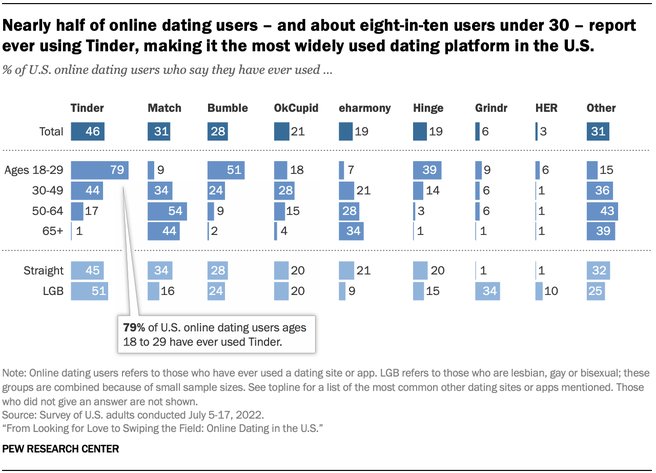
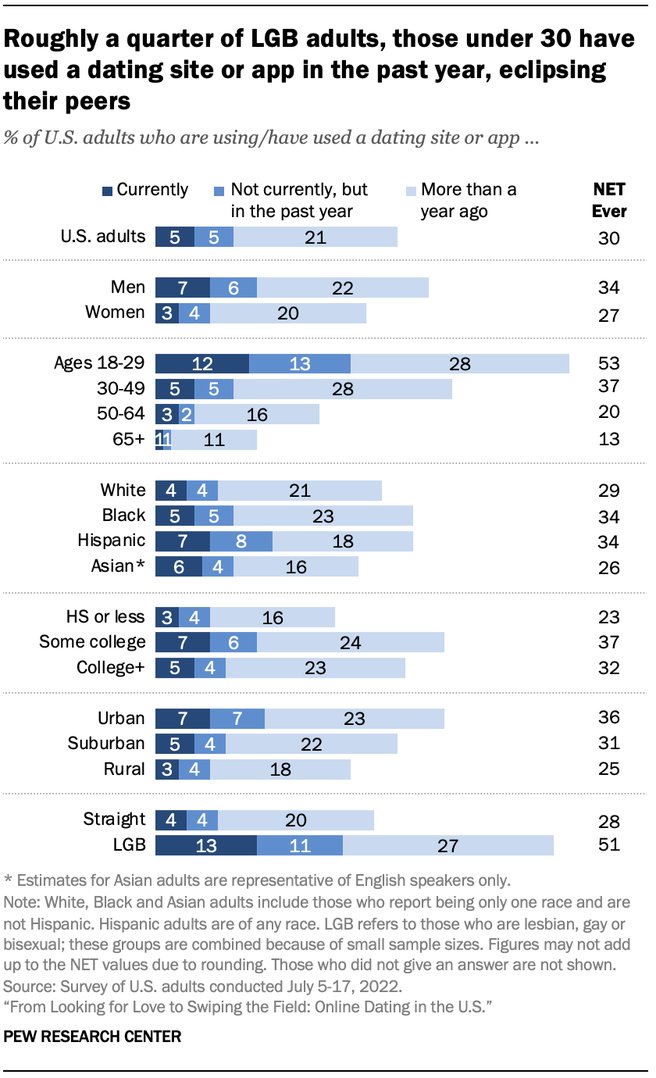
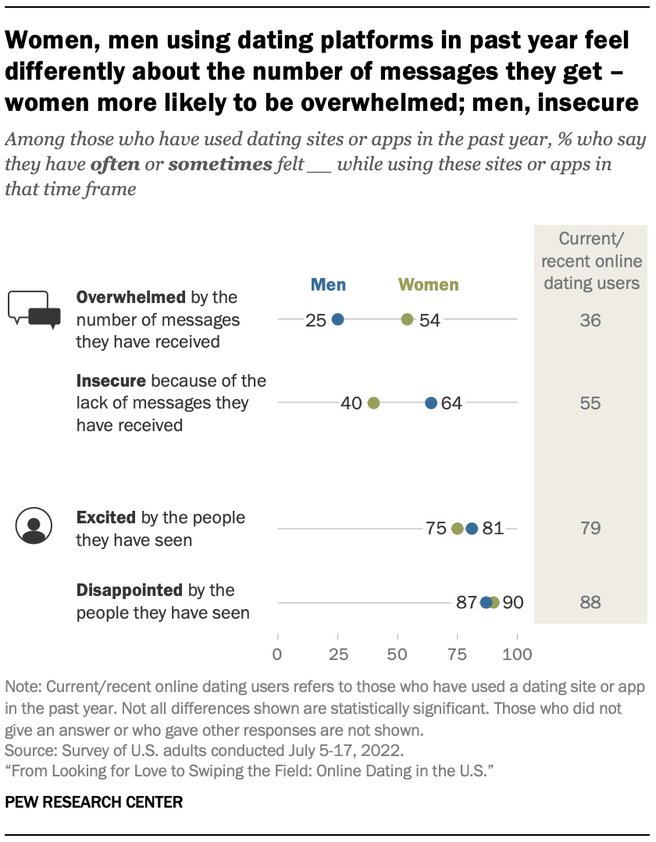
A survey conducted in July 2022 and published in February 2023 found that three in ten U.S. adults said they had ever used a dating site or app. Among people who had used one, Tinder was the most common, named by 46 percent of that group. An earlier study, published in 2020, reported that 12 percent of adults had married or entered a committed relationship with someone they first met through a dating site or app. The Center has also asked users to weigh the experience itself, recording both people who found it easy to meet others and people who found the process frustrating or unsafe.
Harassment and safety findings
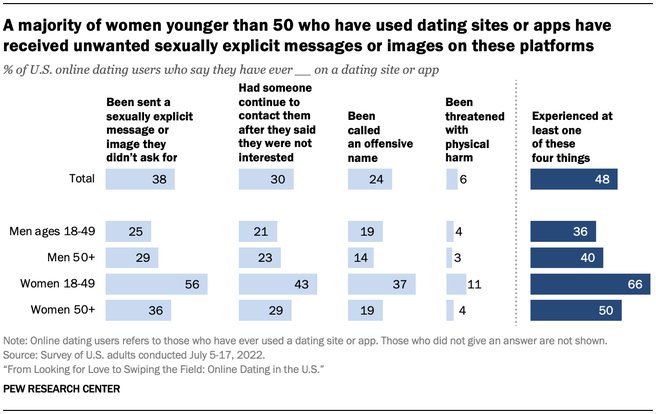
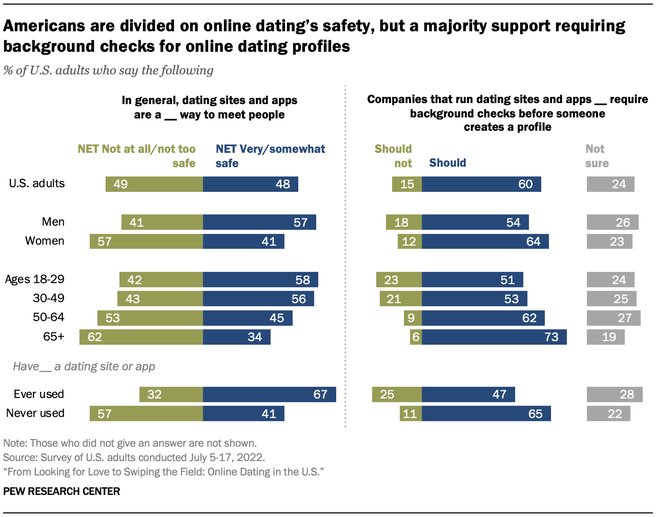
Part of the dating research measures unwanted and hostile behavior, which is the reason a safety-minded directory points to it. The 2023 report found that 38 percent of users had been sent a sexually explicit message or image they did not ask for, 30 percent had someone keep contacting them after they said they were not interested, 24 percent had been called an offensive name, and 6 percent had been threatened with physical harm. About half of all users, 48 percent, had met at least one of these four behaviors. Women under 50 reported them at markedly higher rates than men, a pattern the Center has documented across several of its dating and online-harassment studies. Because these numbers come from a research body with no stake in any dating service, they give readers a baseline for weighing risks that the category's commercial listings do not usually describe.
How the material can be used
All of the Center's reports are free to read and are written for a general audience as well as for specialists. Each dating study is accompanied by a topline questionnaire and a methodology statement, and many are paired with a shorter key-findings piece that pulls out the main numbers. Datasets from many studies are released after an embargo period so that academics, journalists, and other analysts can run their own checks. The Center does not sell the data or endorse any product, which keeps its dating research separate from the marketing claims that surround the services themselves.
Beyond dating, the same survey machinery covers online harassment, teens and technology, privacy, and attitudes toward artificial intelligence, so a reader who arrives through the dating material can follow related questions about life online. The Center employs survey methodologists, data scientists, and subject-area researchers, and it publishes methodological notes explaining how it recruits panels, weights samples, and protects the identity of respondents.
The Center is based in Washington, at 901 E St. NW, Suite 300, Washington, District of Columbia 20004, and its main telephone line is +1 202-419-4300. Media questions are handled through its communications office and general inquiries through the address published on its contact page. As the polling record of who dates online, how they fare, and what they run into, its work supplies the research layer that sits alongside the dating directories grouped in this category.

Business address
Pew Research Center
901 E St. NW, Suite 300,
Washington,
District of Columbia
20004
United States
Contact details
Phone: +1 202-419-4300