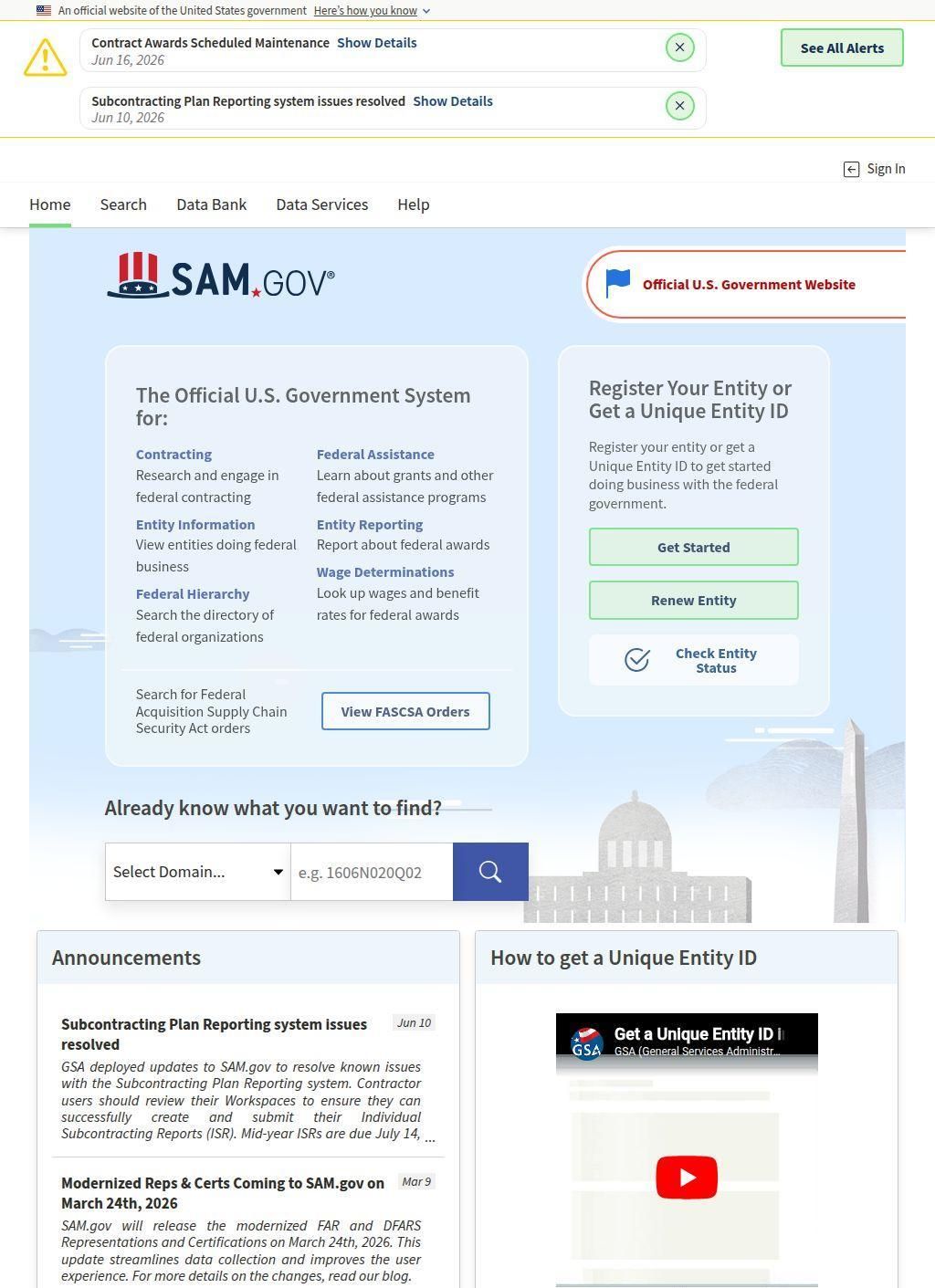
Federal contractors and grant seekers run into SAM.gov (System for Award Management) early, because the site is the gate through which all of them must pass. Registration here is a precondition, not a formality. Administered by the General Services Administration, the portal absorbed a collection of older federal systems into one interface. CCR, FedReg, ORCA, EPLS, FBO, FPDS. Each of those once required a separate login and a separate mental model. They now flow through a single account, and the practical result is that anyone pursuing federal money has one address instead of six.
Entity registration and unique identifiers
The most concrete thing SAM.gov (System for Award Management) does is issue a Unique Entity ID. That number replaced the old DUNS system and is the spine connecting an organization to every later federal transaction. Whether the registrant is a commercial firm, a nonprofit, or an individual chasing a grant, entity registration comes first and nothing downstream works without it. The site does not offer a shortcut around this, nor does it pretend one exists.
Contract Opportunities is the section that draws the most traffic. It holds solicitations, presolicitation notices, sources-sought postings, and award notices for work above the simplified acquisition threshold. Anyone familiar with FedBizOpps is looking at the same function under a different roof. The Federal Assistance Listings catalog sits alongside it, absorbing what the old CFDA used to do, so the grant side of the federal funding picture lives here too, with every assistance program documented in one searchable repository. SAM.gov (System for Award Management) was designed to be the authoritative source for both, and the breadth of what it holds is the strongest argument that one portal can carry both jobs without either suffering.
Opportunities, assistance listings, wage data
The supporting machinery is where SAM.gov (System for Award Management) earns sustained use. Wage Determinations under the Service Contract Act and the Davis-Bacon Act are published here, which matters to anyone pricing labor on a federal job. Pricing a service contract without the right wage determination is a direct path to a non-compliant bid, and having these labor standards inside the same system as the opportunity itself saves a step that can otherwise be missed. The Representations and Certifications module lets a firm self-certify the clauses that attach to a government contract, and the Exclusions database is the public record of entities that have been debarred, suspended, or otherwise barred from receiving awards. Checking that list before partnering with a subcontractor is basic due diligence, and SAM.gov (System for Award Management) makes it free and immediate.
Labor standards and compliance checks
For researchers and grant administrators, the same backbone supports a Federal Hierarchy directory that maps agencies and their subcomponents, plus reporting tools for subcontracting plans and federal award data. Someone tracking where federal money goes can pull from these tools without ever submitting a bid. The Exclusions and Wage Determinations features tend to get overlooked by people who arrive only to find a solicitation, but they are the parts a careful contractor learns to use early. Neither is glamorous. Both prevent expensive mistakes.
From legacy systems to single registration
Consolidating seven legacy systems into one interface solves a discovery problem and creates a navigation one. A first-time registrant facing entity validation, UEI issuance, and Reps and Certs in sequence is doing real administrative work, and the learning curve is steep enough that an entire cottage industry of consultants exists to walk people through it. SAM.gov (System for Award Management) does not hide this; the complexity is the price of putting everything in one place, and the site makes no attempt to disguise it with simplified onboarding.
Public API for federal spending data
There is also a public API. SAM.gov (System for Award Management) exposes contract opportunities, entity data, and assistance listings in machine-readable form, which is what makes large-scale federal spending analysis and third-party tools possible. Many of the commercial bid-tracking services that market themselves to contractors are, underneath, reformatting data that originates here. Going directly to SAM.gov (System for Award Management) costs nothing and removes a layer between the user and the authoritative record.
Set against a commercial aggregator like GovWin IQ, the trade-off is clear enough. GovWin layers analytics, early intelligence, and a more polished dashboard on top of federal data, and for a large contractor the subscription can pay for itself. But much of what it surfaces traces back to feeds that SAM.gov (System for Award Management) publishes for free. A small firm or a researcher who needs the authoritative record rather than predictive analysis is better served going directly to the government source. SAM.gov (System for Award Management) is not optional for anyone serious about federal work, and that changes how its quality gets judged. A reviewer cannot recommend skipping it, because there is nothing to skip to.
The honest assessment of SAM.gov (System for Award Management) is about whether the consolidation across all those legacy functions pays off. On balance it does. One registration, one identifier, one repository for opportunities and assistance, one place to verify exclusions and pull wage data. The interface asks for patience, and the volume of certifications can overwhelm a newcomer, but the alternative of chasing seven disconnected systems was demonstrably worse. The polish lives elsewhere. The authoritative federal record lives here.
Business address
U.S. General Services Administration
1800 F Street NW,
Washington,
DC
20405
United States
Contact details
Phone: 1-866-606-8220