An aggregator of open-access research papers
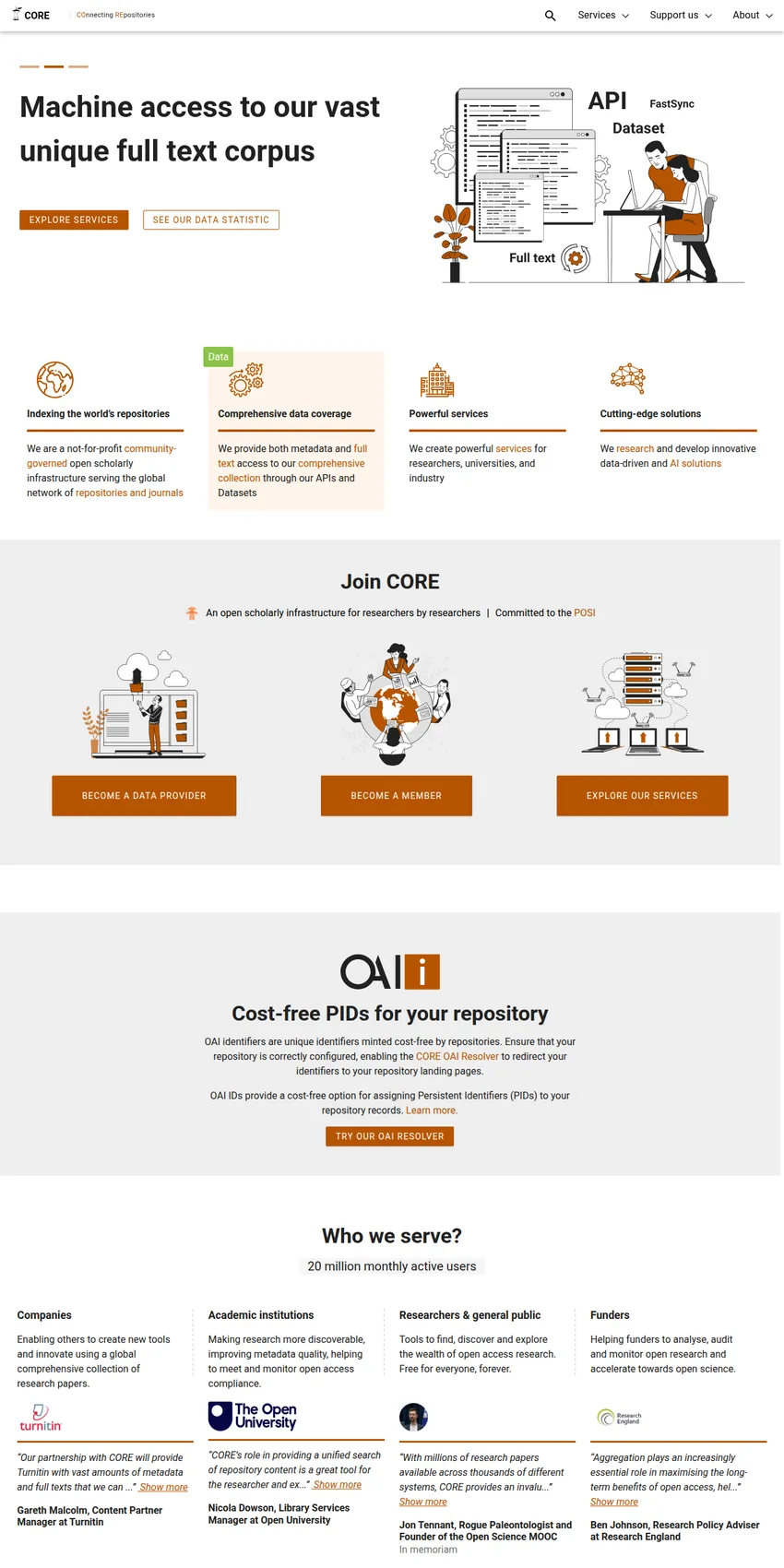
CORE is a service that gathers open-access research papers from around the world and makes them searchable in one place. It collects records from thousands of repositories and journals, stores a description of each item, and where the full text is freely available it provides a link to it or keeps a copy on its own servers. The result is a single catalog that a reader can query instead of visiting each repository one at a time. CORE describes itself as the largest collection of open-access research papers, and its published figures support a claim to very large size.
The service fits the article-directory category because its purpose is to index and point to scholarly articles rather than to publish them. A researcher who searches CORE receives a list of matching papers with author, title, year, and source, and then follows the record to read the work. Because the catalog draws on repositories in many countries, one search can reach material that no single institution holds. This breadth is one reason libraries and search tools list it among the main routes to open scholarship.
Origins and institutional support
CORE was created in 2011 by Petr Knoth and is developed at the Knowledge Media Institute, a research unit of The Open University in the United Kingdom. The Open University is a public distance-learning university, and the institute works on knowledge technologies, which made it a fitting home for a large text-gathering project. The founder set out to make it easier to search across large volumes of research and to run text mining over them, work that was awkward when papers sat in separate archives. Funding has come from several bodies over the years, among them Jisc, the United Kingdom agency for digital services in education and research, and the European Commission. This backing has kept the main service free to use while it grew.
Scale and how the collection is gathered
The numbers give a sense of the size. As of November 2025 the service reported 431 million metadata records, about 323 million links to full text that is free to read, and 46 million full-text documents hosted directly by CORE. An earlier snapshot from 2017 recorded content from 102 countries in 52 languages, and the collection has grown since. New records are added continuously as partner repositories publish and update their holdings. The sources are institutional and subject repositories together with open-access and hybrid journals.
Harvesting and hosting
CORE builds its catalog by harvesting metadata from repositories that expose their holdings through shared protocols, chiefly the Open Archives Initiative Protocol for Metadata Harvesting. Where a provider allows it, the service also downloads the full text of a paper and keeps a copy, which lets it offer text and data mining across the collection and lets a document stay reachable even if the original repository is briefly offline. This mix of linking and hosting is one reason the full-text figure is high.
What a record offers a reader
A typical entry holds the bibliographic details of a paper: the title, the authors, the year, the name of the source repository or journal, and often an abstract. When a free copy exists, the record shows a route to it. Because CORE also stores many documents itself, a reader can sometimes open the paper without leaving the service. The catalog covers preprints, journal articles, conference papers, theses, and reports, so it reaches both formally published work and grey literature.
Services built on the data, and contact details
Tools for readers and repositories
Beyond the search page, CORE publishes a set of tools that let other systems use its data. The main ones include the following:
- CORE API and SDKs for programmatic access to records and full text
- CORE Dataset, a bulk download of the collection for research
- CORE Recommender, which suggests related papers inside repositories and journals
- CORE Discovery, which helps readers find a free copy of a paywalled article
- CORE Repository Dashboard and Analytics Dashboard for the libraries that supply content
The data is available freely over the CORE API to anyone, including users who do not register, while higher rate limits are offered to academics at member institutions and to paying users. In 2025 the service began reviewing its licensing so that factual metadata stays openly reusable while the expressive content of papers is offered under conditions suited to lawful text and data mining.
CORE is run from the Knowledge Media Institute at The Open University, whose campus is at Walton Hall in Milton Keynes, in the county of Buckinghamshire, postal code MK7 6AA, United Kingdom. The institute can be reached by telephone at +44 1908 653800. For a directory of articles, CORE is one of the broadest examples available: a freely searchable index, built by a university research group, that connects readers to hundreds of millions of scholarly papers gathered from repositories and journals worldwide.





Business address
Knowledge Media Institute, The Open University
Walton Hall,
Milton Keynes,
Buckinghamshire
MK7 6AA
United Kingdom
Contact details
Phone: +44 1908 653800