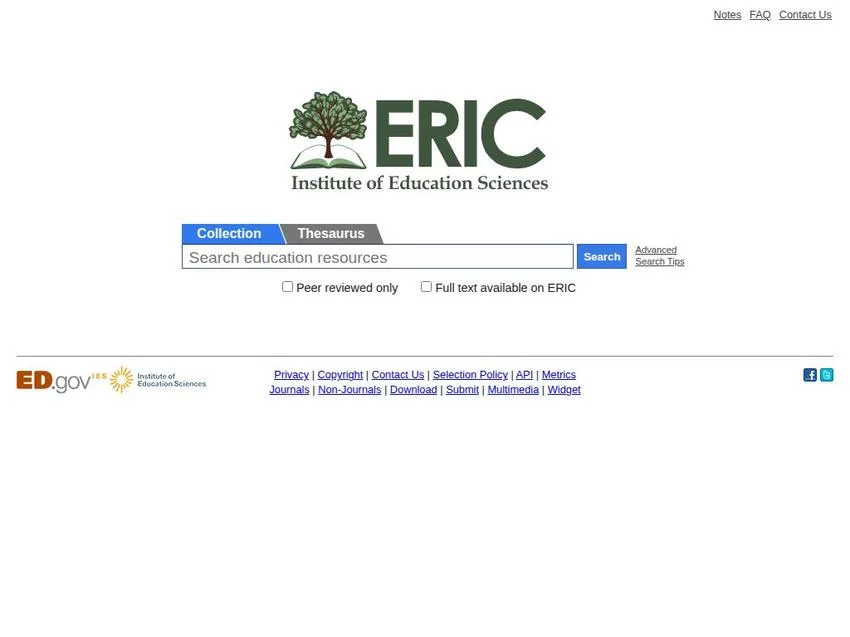
A federal index of education research
The Education Resources Information Center, known as ERIC, is an online index of education research and information run by the United States government. It is a bibliographic database: for each item it holds a record with the title, the authors, publication details, an abstract, and subject terms, and where permission allows it links to or stores the full document. The collection covers scholarly journal articles alongside reports, conference papers, and other education writing that is often hard to find through ordinary channels. ERIC is sponsored by the Institute of Education Sciences, the research arm of the United States Department of Education, and the public can search it without charge or registration.
Because its main job is to describe and organize published articles and documents so that researchers, teachers, and policymakers can find them, ERIC belongs among directories of articles. It does not publish original studies of its own. Instead it selects material from thousands of journals and organizations, catalogs each item to a common standard, and makes the result searchable in one place. The database is used across schools, universities, and government offices, and its records are cited in evidence reviews on teaching and learning.
From a network of clearinghouses to one database
The clearinghouse years
ERIC was established on 15 May 1964, and its collection began to take shape in 1966. For its first decades it worked as a distributed system rather than a single office. Sixteen subject-specific clearinghouses, each housed at a university or professional body and each responsible for a field such as reading, science education, or higher education, gathered and indexed the literature in their area. A set of adjunct and affiliate clearinghouses and three central support components rounded out the network. This arrangement let subject experts decide what entered the database and how it was described.
Consolidation in 2004
In January 2004 the program was reorganized. The separate clearinghouses were replaced by a single centralized operation with one website and upgraded technical systems. The change unified indexing practices and moved acquisition, cataloging, and quality control under one contract managed for the Institute of Education Sciences. The historical records created during the clearinghouse era stayed in the database, so material indexed in the 1960s and later can still be retrieved next to recent additions.
What the collection holds and how it is searched
ERIC provides access to roughly 1.5 million bibliographic records, and hundreds of new records are added each week. About one quarter of the collection is available in full text, much of it as PDF files of reports and papers that never appeared in a commercial journal, the kind of material librarians call grey literature. Coverage reaches back to the mid 1960s, which lets a user trace how research on a topic developed across decades. Every record is tagged with terms drawn from a controlled vocabulary called the Thesaurus of ERIC Descriptors, which keeps subject labeling consistent so that a search for a concept returns items that different authors described in different words.
Record types and the thesaurus
The database separates its two main kinds of record by an accession prefix. Journal articles carry an EJ number, and documents that are not journal articles, such as reports, curriculum guides, and conference papers, carry an ED number. A reader can limit a search to peer-reviewed journal material, to full-text items only, by publication date, by education level, or by document type. The advanced search also accepts descriptor terms from the thesaurus for precise subject retrieval.
The formats indexed include the following:
- Peer-reviewed and other journal articles
- Research reports and technical reports
- Conference papers and proceedings
- Dissertations and research syntheses
- Policy papers, books, and curriculum materials
Sponsorship, access, and contact details
A published selection policy governs what may enter ERIC. Content is judged on relevance to education, on quality, and on whether the source meets the program's standards, and journals are reviewed for inclusion rather than added automatically. In 2025 the program announced a reduction of about 45 percent in the number of sources it would catalog going forward, a change to its selection scope that did not remove existing records. The controlled selection is one reason libraries treat ERIC as a dependable place to begin work on education topics.
ERIC sits within the Institute of Education Sciences, and its work is connected to the National Library of Education, the federal library for education housed in the Department of Education. The library and the department can be reached at 400 Maryland Avenue SW, Washington, in the District of Columbia, postal code 20202, and the National Library of Education answers reference questions by telephone at +1 202-205-5015. The database itself is free to all users, and its records are also distributed to other library systems and search tools that rely on ERIC indexing. For a category of article directories, ERIC is a long-running public example, a government catalog that has described education articles and reports for more than half a century.






Business address
Institute of Education Sciences (U.S. Department of Education)
400 Maryland Avenue SW,
Washington,
District of Columbia
20202
United States
Contact details
Phone: +1 202-205-5015