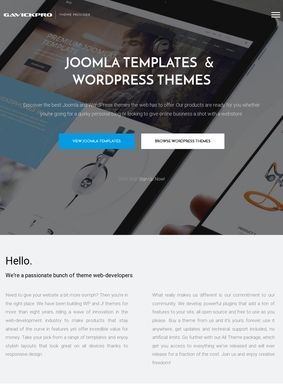
GavickPro is built around a single sales pitch: pay once for the entire template library instead of buying themes one at a time. That makes sense if you build sites professionally and need a stocked toolkit, less so if you are setting up one blog and will never touch most of what you paid for. The catalogue covers Joomla templates and WordPress themes across a wide spread of categories: blogs, portfolios, ecommerce stores, news and magazine layouts, school and educational sites, restaurant and food themes, event portals, and game portals.
Template library across multiple categories
Breadth is not automatically a virtue in theme shops, since plenty of them pad a library with minor variations on a single layout. Here the categories map to genuinely different structural needs. A magazine theme has to handle dense article grids and high publishing frequency; a restaurant theme leans on menus and visual display; an event portal lives on scheduling and registration. GavickPro builds its templates responsive, with CSS3 animations and parallax effects, which is standard now but still worth confirming before any purchase. Those effects look polished in the previews and say relatively little about how a theme performs once you load it with real content and your own plugins.
Quickstart packages and free modules
What is more useful is the quickstart package that ships with each product. Rather than installing a blank theme on an empty site and painstakingly rebuilding the demo by hand, you load the quickstart and get something close to the preview, then strip out what you do not need. Anyone who has spent a frustrating afternoon trying to make a fresh install match marketing screenshots will see the practical value immediately. GavickPro also offers free Joomla modules and open-source plugins alongside paid templates. A theme rarely stands alone; you need small functional pieces to extend a layout, and having some of those available without extra cost keeps a build moving. It also fits how the Joomla community tends to work, where free modules build trust ahead of the paid transaction.
Documentation and live demos at separate URLs
Documentation lives at gavick.com/documentation and working demos run at demo.gavick.com, separate from the marketing pages. A vendor keeping demos live and accessible is a minor but meaningful honesty indicator: you can check load speed and responsiveness yourself, see how the theme actually behaves rather than reading a feature checklist, and compare the demo against the description before spending anything.
Support now routes through JoomlArt
The structural fact a buyer needs to know before deciding is that GavickPro has been absorbed into JoomlArt. Support is no longer self-contained at gavick.com. Forums, help desk tickets, live chat, and round-the-clock telephone support all run through joomlart.com, and pricing lives there too at joomlart.com/pricing. This is not hidden, and a larger platform acquiring a smaller theme house is a common outcome in the Joomla and WordPress economy. GavickPro built a real name over years in that market, so the move reads more like consolidation than collapse.
Even so, it changes what you are signing up for. You buy a GavickPro template and your relationship for renewals, billing, and any problem afterwards belongs to a different company. No phone number and no email address appear directly on gavick.com. To reach anyone you follow links to the JoomlArt help desk or forums. The documentation available on the main site softens this somewhat, since many questions a buyer might otherwise email about are answered there. A ticket system and a forum can cover the gap. But the handoff adds a step: you start on one brand and resolve issues on another, and that kind of seam is exactly where impatient customers lose patience.
Limited public review activity online
GavickPro's public reputation trail is limited, and what exists is not encouraging. Reviewed247.com carries a written account that flags support as sometimes unhelpful or unclear, with users left without a working resolution. One account is not a verdict; a single negative voice can reflect an edge case or an off day. But it lines up uncomfortably with the arm's-length support structure already described. When the one substantive review you can find points at the same friction the setup already hints at, that overlap is worth taking seriously. ZoomInfo and Crunchbase both list GavickPro, though only with short descriptions and no aggregated ratings or review tallies. A search across Google, Trustpilot, and Yelp returns nothing that would let you triangulate the experience across many buyers.
For a vendor selling to developers and site builders, that quiet footprint is worth noting. People who buy templates are generally vocal when a theme saves them time or wastes it. A sparse trail can mean modest recent volume, or a customer base that does not post, or that whatever conversation does happen is now gathering under the JoomlArt name and no longer under GavickPro. With the two operations merged, that is plausible.
So the case for GavickPro rests mostly on what the site shows directly: a genuine range of templates across meaningfully different categories, quickstarts that solve a real installation problem, live demos and documentation that let you evaluate before paying, and free modules that add practical value around the paid products. The case against concentrates in the after-sale: an ownership change that reroutes all support to JoomlArt, no direct contact on the page, and the one detailed review in circulation pointing at that support as the weak point.
Test before committing to the full bundle
If you are at home in the Joomla or WordPress world and you treat the demos and documentation as your real evaluation tool, GavickPro can be a reasonable template source, particularly if the all-theme bundle fits the volume you build at. If you expect first-party support and a buyer community you can read before committing, the gaps here are real. Testing a single low-cost theme and one support ticket before investing in the bundle is the practical way to answer the support question on your own terms, because the published evidence only gets you so far.