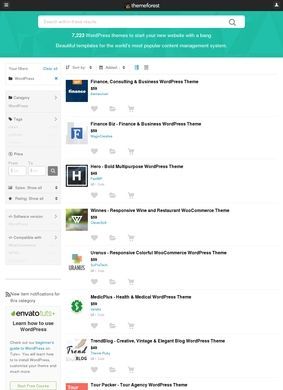
You need a WordPress theme that looks professional, works with WooCommerce, and won't fall apart the first time you update a plugin. That search lands a lot of people on Theme Forest, the Envato-run marketplace where independent developers list ready-made designs and you buy a license for whatever you pick. The pull is obvious: instead of paying a studio to build from scratch, you browse thousands of finished templates, preview the demos, and pay somewhere around thirty to a hundred dollars for the one that fits.
Templates spanning WordPress to Figma
The catalogue goes well past WordPress, which is the part casual visitors tend to underestimate. There are Shopify and WooCommerce templates for storefronts, plain HTML site templates for people who want to hand-code their own backend, and CMS themes for Joomla, Drupal, HubSpot, and Webflow. On top of the website themes sit email templates, landing-page designs, Blogger and Ghost blogging themes, and a stack of UI design files for Figma, Adobe XD, Photoshop, and Sketch. Theme Forest also covers the freelancer charging a small business for a five-page site and the in-house team at a larger company sourcing a starting point: supporting tools on Theme Forest include template kits, plugins, creator portfolios, an affiliate program, API access, and a client workspace feature.
Comparing Theme Forest to Envato Elements
Theme Forest keeps nudging visitors toward Envato Elements, the sister subscription that swaps per-item buying for unlimited downloads of stock assets and AI tools. For someone who needs one theme and nothing else, that cross-sell is noise. For an agency churning out projects, it can be the smarter spend, and the site is upfront that the two models coexist.
Reputation across review platforms
This is where I'd slow a buyer down. The selection is genuinely deep, but the reputation outside the marketplace is rough. Reviews.io shows an average of 1.24 out of 5 across seventeen reviews. SmartCustomer sits at 1.5 out of 5 from sixty-nine. AskmeOffers splits the room, with 42 percent rating it excellent and 35 percent calling it terrible, which tells you experiences here are not middle-of-the-road. Trustpilot carries a far larger pool, over three thousand reviews, with sentiment described as mixed.
Refund policy and account bans
The recurring complaints are specific. Buyers report a strict no-refund policy even when a theme arrives defective, and several describe account bans after disputing a charge. When you buy on Theme Forest you are buying from an independent author through the platform, so the quality and the support you get depend heavily on which seller you pick. A polished demo does not guarantee a developer who answers questions six months later.
Advice for careful buyers
None of that erases the value for someone who does their homework. The split in the AskmeOffers numbers reads like a marketplace where careful buyers who check an author's track record, recent updates, and support thread come away happy, while people who grab the first attractive demo run into trouble. The inventory is large; so is the risk that the item you choose is the wrong one. Theme Forest as a business directory equivalent for digital products works well when you treat it as a sourcing tool, not a guarantee.
Support channels without direct contact
The landing page shows no phone number and no general email. Support runs through a Help Center at the Envato market domain and a community forum, with the parent company offering a careers page but no obvious customer line from the homepage. For a transactional purchase this is workable, since most questions about a specific theme go to its author anyway. For anyone who hit the dispute and ban complaints described above, a routed support system is exactly the friction that shows up in the angry reviews.
Value of the community forum
The structure is normal for a marketplace at this scale, and the forum gives buyers a public place to compare notes. Reading a theme's comment thread is probably the single most useful thing a prospective buyer can do on Theme Forest, more useful than the star rating on the Theme Forest item page itself.
Weighing marketplace risks and rewards
The honest picture is a marketplace with real depth and real warning signs. The inventory is large, the licensing is clear, and the prices are reasonable for what a finished theme saves in build time. The flip side is a no-refund stance that bites when a purchase goes wrong and a support path that frustrates the people it most needs to help. Theme Forest rewards buyers who vet the author, read the comment thread, check the last update date, and go in knowing they own the choice. The outside ratings are too consistent in their criticism to ignore entirely, but the people happy with their purchases clearly did their groundwork before spending.