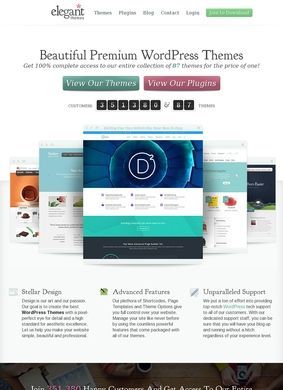
One product carries this whole company: Divi, the drag-and-drop WordPress theme and page builder that has grown into an ecosystem rather than a single download. Elegant Themes sells other things, but almost every decision on the site orbits Divi, and that focus is the reason the operation reads as serious instead of scattered. The pitch is a visual editor where you build a page by moving elements around on the screen, and the latest generation, Divi 5, is presented as a rebuilt version of that engine.
Divi and the surrounding ecosystem
Around the flagship sits a set of tools that turn a theme purchase into something closer to a subscription platform. There is Divi AI for generating copy and layouts, Divi Cloud for storing design assets across projects, and a Marketplace where third-party developers sell extensions and pre-made layouts. For anyone running more than one site, Divi Dash offers a single dashboard to manage them, and Divi Teams adds collaboration for people who work with others. Elegant Themes even folds in managed WordPress hosting under Divi Hosting, so it is possible to build, host, and maintain a site without leaving the family of products. That vertical stack is unusual for a theme shop, and it explains why Elegant Themes talks about agencies and freelancers as much as it does hobbyists.
Legacy products beyond Divi
Beyond Divi, the older catalog is still there and still supported. Extra is a magazine and blog theme aimed at publishers who want category-heavy layouts. Bloom handles email opt-in forms for lead capture, and Monarch covers social sharing buttons. These plugins predate the current builder-centric era and feel like holdovers from an earlier phase of the business, but keeping them alive is a point in the favour of Elegant Themes, since plenty of vendors quietly abandon side products once a headline release takes over.
Browsing by product or use case
The site organizes itself in two useful ways at once. You can browse by product, or you can browse by who you are: a web design agency, a small business owner, an online store owner, a freelancer. That second path leads to use-case pages spanning portfolios, ecommerce, blogging, coaching sites, restaurants, and nonprofits, which is a smart way to help a non-technical visitor picture the result up front. Membership plans at Elegant Themes gate access to the whole lineup, and the pricing is structured as a subscription with 24/7 support, documentation, and community resources attached. The documentation and support hub is where I spent the most time poking around, and it is deep enough that the recurring fee starts to make sense as an ongoing service rather than a one-off theme sale.
Support and contact options
Support routes at Elegant Themes are clearly separated, which counts for something on a site this large. There is a contact page, and it splits into a sales channel and a support channel, with a members-area help section for existing customers. What you will not find is a phone number or a street address anywhere on the site. For a software company selling to a global, mostly remote audience that is normal, and the ticket-and-documentation model is the format most buyers of a WordPress product would expect. Still, a reader who wants to speak to a person before paying should know the relationship here is handled entirely through web forms and written help.
Ratings across multiple review platforms
This is where the picture gets genuinely strong, and also where it needs a careful read. On Trustpilot, Elegant Themes holds a 5-star rating drawn from a staggering 24,956 reviews, a volume that dwarfs almost anything in the WordPress theme space. Reviews.io tells a similar story with an average hovering around 4.76 to 4.79 across roughly 225 to 244 reviews, about ninety percent of them rated excellent. Sitejabber is the outlier at 3.9 stars from 129 reviews, which is a healthy corrective: no product this widely used pleases everyone, and Divi in particular has long attracted complaints about the amount of shortcode it leaves behind and the learning curve of its interface.
Independent coverage from sites such as WPKube, Webstick, and BloggersNeed lands mostly positive, citing the quality and quantity of what you get for the price. Taken together, the ratings suggest a product that satisfies the large majority while frustrating a vocal minority, which is about as honest an outcome as a mass-market tool can hope for.
Weighing subscription costs and lock-in
A few caveats are worth naming plainly. The subscription model at Elegant Themes means the cost keeps coming, so the value calculation depends on how many sites you build and how long you stay. Divi's builder produces sites that are tightly bound to Divi; move away from it later and you inherit cleanup work. And the sheer breadth of the ecosystem, from AI to hosting to team tools, can feel like a lot to evaluate when all you wanted was a theme. None of these sink the offering, but a careful buyer should weigh them against the polish on display.
Comparing Divi with Elementor
For a small business owner or a freelancer who wants to build visually and keep everything under one roof, Elegant Themes makes a strong case, and the pairing of a mature product with a lifetime-plan option gives it staying power that newer entrants lack. The obvious comparison is Elementor, which pairs a free tier with a familiar builder and a huge add-on market. Elementor lowers the entry cost and lets you try before you buy, while Elegant Themes bets on an all-inclusive membership that bundles the builder, the extras, and the support into one price.
If you value a free starting point and a plugin-first approach, Elementor may fit better. If you would rather pay once (or annually) and get the whole toolkit plus a decade of refinement behind it, the Divi camp is the more complete package, and the review numbers back that up.