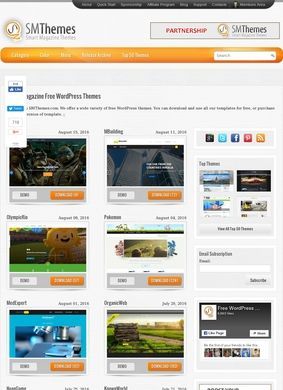
How many WordPress themes does one site need before it becomes a useful place to shop for a design? SM Themes answers that with a catalogue of more than a hundred, split between free downloads and paid versions, and it has been doing this since at least 2012. That longevity is worth noting up front. A theme shop that survives a dozen years in a market this crowded has either kept its work current or kept enough people downloading to stay afloat, and the size of the library here suggests the former rather than a slow coast to irrelevance.
A hundred themes across many industries
The themes span a wide spread of use cases: business sites, education, fashion, hi-tech, and plenty in between. That breadth is the main selling point. Someone building a small company page and someone setting up a personal blog can both find a starting point without leaving the site. The free tier matters here because it lets a builder test a layout in their own install before deciding whether the premium version is worth paying for. The paid editions are described on the site as a "free links version" of the templates, which is a slightly awkward phrase, but the practical split is clear enough: download for nothing, or pay to get the fuller release. SM Themes does not obscure that distinction, which is more than can be said for some shops that bury the free option.
Free downloads and paid versions
Each theme leans on the standard WordPress toolkit, which is exactly what you want from a template you intend to live with. Custom menus, widgets, shortcodes, and responsive layouts are all part of the package, and the themes are built to work across the major browsers. None of that is exotic in 2026, but the absence of it would be a red flag, and SM Themes does not give you that worry. Responsive design in particular is non-negotiable now, given how much WordPress traffic arrives on phones, so seeing it stated plainly is reassuring.
Standard WordPress features included
SM Themes puts forward a theme called "Review" as a centrepiece of what its premium work can do. It is aimed at movie review and fan blog sites, and it ships with an integrated slider, a responsive layout, and an admin panel for controlling the options. This is a sensible thing to highlight, because a niche theme like that tells a prospective buyer more than a generic corporate template would. It shows the shop has thought about specific audiences and built tooling, the admin controls especially, around them. A movie blogger looking at that one theme can picture exactly how their finished site behaves, which is harder to do from a row of identical business mockups.
The Review theme showcases niche specialization
To back the catalogue, SM Themes displays a portfolio of more than a hundred sites reportedly built with its themes. A portfolio of that depth is a stronger argument than the usual handful of cherry-picked screenshots, because it points to real deployment rather than just demo renders. Whether every one of those sites is still live and still running one of those templates is impossible to verify from the listing alone. The number is best read as evidence of consistent activity over the years, not a guarantee of current installs, but it does establish real deployment in the wild.
Portfolio demonstrates real-world deployment
The reach of SM Themes is uneven, and the numbers tell an interesting story. At its peak the site ranked around #8,739 worldwide, which for a niche theme vendor is genuinely high. More recent third-party estimates place it nearer #102,108 globally, a steep drop from that peak. India is the standout source of visitors, contributing roughly 27.6 percent of total traffic, with a national rank around #103,553. That concentration points to a strong following among Indian WordPress developers and site builders, possibly because the free tier is attractive in markets where every dollar on a premium theme gets weighed carefully.
Traffic concentrated in India
The gap between the historical peak and the current standing deserves an honest read. A site can slide in the rankings for reasons that have nothing to do with quality: the theme market has consolidated around a few large marketplaces, search habits shift, and a smaller independent shop will feel that pressure. The library is still here and still substantial, so the decline reads more as a changed competitive field than as abandonment. A buyer choosing a theme cares less about a vendor's global rank than about whether the specific layout suits the job, and the spread of categories at SM Themes means that question can usually be answered on the site itself.
Built for hands-on WordPress builders
The traffic picture also flags who this is really for. The audience skews toward hands-on builders, people comfortable installing a theme, wiring up widgets and shortcodes, and tweaking an admin panel. SM Themes targets WordPress site builders of all types, but the practical reality is that you need a working WordPress install and the willingness to configure it. This is not a hosted website builder. It is a source of themes for people who already know their way around the dashboard, and SM Themes is designed for them.
Mixed reviews and limited public feedback
On outside opinion the record is mixed. MyWot analytics, cited through easycounter.com, describes smthemes.com as a trustworthy domain but notes that visitor reviews skew mostly negative. No count and no numeric rating come with that assessment, so it is a soft signal and a contradictory one: trusted on the technical side, grumbled about by some users. A search across Google, Trustpilot, Yelp, Facebook, and the BBB turned up nothing, which is fairly common for a download-driven theme shop where most users never leave public feedback. The practical upshot is that a buyer cannot lean on a wall of star ratings. The themes have to be judged on their own demos and on the free downloads.
Support contact information missing
Contact is where SM Themes asks for more trust than it shows. The homepage carries no phone number, no email address, no physical address, and no obvious route for getting in touch. For a free theme that may not bother anyone, since you download and go. For a premium purchase it is a real consideration. If a paid theme breaks after a WordPress core update, the buyer wants a clear path to support, and that path is not visible from the front of the site. There may be a support channel behind a login or inside the theme documentation, but a visitor cannot tell that from the homepage, and a site that sells things ought to make help easy to find before money is involved.
Weighing it all, SM Themes is a long-running theme shop with a deep and varied library, a free tier that lowers the risk of trying before buying, and a documented history of sites built on its work. Set against that is a limited public feedback record and a contact setup that does not inspire confidence for paid purchases. The Review theme and the breadth of categories are the parts most likely to bring someone back. The download page works, the options are genuinely varied, and the free tier exists precisely so the product can be tested before any money changes hands.