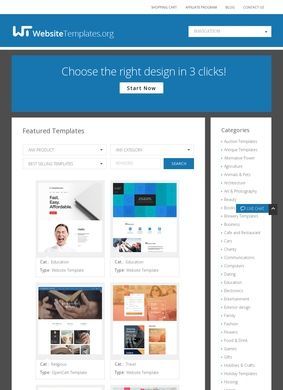
Can you skip the cost of custom web design and still end up with a site that looks like your own? That is the pitch behind Website Templates, a marketplace of pre-made layouts you download and edit yourself. Pick a design that fits your line of work, swap in your own text and images, and put it online without paying a developer. For someone launching a small business site on a tight budget, that is a reasonable shortcut, and the catalogue at Website Templates is built around exactly that buyer.
Category options for different business types
The range of categories is genuinely useful. Website Templates sorts layouts into niches such as Business, Medical, Hotels, Family, Computers, Agriculture, and Online Store, so a clinic owner and a farm-supply shop are not sifting through the same generic stock. On the platform side, the collection covers plain HTML alongside Joomla and Drupal themes, which widens the audience to people already committed to a particular content management system. There is also a free section, including free online store templates, which gives a hesitant visitor a way to test the waters before spending anything. The collection is described as growing, and everything is licensed for both personal and commercial use, so a freelancer reselling work to a client is not stuck in a hobby-only grey area.
Free templates and licensing terms
How much of this can a non-technical person handle alone? The marketing at Website Templates leans hard on "no technical knowledge required," and for swapping headlines and photos in a static HTML file that is broadly fair. Joomla and Drupal are a different matter. Anyone who has set up either platform knows the install and configuration steps are where beginners get stuck, and downloading a template does not remove that barrier. The easy-to-modify claim reads as honest for the HTML layouts and optimistic for the CMS ones. The variety is the real selling point, and the framing of these designs as a cheaper path than commissioning a custom build is accurate enough.
Ease of use for non-technical users
Where confidence drops is everything around the catalogue. The site would not load directly during this review: repeated fetch attempts came back as server errors and access refusals, which leaves the offering judged from what the listing and outside references describe instead of from a hands-on look at the templates. That alone is not damning, since servers block automated requests routinely, but it does leave the buying experience unverified. A real shopper wants to know how the download works, whether the license terms are spelled out clearly, and what happens if a file is broken or a design does not match the preview. Website Templates does not make any of that easy to check from the outside.
Server access and download experience
The reputation trail is where Website Templates gives the least to stand on. No listing turned up on Trustpilot, Google, Yelp, the BBB, Sitejabber, or any other platform where customers usually leave a paper trail. For a download marketplace asking for payment, that absence is notable. Plenty of legitimate sites fly under the review radar, but a template shop is precisely the kind of operation where buyers look for proof that other people got their files and their money's worth. The one third-party mention that turned up, on a review aggregator, was lukewarm: the writer reported that the live chat would not work and openly questioned how the site differs from a competing template provider. One unenthusiastic comment is not much of a foundation.
Customer reviews across major platforms
Reaching a human is the other soft spot. No contact page, no phone number, no postal address, and no working support channel appeared in anything reachable or in the snippets that reference the site. A missing public email is no great sin when a form usually covers it, but here there does not appear to be a form, a phone line, or an address either. Combine a broken live chat with no visible way to reach a human, and a buyer who hits a snag during checkout or download has nowhere obvious to turn. For a service selling digital goods, that gap in reachability is part of what you are paying for, and Website Templates leaves it open.
Contact options and support availability
The product idea is sound, the category breadth spans a dozen-plus niches, and the free tier lowers the risk of trying it. Website Templates is selling something people genuinely want, and the niche-by-niche organisation is more useful than a flat wall of generic designs. The framing of templates as a budget alternative to custom work is fair, and the commercial-use licensing lets a freelancer hand finished work to a paying client without licensing trouble.
Weighing budget savings against trust gaps
But a download shop lives or dies on trust, and trust is exactly what Website Templates has not put on the table. No customer reviews anywhere, no reachable contact route, and a support channel that an outside reviewer found broken leave wide open the question of what happens after a buyer hands over money. The designs may be perfectly good. Nothing reachable lets a buyer confirm that, and for a paid service handling digital goods, that absence of any safety net is the gap that should give a budget-minded shopper pause.