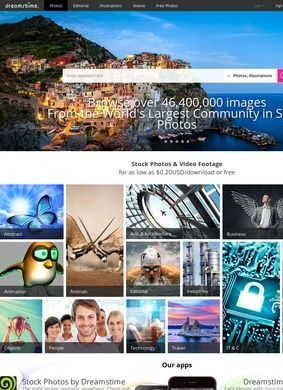
Dreamstime launched in 2000 under founder Serban Enache and now positions itself as the largest stock photography community online, with a catalogue running past 359 million royalty-free files. Photos dominate the Dreamstime library, but the collection also covers vector illustrations, video clips and audio tracks, so a designer hunting for a background texture and a video editor needing a short clip can both shop in the same place without bouncing between platforms. The site operates under a marketplace model, meaning most content is contributor-uploaded rather than produced in-house, which explains both the range and the occasional unevenness in quality across subject areas.
Pricing for buyers
Pricing at Dreamstime follows the two paths common to microstock. Buyers who want a handful of images can purchase credit packs, opening at roughly $9.99 for eight credits, with the cost per file scaling by size. Anyone downloading in volume can switch to a subscription or unlimited-download plan, where the per-image price drops the more you pull down. Dreamstime also runs a free tier, a rotating set of images available at no cost, which lets people try the library before handing over money. The structure rewards heavy users and keeps the door open for occasional ones, which is roughly the balance you would hope for.
Contributor earnings model
On the supply side, contributors upload to Dreamstime at no charge and earn a royalty on every sale. Those payouts run anywhere from about $0.35 to north of $40 per image depending on the licence, and an extended or buyout licence hands the buyer full usage rights for a higher fee. By early 2022 the platform reported 40 million registered members and more than 800,000 contributing photographers. Whether $0.35 on a single small download feels worth the effort is a question every photographer answers for themselves, and the lower end of that range is a fair thing to weigh when considering where to place a portfolio.
Who uses Dreamstime?
The audience splits cleanly. On one side sit the people who need commercial-use visuals: designers, marketers, advertisers, publishers and individual creatives who want a clean image without legal headaches. On the other are the photographers, illustrators and videographers chasing passive income from work already sitting on a drive. Dreamstime tries to keep both groups fed, and the site reflects that with a contributor mobile app alongside the buyer-facing storefront.
Search and navigation tools
Navigation leans on the things you would expect. There is keyword and category search, a free photos section, separate areas for editorial imagery, illustrations, vectors, video and audio. The editorial split matters more than appearances suggest, since editorial-licensed images carry different usage rules than commercial ones, and keeping them in their own lane spares buyers a costly misstep. Reverse image search is also available, which helps when a buyer has a reference image and needs something close to it. Nothing about the layout is novel for the category, but the coverage is broad and the sorting is logical.
Getting help and support
Direct contact is not front and centre on Dreamstime. There is an About page and a detailed FAQ, and help flows through support pages and an online help system, but no phone number or street address greets you on the homepage. For a self-service marketplace that is normal enough, and the help infrastructure looks reasonably built out, yet anyone who prefers to reach a human quickly should know the route runs through tickets and documentation.
User reviews across platforms
The outside picture for Dreamstime is mixed rather than uniform. Trustpilot carries around 2,300 reviews at four stars, which is a solid showing at real volume. SmartCustomer is cooler, with roughly 1,260 reviews landing at 3.7 stars. G2 sits at about 4.3 across 646 reviews. Smaller pools run warmer: Reviews.io near 4.9 over 16 entries and ResellerRatings at 4.95 across 81. The tiny samples deserve less weight than the big ones, so the honest read is a service that satisfies most users solidly while leaving a meaningful minority unimpressed, with that 3.7 likely reflecting friction somewhere in licensing or payouts.
Company background
Headquartered in the United States as Dreamstime LLC, the company has the longevity that counts in a market where plenty of stock sites have come and gone. Two decades of operation and a catalogue this size are not trivial. That depth genuinely serves buyers who want options across media types at an affordable price. The weaker points are the contributor royalties at the floor of the range and that lukewarm patch in the review record. Neither buyers nor contributors are being sold a fantasy here, which is more than can be said for glossier pitches elsewhere in the category.