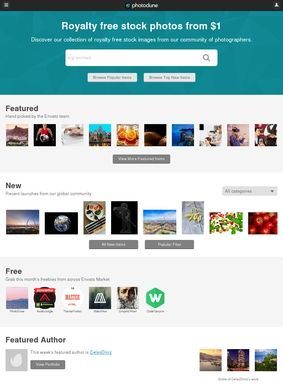
On Photodune, a few dollars buys a single royalty-free photo, somewhere in the $2 to $6 range, pulled from a library that runs into the millions of files, all inside a much bigger empire. That is the simple pitch, and it is worth taking apart, because the simplicity hides a more complicated arrangement underneath. The headline number sounds generous, yet what you are really paying for is access to one image at a time, with no obligation past that single transaction.
How Photodune fits in the Envato ecosystem
The marketplace is owned and run by Envato, and that ownership shapes almost everything about how the site behaves. You browse by familiar buckets: Animals, Architecture, Business, Food, Health, Sports, People, Technology, Travel. There are weekly hand-picked selections, lists of popular files, top-seller rankings, and creator portfolios that carry their own ratings. A video footage section sits alongside the stills, so it is not strictly a photo shop. The model is pay-per-image, which still has a real audience: people who need one good shot for a specific job and do not want to commit to a recurring plan to get it.
Browse by category and curator picks
That one-off buying is the clearest reason someone would land on Photodune instead of reaching for a subscription service. If a designer needs a single hero image for a client deck and nothing more, paying two dollars and walking away is a genuinely sensible move. The independent photographers behind the catalogue are the other half of the equation, uploading work and earning from sales, and the portfolio-with-ratings setup gives buyers at least a rough way to judge a contributor before they hand over money. The top-seller and weekly-pick lists surface files that have already proven themselves, so a buyer in a hurry is not staring at an undifferentiated wall of thumbnails. Photodune also maintains a business directory of contributor portfolios, so buyers can follow specific photographers they trust rather than starting a fresh search each time.
Single image purchases versus subscriptions
Understanding Photodune means understanding what surrounds it. Envato also runs Envato Elements, an unlimited-download subscription that bundles stock assets with AI tools; Placeit, which handles mockup customisation; and Envato Tuts+, a free library of tutorials. Photodune is the a-la-carte corner of that group, and the contrast with Elements is the thing a prospective buyer should sit with for a minute. Nothing about Photodune hides this; the Envato branding is visible throughout.
If you are buying images regularly, the subscription almost certainly works out cheaper per file, and Envato has every commercial reason to nudge heavy users toward Elements. That leaves Photodune occupying a narrower slot than its millions-of-files headline implies: it is the place you go when a subscription would be overkill. There is nothing wrong with that, but it does mean the site's best use case is also the one that brings in the least money, which raises a quiet question about how much attention this particular property still gets internally.
Royalty-free licensing terms
Licensing is royalty-free across the board. Pay once, use within the license terms, no per-use accounting afterward. For most small commercial jobs that is exactly the model people want, and Photodune does not complicate it. The price you see is close to the price you pay, terms consistent regardless of which contributor you buy from.
Contributor commission rates
On the seller side the picture is less flattering. One editorial assessment, from Wealthinflator, lands at 2.5 out of 5 and points the finger squarely at high commission rates for contributors. Even for buyers that is relevant, because the cut a marketplace takes affects who bothers to upload and how fresh the catalogue stays. A site that squeezes its photographers tends, over time, to lose the photographers worth buying from.
Reputation and review scores
The wider reputation is a genuine mix, and the spread is more telling than any single number. On Knoji, Photodune sits at 3.9 out of 5 across 34 reviews, which is respectable without being glowing. That is the sort of score a service earns when it does the job competently for most people and frustrates a vocal minority. Crozdesk gives a composite of 88 out of 100, driven by a perfect user-satisfaction score but dragged down by weaker press coverage at 61. Trustpilot carries reviews filed under the Envato banner, with sentiment described as mixed and no firm count to lean on. Digital-expert.online runs a positive editorial that singles out high image-quality standards, which squares with the curated, hand-picked feel of the front pages.
Age of available editorial coverage
Then there is the matter of age. Stock Photo Adviser and Microstock Insider both carry editorial write-ups, but those land somewhere in the 2012 to 2020 window. That is a long time in this market, especially now that AI-generated imagery and AI-assisted search have rearranged what buyers expect from a stock library. The bulk of the serious commentary was written before that shift, and a reader has to weigh those verdicts knowing the ground has moved underneath them. A glowing 2014 review tells you almost nothing about whether Photodune is competitive against current AI-assisted alternatives.
Support through help center and forums
Contact is handled the way large platforms tend to handle it. On Photodune there is no direct phone line, no email address, and no street address on the site. Support runs through the Envato Help Center, community forums, and dedicated author support pages, backed up by the usual social channels. For self-serve digital purchases this is normal: the help centre and forums are searchable, and most buyer problems get resolved without a human conversation. What it does mean is that anyone expecting personal, named support will not find it, and if a transaction goes sideways the route to resolution is a ticketing system, not a quick call.
That impersonal structure is the trade-off baked into buying from a big marketplace, and Photodune does not pretend otherwise. The Envato Help Center and author support pages are thorough, and for a contributor chasing a payout question the forums are often quicker than a ticket. The same scale that gives buyers a huge catalogue and consistent licensing is what keeps every interaction at arm's length. For a quick image purchase that distance barely registers. For anything that needs explaining, it becomes the whole experience.
So where does that leave a designer or small business weighing Photodune against the field? The image quality looks solid, the curation is evident in the front-page picks, and the pay-per-photo model fills a need subscriptions cannot. Pricing is low enough that a single purchase rarely warrants a second thought. The ratings, taken together, describe a service that works and that people are broadly satisfied with once they are inside it.
The doubt is about momentum. Photodune mostly serves the cheapest, least-recurring kind of customer, sits beside a subscription product its owner has clear reasons to favour, and its most detailed reviews predate the AI upheaval. Whether Photodune is still being actively grown or quietly kept as a feeder for the rest of the Envato group is the one thing the public picture cannot answer. For occasional purchases the current evidence is good enough. For treating it as a long-term primary source, the case is harder to make without fresher independent coverage.