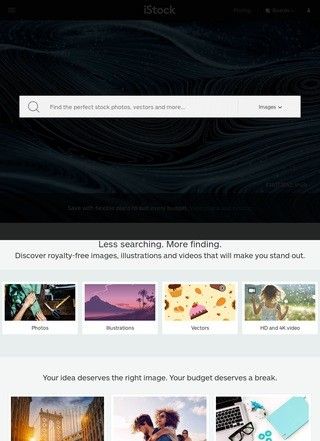
Can a single library really cover everything a working designer needs to license? iStockphoto answers with scale. The site, run as iStock by Getty Images, points to one photo category alone, its collection of reviews imagery, holding more than 435,800 items, and offers that up as a sample of how deep the whole catalog runs. That is one slice among many.
The marketplace spreads across stock photography sorted into numerous categories, from nature to business, stock video in HD and 4K with slow-motion options, editable illustrations and vectors that include animated graphics, licensed music and audio, and a set of AI tools that generate or modify images. iStockphoto began as an independent marketplace and later became part of Getty Images, which is the pedigree sitting behind all that inventory.
The catalog against the reviews
The offering is broad, and iStockphoto aims the pitch at working designers and commercial creators who need licensed material without a full studio budget. Whether the library delivers on that promise is a separate question from how large it is, and the outside record complicates the answer in a way worth taking seriously.
What follows splits the case in two: what the product actually includes, and what paying customers say happened after they bought in. Both matter, and they pull in opposite directions. A catalog this wide is only useful if the buying and licensing around it works cleanly, and that is precisely where the outside reviews get loud.
Photos, video, vectors, and the Signature Collection
Beyond raw volume, iStockphoto markets a Signature Collection it describes as exclusive content available nowhere else, which is the part a designer paying for differentiation would actually care about. Anyone can license a generic stock photo. The value is in imagery a competitor cannot pull off the same shelf an hour later.
The mix of stills, footage, vector art, and licensed audio means one account can supply a whole project from start to finish, and free weekly photo, illustration, and video selections give a low-stakes way to test the well before committing money.
For a budget-conscious professional, that range under one login is the core appeal of iStockphoto, and on paper it is a real convenience worth the price of admission. The free weekly downloads also let a designer build up a small stock of usable assets over time without touching a paid plan, which softens the commitment for anyone still testing the waters.
The no-AI-from-contributors pledge and licensing terms
One policy stands out. iStockphoto states that contributors may not submit AI-generated content, a promise about the authenticity of what people upload, kept separate from the AI generation tools iStockphoto itself offers customers. Holding both positions at once is a fine line to walk, and I suspect plenty of buyers will need a moment to square a no-AI-from-contributors rule with a built-in AI image generator sitting a click away.
It also advertises daily-curated, authenticated content and licensing backed by what it calls industry-leading insurance, the indemnification that matters to a company worried about a lawsuit over image rights. That legal cover is a genuine selling point for a business, not a decoration. The plans-and-pricing page exists, though the actual rates did not surface on the homepage, so getting a real number means clicking through and starting the process yourself.
For a buyer comparing services, that hidden pricing is a mild irritation, since the whole point of a plans page is to let someone weigh cost before sinking any time into an account.
What the ratings and support say
Here the picture turns hard. SmartCustomer shows iStockphoto at 1.2 out of 5 across 196 reviews, and a Trustpilot UK page sits near 1.1 out of 5 from 912 reviews. Those are not soft scores from a small sample. They are low marks from large ones, and the consumer-rating sites are genuinely damning for iStockphoto.
The record is not uniform. The Better Business Bureau reportedly gives an A plus, and G2's page leans positive on content variety and search features, so the story has two visible sides. Recurring complaints across the negative sources center on image quality and AI assets slipping into contributor content, billing and cancellation trouble, and customer service. On the employer side, Glassdoor's 19 reviews read milder, with 52 percent saying they would recommend working there, 4.4 out of 5 for work-life balance, and 3.7 for culture and values.
Reaching the company is at least straightforward, with a support and contact page, an FAQ and help section, and accounts on Facebook, Twitter, and Instagram. So the support exists on paper, even as the loudest reviews complain about what happens when a customer actually uses it, especially around canceling a plan, and that gap between an easy signup and a hard exit is the crux of the whole complaint.
The tension is impossible to miss. iStockphoto sells depth, exclusivity, and legal cover, and it clearly has the catalog to back the first claim. Yet two separate review platforms park it near a single star from more than a thousand combined voices, with most of the anger aimed at billing and cancellation rather than the images themselves. That gap between an iStockphoto library worth using and an account that is hard to close is the doubt that will not settle.