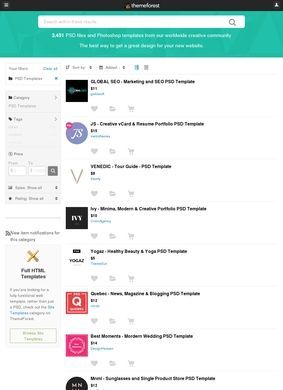
Where do you go when you need a finished website design but you are not going to build one from scratch? For a lot of freelancers and small business owners, the answer has been Theme Forest, the Envato-run marketplace where independent developers and designers sell ready-made themes and templates. The pitch is straightforward: buy a license to a design someone else already built, tested and packaged, then make it yours. The catalogue is enormous, and that breadth is the first thing worth understanding before deciding whether the place suits you.
WordPress themes and alternative platforms
The bulk of the inventory sits in WordPress themes, and the sub-categories there cover most of what people build: blog and magazine layouts, corporate sites, creative portfolios, eCommerce shops, education sites. Beyond WordPress there are plain HTML site templates, eCommerce templates targeting Shopify, WooCommerce and BigCommerce, and CMS templates for Joomla, Drupal and Webflow. Theme Forest also stocks email and landing page templates for marketing work, plus Elementor page-builder resources for people who assemble pages visually instead of touching code. That spread is the main argument for the marketplace. Whatever stack you happen to be on, there is probably something here that fits it.
Pricing and payment scale
Pricing tends to land between $30 and $100 for a theme, putting it in reach for someone running a single project on a tight budget. The numbers Theme Forest quotes about itself are large: more than 78.7 million items sold and over $1.25 billion paid out to the creators who supply the designs. Those figures say two useful things. The marketplace has been moving product at scale for years, and the people building the themes are getting paid enough to keep coming back. That continuity matters if you are buying something you hope will still receive updates twelve months from now.
Related Envato services
Theme Forest does not stand alone. It sits next to Envato Elements for subscription stock assets, Placeit for mockup and design tools, and Envato Tuts+ for tutorials. If you already use any of those, the marketplace slots into a workflow you may know. If you do not, it functions perfectly well on its own. The audience Theme Forest is aimed at is fairly clear from the catalogue: freelancers and web designers building for clients, small business owners doing it themselves, and developers or agencies who would rather start from a solid base than reinvent a checkout page.
Customer ratings across review sites
The outside reputation deserves honest attention, and it is genuinely uneven. On Trustpilot there are 3,322 reviews, with feedback described as mixed. That alone is not damning, since any marketplace with millions of buyers will collect complaints. The smaller, more specialised review sites tell a harsher story. SmartCustomer shows 69 reviews averaging 1.5 out of 5. Reviews.io is worse, at 17 reviews averaging 1.24. AskmeOffers splits sharply, with 42 percent rating Theme Forest excellent and 35 percent calling it terrible. That is the profile of a service that works smoothly for some buyers and badly for others. One outlier, myprosandcons.com, lands at 4.0 out of 5 from verified buyers.
Author quality varies by individual theme
A spread like that is not random noise. The experience depends heavily on which theme you buy and which author stands behind it. Theme Forest is essentially renting you access to thousands of separate small operations under one roof. A polished, actively maintained theme from a responsive author is a fine purchase. A neglected one from an author who has drifted away is a different experience entirely, and the buyer often cannot tell which is which until after the money has changed hands. The wide rating distribution is consistent with exactly that gamble, and no amount of platform-level statistics changes it at the individual-purchase level.
Support channels and contact options
Contact and support are the other soft spot. There is no phone number and no physical address on the landing page or in the footer, which is normal for a digital platform of this size but still worth noting for anyone who likes a direct line. Support runs through a Help Center, a separate Author Support portal for sellers, and a community forum. Those channels exist and are organised by purpose, so help is reachable if you go looking for it. A prominent contact route is not put in front of you, though, and given how much of the negative feedback elsewhere tends to involve support and refunds, that absence does not inspire confidence when something goes wrong.
Platform reliability and transaction volume
To be fair about what the structure gets right: buying through Theme Forest instead of going directly to an unknown developer's own site does give you a single billing relationship, a licensing framework, and a platform that has handled tens of millions of transactions. There is a layer of process between you and a stranger's code. For a one-off purchase that counts for something, and it is part of why people keep using the marketplace despite the grumbling. The volume figures are not marketing fluff; they reflect a system that does move product reliably for a great many buyers.
Checking the seller before you buy
The catalogue depth is the genuine strength. If you need a Shopify storefront design, a WooCommerce shop, a corporate brochure site, a Webflow layout or a magazine theme, the odds of finding several credible options on Theme Forest are high, and the preview-and-purchase flow is well worn. For someone who knows what they want and is willing to vet the individual seller, the price-to-value ratio can be very good. The risk is concentrated almost entirely in the author behind whatever you pick, and Theme Forest does little to surface that risk before you pay.
Author responsiveness determines your experience
So the recommendation comes with a condition rather than a clean stamp of approval. Before buying anything, read the reviews on the specific theme, check when the author last shipped an update, look at how they answer questions in the comments, and treat the platform's overall scale as background rather than a guarantee about your particular purchase. Do that homework and Theme Forest can be a sensible place to shop. Skip it and you are leaning on a marketplace whose own outside ratings put the floor a lot lower than the ceiling.
The strongest themes on Theme Forest are very good and the weakest leave buyers angry enough to drag the average down to barely above one star on more than one review site. Theme Forest gives you the catalogue and the checkout, but it does not, in any visible way, solve the part that decides whether your purchase goes well: whether the person who built your chosen theme is still around to support it. Until that uncertainty is easier to read before you pay, the burden of getting it right sits squarely with you.