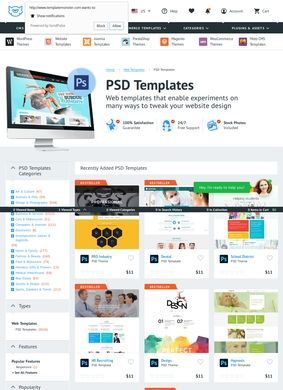
Say a small business owner needs a polished website by the end of the month, has no time to design from scratch, and does not want to pay an agency thousands for a brochure site. That is the gap Template Monster has built itself around. The catalog runs deep on website templates for the platforms most people are already on: WordPress, HTML5, WooCommerce, Shopify, PrestaShop, and Joomla. You pick a theme that fits your industry, buy it, and adapt it. For someone who knows their way around a CMS but is not a designer, that shortcut is the whole point.
Templates across platforms and file types
The range goes well past websites. There are presentation templates for PowerPoint, Google Slides, and Keynote, plus a graphics library covering icons, fonts, vectors, illustrations, and UI elements. Developers can pick up plugins and extensions, and the store also stocks 3D models, stock video, and stock music. More than a hundred templates are free, so a buyer can gauge the quality without spending anything first. The breadth means a marketing team could, in theory, source a site theme, a pitch deck, and the supporting visuals from one account.
Comparing MonsterONE subscriptions with per-item purchases
Two things separate Template Monster from a plain template shop. The first is MonsterONE, a subscription that swaps per-item purchases for unlimited downloads across the marketplace. For a studio churning through projects, that math can work out far cheaper than buying assets one at a time. The second is TM WebStudio, a custom development arm that takes on the people who do not want to touch the code themselves. It handles website design, store setup, SEO work, and marketing support, with project managers assigned to a job. So the same brand serves both the do-it-yourself buyer and the hand-it-off client, which is an unusual spread.
Industry-specific organization and marketplace model
The products are organized by industry, with verticals for fashion, real estate, restaurants, technology, and medical among others, so a restaurant owner is not wading through enterprise software dashboards to find something suitable. Underneath the storefront sits a multi-vendor model: independent authors upload and sell their own products and take a commission, with better rates for listings sold exclusively through the platform. That structure explains both the enormous selection and the variation in quality, since the work comes from many hands operating to their own standards. It is less a single product than a venue, and Template Monster runs it like one.
Mixed reviews across multiple rating platforms
That variation is where the outside reviews get interesting, and they are genuinely mixed. The numbers do not all point the same way. Reviews.io carries 59 reviews at an average of 3.56 out of 5. SmartCustomer has a far larger sample, 1,682 reviews, landing at 3.3. G2 shows just 3 reviews but a higher 4.3. Trustpilot hosts an active profile with customer reviews present, though the exact volume was not clear from what surfaced. A spread like that, weighted toward the middle, tells you more than any single glowing score would.
Editorial coverage and consumer sites such as 99consumer echo the same split on Template Monster. The recurring complaints center on code quality on some templates and on support responsiveness, which is the predictable downside of a marketplace where a thousand authors set their own bar. The praise is just as consistent: people like the sheer variety and the depth of selection. Both can be true at once. A careful buyer who reads the reviews on an individual template, checks the demo, and sticks to well-rated authors is in a different position than someone who grabs the first cheap theme that looks the part.
Support channels and company structure
Support is structured but a little indirect. There is a contact page on the site, and most help flows through a helpdesk rather than a single inbox. A customer care address turns up in the replies Template Monster posts on Trustpilot, which at least shows someone is reading and answering public feedback. There is no phone number or physical address on the homepage, so anyone hoping to call before buying will not find that route. For a digital product sold worldwide that is a common setup, and the public review responses suggest the support channel is staffed, even if reaching a human takes a few clicks.
Worth knowing for context: Template Monster is operated by Jetimpex Inc., and the scale of the operation shows in how many product categories it tries to cover at once. That ambition cuts both ways. The catalog is one of the largest a buyer is likely to encounter, and the MonsterONE plus WebStudio combination gives real options at different budgets and skill levels. The trade-off is that quality is uneven by design, because the platform is a host for many sellers, not a single studio with one house style.
From quality variation to careful buyer practices
So the honest picture is a big, established marketplace that rewards the buyer who does a little homework and frustrates the one who does not. The free templates and the per-item review data make that homework easy to do. Reading the reviews on a specific template, leaning on higher-rated authors, and treating the middling aggregate scores as a fair warning to look closely are the steps that separate a good purchase from a frustrating one. The catalog and the tools are there; the outcome depends mostly on how carefully someone uses them.