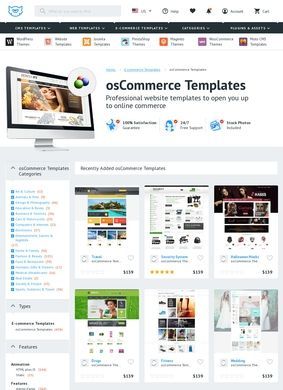
Template Monster has been selling website templates since 2002, which makes it one of the longest-running marketplaces of its kind still operating at scale. That longevity shows in the sheer breadth of what sits in the catalog today. The osCommerce templates that put this listing in its category are a small slice of a store now covering WordPress themes and plugins, WooCommerce, Shopify, Magento, PrestaShop, OpenCart, HTML5 builds, Joomla, Drupal, and standalone landing pages. If a platform has a market, there is a fair chance a theme for it exists here.
Two decades of templates across platforms
The web templates are only half the story. Template Monster also sells graphic assets that have nothing to do with a CMS: icon sets, fonts, logo templates, stock photos, vectors, UI element kits, animated banners, and product mockups. Add presentation decks for PowerPoint, Keynote, and Google Slides and the place starts to look less like a theme shop and more like a general-purpose design supply store. Someone building a brand from nothing could plausibly source a logo, a slide deck, and a storefront theme in a single visit without ever leaving the site.
Design assets beyond website themes
Pricing flexibility is one of the genuinely useful parts of the model. Individual items can be bought outright, but Template Monster also runs MonsterONE, a subscription that opens unlimited downloads across the whole catalog. For a freelancer or an agency churning through projects, that subscription math can work out far cheaper than buying assets one at a time. There is also a free tier of at least a hundred items, which gives a cautious buyer a way to test file quality without spending anything. That free band is more about trust than budget, since it lets you check how clean the code and the documentation actually are before putting money down.
Subscription model and free tier options
Template Monster runs a two-sided marketplace where independent designers upload and sell their own products, taking a commission that climbs higher on exclusive items. That open-door approach is what drives the enormous selection, but it also means quality is not uniform. A theme from one seller can be polished and well-supported while another, sitting on the same shelf, ships with sloppier code. Template Monster curates, but it does not manufacture everything it sells, and a buyer needs to read each product page on its own merits.
Quality varies across independent sellers
Alongside the marketplace sits a set of done-for-you services aimed at people who do not want to touch the files themselves. TM WebStudio offers custom website design and development, and Template Monster also sells website maintenance, SEO work, full all-in-one store setup, and broader marketing services. This side of the operation targets the small business owner or startup founder who would rather pay for an outcome than learn a template editor. Larger companies needing e-commerce builds are courted here too. It is a sensible way to capture customers at every level of technical confidence, from the developer hunting a five-dollar HTML starter to the owner who wants someone else to do the whole thing.
Custom design services for non-technical buyers
That spread of audiences explains how Template Monster has stayed relevant for more than two decades. The marketplace feeds the agency, and the agency catches the people the marketplace intimidates. It is a coherent model even if the two halves can feel like different businesses when you are navigating the site.
Mixed ratings across review platforms
What deserves a clear-eyed look is the reputation, because the picture is mixed and a buyer should know that going in. On Reviews.io the average sits at 3.56 out of 5 across 59 reviews. SmartCustomer carries a much larger sample, 1,682 reviews, landing at 3.3 out of 5. G2 shows 4.3 from just 3 reviews, and WorthePenny posts a perfect 5.0 from just 4, samples too small to mean much. Trustpilot has reviews present with sentiment that runs both ways. None of these are disastrous numbers, but the larger and more credible samples cluster in the low-to-mid threes, which is a more sober story than the marketing would suggest.
Code quality and support response times
The substance behind those numbers is consistent enough to take seriously. Recurring complaints on the lower-rated platforms point at two things: code quality on some templates and support that can be slow or unresponsive when something goes wrong. The praise tends to land on the opposite side, citing the variety of the catalog and an interface that is easy to navigate. Read together, the verdict is coherent. Template Monster gives you enormous choice and a pleasant buying experience, and the risk lives in the after-sale, both in the file you end up with and in how quickly anyone helps if it breaks.
How should you contact support?
Contact is handled the way most digital marketplaces handle it: no phone number or street address on the homepage. Support routes through a Help Center at a dedicated help subdomain, a contact form, and a support email. The social presence is wide, with links to Instagram, Facebook, YouTube, Twitter, Pinterest, and TikTok. For a software product this setup is normal and not a red flag on its own, though it is worth pairing with those support complaints. When buyers say responses can be slow, the absence of a phone line means there is no faster channel to fall back on.
Evaluating fit for your needs
A buyer who is comfortable reading a product page critically, checking the demo, and skimming reviews of the individual seller will likely find good value at Template Monster, especially on a MonsterONE subscription if the volume justifies it. A buyer who expects every file to be flawless and every support ticket answered within the hour may run into the friction the reviews describe. The free tier is the smart first move either way, since it costs nothing to judge the quality firsthand.
Comparing with ThemeForest
Weighed against ThemeForest, the Envato marketplace that is the obvious comparison, Template Monster holds its own on catalog size and arguably beats it on the bundled extras like the subscription and the in-house design services. ThemeForest tends to draw stronger word of mouth on average template quality and has a larger pool of buyer reviews per item, which makes vetting easier before you spend. The choice comes down to temperament. For a one-stop source that also offers to build the whole site for you, Template Monster is a strong candidate; for the buyer who wants the deepest pool of per-item feedback, the Envato side still has the edge. The mid-three star ratings on the larger platforms are a reason to shop carefully inside Template Monster, not a reason to skip it entirely.