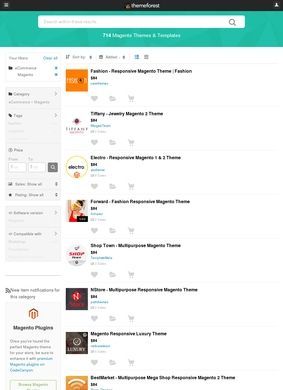
You need a Magento storefront that looks finished by next week, and you do not have a designer on staff or the budget to commission one from scratch. That is the moment most people land on Theme Forest. Type "Magento" into its search box and you get a wall of ready-made storefront themes, each with a demo you can click through before spending a cent. The pitch is simple: pick a design, pay once, download the files, and skip the months a custom build would cost. For a small shop or an agency under deadline, that math is hard to argue with.
Templates across platforms
Run by Envato, the marketplace calls itself the largest of its kind, and the catalog backs that up. Theme Forest covers far more than Magento storefronts. The same site sells templates for WordPress (blogs, corporate sites, real estate, full eCommerce), Shopify, Joomla, Drupal, HubSpot, Webflow, and Elementor, plus plain HTML site templates for people who want to hand-code the rest. On the commerce side it covers WooCommerce and PrestaShop alongside Magento, and there is a separate marketing section with email and landing-page designs. WordPress alone runs past 17,000 themes, which tells you something about the scale and something about the haystack you are searching through.
WordPress themes and other builders
Most WordPress themes on Theme Forest sit between roughly $19 and $69 as a one-time purchase, and Magento templates fall in a comparable band. You buy the item, you own that copy. No recurring fee, no per-seat licensing puzzle, which is the part that appeals to anyone who has been burned by a subscription that quietly renews. That said, one-time pricing on a theme is rarely the whole cost. Support and updates depend entirely on the author who built it, and the gap between an actively maintained theme and an abandoned one is enormous.
Pricing and ownership
Theme Forest is one piece of a larger Envato ecosystem, and it helps to know the neighbours before you buy. Envato Elements is the subscription cousin: pay monthly and download unlimited templates and stock assets, which works out cheaper than Theme Forest if you need many items rather than one. Envato Tuts+ offers free tutorials, and Placeit handles mockups and logo tools. The single Magento template you came for is the narrow end of a much wider funnel, and the company would clearly prefer you onto Elements over time. Knowing that, a buyer can decide which model fits before committing to either.
Inside the Envato ecosystem
There is also an Author Program, where independent designers list and sell their own work. This is the engine of the whole place and also its central tension. The variety exists because thousands of separate authors upload to Theme Forest. The inconsistency exists for exactly the same reason. Two Magento themes sitting side by side in search results can come from a studio that ships updates for years and from someone who listed one file and vanished. The marketplace sets a baseline through its review process, but it cannot make every author equally reliable.
Authors and quality control
The outside picture is rougher than the slick demos suggest. On Trustpilot the listing has gathered around 3,322 reviews, and the broader trend across review sites is not kind. Reviews.io shows an average near 1.24 out of 5 across 17 reviews, SmartCustomer sits at 1.5 out of 5 over 69 reviews, and Sitejabber lands at 2.3 from a small handful. Those are low numbers, and they cluster around a consistent set of complaints: theme quality that varies wildly from one author to the next, and refunds that buyers find hard to get when a purchase does not work out.
What review sites reveal
Those scores deserve weight but not blind faith. Marketplaces of this size attract disproportionate complaint volume, because every dud theme and every refund dispute across an enormous catalog flows into the same review pile, while satisfied buyers rarely bother to post. A 1.24 average does not mean every theme is bad; it means the unhappy outcomes are loud and the support experience leaves a sour taste. Editorial coverage from third parties echoes the same split: genuine praise for the sheer range, genuine frustration with uneven quality and the refund process.
How to evaluate before buying
What this means in practice is that the burden falls on the buyer more than Theme Forest lets on. The demo, the live preview, the author's update history, the visible support responses, the count of recent sales: these are the real safeguards on Theme Forest, and they matter precisely because the platform's own quality floor is uneven. Buy from an author who is plainly still active, read the comments under the item, and assume that getting money back later will be a fight you may lose.
Support structure
The homepage carries no phone number and no physical address, which is normal for a marketplace this size. Support is funnelled through a Help Center at the Envato help domain and a community forum, with the usual social channels listed as well. None of it is surfaced prominently from the front page, so a first-time buyer has to go looking at the moment they least want to.
Marketplace versus author responsibility
The structure of that support also splits responsibility in a way buyers should understand going in. Marketplace-level problems such as billing, account access, or broken downloads route to Envato's Help Center. Theme-level problems, a layout that breaks in your Magento version, a feature that does not behave, go to the individual author, and the quality of that response is theirs alone. The forum is useful for shared issues, and the documentation behind a well-built theme can be excellent. The catch is that you cannot tell from the listing alone which kind of author you have bought from until you need them.
The honest summary of Theme Forest is a marketplace that delivers exactly what it advertises on the surface and asks a lot of judgement from you underneath. The breadth is real, the one-time pricing is genuinely useful, and a careful buyer who vets the author can walk away with a solid Magento theme for the price of a takeaway dinner. A careless buyer can land a dated file from a seller who never answers, then discover the refund door is heavy. Theme Forest is not hiding any of this, but it is not foregrounding it either.
Theme Forest works best as a tool for people who already know what they are doing, or who are willing to spend an hour vetting before they spend the money. It rewards scepticism and punishes the impulse buy. Given the scale, the low cost of entry, and the very real chance of picking a maintained theme over an abandoned one, the question worth sitting with is simple: are you ready to do the homework on the author, or are you hoping the marketplace will have done it for you?